
17/06/2025, 09:23 Sharp ESO 2025 Exam COMPREHENSIVE QUESTIONS AND VERIFIED ANSWERS 2025(GRADED A+) DETAILED ANSWERS!…
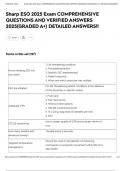
Sharp ESO 2025 Exam COMPREHENSIVE
QUESTIONS AND VERIFIED ANSWERS
2025(GRADED A+) DETAILED ANSWERS!!
Save
Terms in this set (157)
1. Life threatening condition
2. Precipitating factors
Nurse initiating ESO will
3. Specific ESO implemented
document
4. Patient response
5. When and which physician was notified
For life-threatening patient conditions in the absence
ESO are initiated:
of the physician or specific orders
1. Push hard
2. Full chest recoil
3. Minimize interruptions
Adequate CPR
4. 100-120 compressions/min
5. 15 L O2 by bag mask (10 breaths per min)
6. 30:2
Use to assess quality of CPR and evaluate return of
ETCO2 monitoring
rosc
How many breaths with 1 breath every 6 seconds
advanced airway?
Should be used on all patients not following
Targeted temperature
commands or purposeful movement within 120 mins
management
after ROSC
https://quizlet.com/1054960902/sharp-eso-2025-exam-comprehensive-questions-and-verified-answers-2025graded-a-detailed-answers-flash-cards/?… 1/23
,17/06/2025, 09:23 Sharp ESO 2025 Exam COMPREHENSIVE QUESTIONS AND VERIFIED ANSWERS 2025(GRADED A+) DETAILED ANSWERS!…
What is a rapid bolus? Fluids administered in 5-15 mins
Device that uses bioreactane to determine cardiac
Non invasive cardiac output and is implemented where available by RRT or
monitoring ICU RN to determine fluid responsiveness and guide
fluid resuscitation
Position patient flat on their back, and their legs are
Passive leg raise
elevated to 45 degrees.
1.
Obtain intravenous (IV)/intraosseous (IO) access
2. Begin IV infusion of normal saline (NS) at keep vein
open (KVO). If IV access is unavailable: Lidocaine,
Epinephrine, Atropine, and Naloxone (Narcan) may be
administered via endotracheal route at doses of 2-2
1/2 times the IV dose.
These interventions are 3. If IV access is unavailable, Naloxone (Narcan) may
instituted for all be administered IM at the same dose as IV
emergency situations administration
outlined in the ESO
Standardized Procedure: 4. Flush the IV line with 20mL of NS after each IV
medication given and elevate the extremity if
applicable.
5. In applicable situations, obtain oxygen (O2)
saturation
6.Monitor and document ETCO2 for code blue events.
7. Titrate oxygen to patients' response.
Tachypnea, apnea, respiratory depression,
tachycardia, bradycardia, arrhythmias, hypotension,
Signs (objective): decreased O2 saturation, dyspnea, change in level of
consciousness, increased intracranial pressure (ICP),
status epilepticus
https://quizlet.com/1054960902/sharp-eso-2025-exam-comprehensive-questions-and-verified-answers-2025graded-a-detailed-answers-flash-cards/?… 2/23
, 17/06/2025, 09:23 Sharp ESO 2025 Exam COMPREHENSIVE QUESTIONS AND VERIFIED ANSWERS 2025(GRADED A+) DETAILED ANSWERS!…
Dizziness, lightheadedness, chest pain, shortness of
Symptoms (subjective) breath (SOB), chest pain, weakness, cold, diaphoresis,
heart palpitations, anxiousness
What is the initial Initiate CPR immediately
treatment for asystole?
What is the recommended O2 at 15L/minute ambu bag (10 breaths/minute)
oxygen flow rate for a
patient in asystole?
What medication is Epinephrine 1mg IVP/IO (0.1 mg/mL), repeat every 3-5
administered in asystole min
and how often?
How frequently should Every 2 minutes
pulse checks be
performed during CPR for
asystole?
What should be verified Verify with pulse check and ensure that all leads are
before initiating treatment connected
for asystole?
Bradycardia - Initial 1. O2 at minimum 10 L/minute (NRBM)
Treatment
Bradycardia - Atropine 1. Atropine 1mg IVP/IO, repeat every 3-5 minutes up to
Administration a maximum of 3 mg
1. Start Dopamine 400mg/250 mL D5W at 5
Bradycardia - Dopamine
mcg/kg/minute if above algorithm is ineffective. ICU
Administration
or RRT RN to titrate until patient is asymptomatic.
1. Start Epinephrine 2mg/250 mL NS at 2mcg/minute if
Bradycardia - Epinephrine
above algorithm is ineffective. Titrate to patient
Administration
response up to 10 mcg/minute. (RRT or ICU RN Only)
What are common causes Hypovolemia and hypoxia
of Pulseless Electrical
Activity (PEA)?
https://quizlet.com/1054960902/sharp-eso-2025-exam-comprehensive-questions-and-verified-answers-2025graded-a-detailed-answers-flash-cards/?… 3/23
Sharp ESO 2025 Exam COMPREHENSIVE
QUESTIONS AND VERIFIED ANSWERS
2025(GRADED A+) DETAILED ANSWERS!!
Save
Terms in this set (157)
1. Life threatening condition
2. Precipitating factors
Nurse initiating ESO will
3. Specific ESO implemented
document
4. Patient response
5. When and which physician was notified
For life-threatening patient conditions in the absence
ESO are initiated:
of the physician or specific orders
1. Push hard
2. Full chest recoil
3. Minimize interruptions
Adequate CPR
4. 100-120 compressions/min
5. 15 L O2 by bag mask (10 breaths per min)
6. 30:2
Use to assess quality of CPR and evaluate return of
ETCO2 monitoring
rosc
How many breaths with 1 breath every 6 seconds
advanced airway?
Should be used on all patients not following
Targeted temperature
commands or purposeful movement within 120 mins
management
after ROSC
https://quizlet.com/1054960902/sharp-eso-2025-exam-comprehensive-questions-and-verified-answers-2025graded-a-detailed-answers-flash-cards/?… 1/23
,17/06/2025, 09:23 Sharp ESO 2025 Exam COMPREHENSIVE QUESTIONS AND VERIFIED ANSWERS 2025(GRADED A+) DETAILED ANSWERS!…
What is a rapid bolus? Fluids administered in 5-15 mins
Device that uses bioreactane to determine cardiac
Non invasive cardiac output and is implemented where available by RRT or
monitoring ICU RN to determine fluid responsiveness and guide
fluid resuscitation
Position patient flat on their back, and their legs are
Passive leg raise
elevated to 45 degrees.
1.
Obtain intravenous (IV)/intraosseous (IO) access
2. Begin IV infusion of normal saline (NS) at keep vein
open (KVO). If IV access is unavailable: Lidocaine,
Epinephrine, Atropine, and Naloxone (Narcan) may be
administered via endotracheal route at doses of 2-2
1/2 times the IV dose.
These interventions are 3. If IV access is unavailable, Naloxone (Narcan) may
instituted for all be administered IM at the same dose as IV
emergency situations administration
outlined in the ESO
Standardized Procedure: 4. Flush the IV line with 20mL of NS after each IV
medication given and elevate the extremity if
applicable.
5. In applicable situations, obtain oxygen (O2)
saturation
6.Monitor and document ETCO2 for code blue events.
7. Titrate oxygen to patients' response.
Tachypnea, apnea, respiratory depression,
tachycardia, bradycardia, arrhythmias, hypotension,
Signs (objective): decreased O2 saturation, dyspnea, change in level of
consciousness, increased intracranial pressure (ICP),
status epilepticus
https://quizlet.com/1054960902/sharp-eso-2025-exam-comprehensive-questions-and-verified-answers-2025graded-a-detailed-answers-flash-cards/?… 2/23
, 17/06/2025, 09:23 Sharp ESO 2025 Exam COMPREHENSIVE QUESTIONS AND VERIFIED ANSWERS 2025(GRADED A+) DETAILED ANSWERS!…
Dizziness, lightheadedness, chest pain, shortness of
Symptoms (subjective) breath (SOB), chest pain, weakness, cold, diaphoresis,
heart palpitations, anxiousness
What is the initial Initiate CPR immediately
treatment for asystole?
What is the recommended O2 at 15L/minute ambu bag (10 breaths/minute)
oxygen flow rate for a
patient in asystole?
What medication is Epinephrine 1mg IVP/IO (0.1 mg/mL), repeat every 3-5
administered in asystole min
and how often?
How frequently should Every 2 minutes
pulse checks be
performed during CPR for
asystole?
What should be verified Verify with pulse check and ensure that all leads are
before initiating treatment connected
for asystole?
Bradycardia - Initial 1. O2 at minimum 10 L/minute (NRBM)
Treatment
Bradycardia - Atropine 1. Atropine 1mg IVP/IO, repeat every 3-5 minutes up to
Administration a maximum of 3 mg
1. Start Dopamine 400mg/250 mL D5W at 5
Bradycardia - Dopamine
mcg/kg/minute if above algorithm is ineffective. ICU
Administration
or RRT RN to titrate until patient is asymptomatic.
1. Start Epinephrine 2mg/250 mL NS at 2mcg/minute if
Bradycardia - Epinephrine
above algorithm is ineffective. Titrate to patient
Administration
response up to 10 mcg/minute. (RRT or ICU RN Only)
What are common causes Hypovolemia and hypoxia
of Pulseless Electrical
Activity (PEA)?
https://quizlet.com/1054960902/sharp-eso-2025-exam-comprehensive-questions-and-verified-answers-2025graded-a-detailed-answers-flash-cards/?… 3/23


