

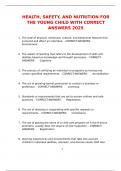
HEALTH, SAFETY, AND NUTRITION FOR
THE YOUNG CHILD WITH CORRECT
ANSWERS 2025
1. The total of physical, emotional, cultural, and behavioral features that
surround and affect an individual. - CORRECT-ANSWERS-
Environment
2. The aspect of learning that refers to the development of skills and
abilities based on knowledge and thought processes. - CORRECT-
ANSWERS- Cognitive
3. The process of certifying an individual or programs as having met
certain specified requirements. - CORRECT-ANSWERS- Accreditation
4. The act of granting formal permission to conduct a business or
profession. - CORRECT-ANSWERS- Licensing
5. Standards or requirements that are set to ensure uniform and safe
practices. - CORRECT-ANSWERS- Regulations
6. The act of obeying or cooperating with specific requests or
requirements. - CORRECT-ANSWERS- Compliance
7. The act of placing the name of a child care program on a list of active
providers; usually does not require on-site inspection. - CORRECT-
ANSWERS- Registration
8. learning experiences and environments that take into account
children's individual abilities, interests, and diverse needs. DAP also
1
, reflects differences among families and values them as essential
partners in children's education. - CORRECT-ANSWERS-
Developmentally Appropriate Practice (DAP)
9. official acknowledgment of the authenticity of a signature or document
by a notary public. - CORRECT-ANSWERS- Notarized
10. An infectious illness caused by an intestinal parasite. May be
present in water (e.g., swimming pools, hot tubs, streams)
contaminated with feces or from unwashed hands. - CORRECT-
ANSWERS- Cryptosporidiosis
11. An unexpected or unplanned event that may result in physical
harm or injury. - CORRECT-ANSWERS- Unintentional Injury
12. Measures taken to avoid an event such as in injury or illness from
occurring; implies the ability to anticipate circumstances and
behaviors. - CORRECT-ANSWERS- Risk Management
13. Monitoring the behaviors and actions of children and others. -
CORRECT-ANSWERS- Supervision
14. learning that occurs in addition to the primary intent or goals of
instruction. - CORRECT-ANSWERS- Incidental Learning
15. legal responsibility or obligation for one's actions owed to
another individual. - CORRECT-ANSWERS- Liability
16. Failure to practice or perform one's duties according to certain
standards; carelessness. - CORRECT-ANSWERS- Negligence
2
THE YOUNG CHILD WITH CORRECT
ANSWERS 2025
1. The total of physical, emotional, cultural, and behavioral features that
surround and affect an individual. - CORRECT-ANSWERS-
Environment
2. The aspect of learning that refers to the development of skills and
abilities based on knowledge and thought processes. - CORRECT-
ANSWERS- Cognitive
3. The process of certifying an individual or programs as having met
certain specified requirements. - CORRECT-ANSWERS- Accreditation
4. The act of granting formal permission to conduct a business or
profession. - CORRECT-ANSWERS- Licensing
5. Standards or requirements that are set to ensure uniform and safe
practices. - CORRECT-ANSWERS- Regulations
6. The act of obeying or cooperating with specific requests or
requirements. - CORRECT-ANSWERS- Compliance
7. The act of placing the name of a child care program on a list of active
providers; usually does not require on-site inspection. - CORRECT-
ANSWERS- Registration
8. learning experiences and environments that take into account
children's individual abilities, interests, and diverse needs. DAP also
1
, reflects differences among families and values them as essential
partners in children's education. - CORRECT-ANSWERS-
Developmentally Appropriate Practice (DAP)
9. official acknowledgment of the authenticity of a signature or document
by a notary public. - CORRECT-ANSWERS- Notarized
10. An infectious illness caused by an intestinal parasite. May be
present in water (e.g., swimming pools, hot tubs, streams)
contaminated with feces or from unwashed hands. - CORRECT-
ANSWERS- Cryptosporidiosis
11. An unexpected or unplanned event that may result in physical
harm or injury. - CORRECT-ANSWERS- Unintentional Injury
12. Measures taken to avoid an event such as in injury or illness from
occurring; implies the ability to anticipate circumstances and
behaviors. - CORRECT-ANSWERS- Risk Management
13. Monitoring the behaviors and actions of children and others. -
CORRECT-ANSWERS- Supervision
14. learning that occurs in addition to the primary intent or goals of
instruction. - CORRECT-ANSWERS- Incidental Learning
15. legal responsibility or obligation for one's actions owed to
another individual. - CORRECT-ANSWERS- Liability
16. Failure to practice or perform one's duties according to certain
standards; carelessness. - CORRECT-ANSWERS- Negligence
2


