

Written by students who passed Immediately available after payment Read online or as PDF Wrong document? Swap it for free 4.6 TrustPilot
logo-home
Document preview thumbnail
Preview 1 out of 3 pages
Exam (elaborations)

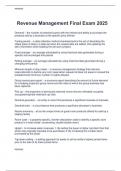
Revenue Management Final Exam 2025

Document preview thumbnail
Preview 1 out of 3 pages

Demand - -the number of potential buyers with the interest and ability to purchase the products sold by a business at the specific price offered Trailing period - -a data collection method characterized by the act of discarding the oldest piece of data in a data set when the newest data are added, this updating the set's information while keeping the set size constant. Fixed average - -an average calculated by using historical data generated during a specific and unchanged time period Rolling average - -an average calculated by using historical data generated during a changing time period Minimum length of stay (mlos) - -a revenue management strategy that instructs reservationists to decline any room reservation request tat does not equal or exceed the predetermined minimum number of nights allowed. Group rooms pace report - -a summary report describing the amount of future demand for a lodging property's group rooms and the rates at which the group business has been captured. Pick up - -the proportion of previously reserved rooms that are ultimately occupied. (occupied/originally held=pick up rate) Demand generator - -an entity or event that produces a significant increase in business Demand drain - -a circumstance that produces a significant decrease in business Rooms inventory - -all os the unique forms of guest room products offered for sale by a lodging facility Room code - -a property-specific, shorten description used to identify a specific room product in a hotel (nsdd- nonsmoking, double-double room) Upsell - -to increase seller revenues: 1. By selling the buyer a higher cost item than that which was originally intended to be purchased. 2. By increasing the number items purchased by the buyer Top-down selling - -a selling approach tat seeks to sell an entity's highest priced items prior to the sale of its lower priced items REVENUE REVENUE Bottom-up selling - -a selling approach that seeks to sell an entity's west priced items prior to the sale of its higher priced items Attrition - -the difference between the purchases a group pledges to make and the purchase it actually makes. Also called wash, wash down or slippage Contract rate - -a long-term rate whose availability is agreed to in advance and for the duration of the contract agreement. For example, the agreement by a hotel to house every night for one year an airline's ten-person flight crew Negotiated rate - -an agreement to provide a elect group of travelers, subject to availability, rooms at and agreed on discount rate. The discount rate is in effect for the term of the negotiated rate agreement. For example, a special given to all travelers employed by the ford motor company. Also referred to as a volume discount rate. Walk - -to relocate a guest wit a confirmed reservation at a hotel to an alternative property. Price management - -the strategies and tactics employed by revenue managers to best match rates or prices charged with prospective customers' willingness to pay Rate code - -a property-specific notation used by a hotel's pms to specify the price of a unique room product. Also known as a rate plan. For example, rack. Special event rate - -an above rack room rate typically implemented during single day or multiday period of extremely high demand for rooms. Also known as premium rack rate. Stay restrictions - -duration rules and limitations related to guest' arrival dates, departures dates and mlos. Also known as stay controls Closed to arrivals (cta) - -a date on which guests are not permitted to being their hotel stays Travel wholesaler - -a large-volume travel industry intermediary who sells to other, smaller-volume travel intermediates. Example is american society of travel agents (asta) Global distribution systems (gds) - -a group of companies that electronically connect travel-related business such as airlines and hotels with those individuals and companies seeking to buy from them Internet distribution system (ids) - -the group of online reservation systems and travel portals that utilize the internet to connect travel-related business such as hotels with those individuals and companies seeking to buy from them REVENUE REVENUE Non electronic distribution channels - -those in which room rate and availability information is delivered to buyers face-to-face Commoditization - -the process by which a product or service reaches a point in its development where one brand has no features that differentiate it from other brands and consumers buy on price alone. Proprietary website - -a web address whose content is 100 percent controlled by a hotel's own management team. Net rate - -the amount per room actually received by a hotel when selling its rooms through an intermediary Merchant model - -a system in which an intermediary obtains rooms inventory at a wholesale rate and then acts as a merchant by selling the rooms to buyers at retail rates Referral site - -a website that searches for and reports information found on other web sites Opaque model - -a system in which the room buyer doesn't know the name of the hotel they have chosen until after they have committed to the purchase price of their room Consumer-generated media (csm) - -various online venues such as forums, blogs and wikis where those seeking to research and buy products can use information and opinions posted by other consumers before making their buying decision Room-related occupation costs - -those rooms-related costs incurred directly as a result of selling a guest room including labor costs, room supplies and room amenities. Also knowch as cost per occupied room (cpor) Minimum adr sales point formula - -the lowest room rate that can be charged and still generate enough revenue to pay all rooms-related occupancy costs plus the cost of any distribution channel commissions and franchise related fees and royalties paid to create the sale. Smerf - -acronym used to describe social, military, educational, religious and fraternal buyers of hotel rooms and services Marketing mix - -the relative proportion of revenue contribute

Content preview

REVENUE


Revenue Management Final Exam 2025
Demand - -the number of potential buyers with the interest and ability to purchase the
products sold by a business at the specific price offered

Trailing period - -a data collection method characterized by the act of discarding the
oldest piece of data in a data set when the newest data are added, this updating the
set's information while keeping the set size constant.

Fixed average - -an average calculated by using historical data generated during a
specific and unchanged time period

Rolling average - -an average calculated by using historical data generated during a
changing time period

Minimum length of stay (mlos) - -a revenue management strategy that instructs
reservationists to decline any room reservation request tat does not equal or exceed the
predetermined minimum number of nights allowed.

Group rooms pace report - -a summary report describing the amount of future demand
for a lodging property's group rooms and the rates at which the group business has
been captured.

Pick up - -the proportion of previously reserved rooms that are ultimately occupied.
(occupied/originally held=pick up rate)

Demand generator - -an entity or event that produces a significant increase in business

Demand drain - -a circumstance that produces a significant decrease in business

Rooms inventory - -all os the unique forms of guest room products offered for sale by a
lodging facility

Room code - -a property-specific, shorten description used to identify a specific room
product in a hotel (nsdd- nonsmoking, double-double room)

Upsell - -to increase seller revenues: 1. By selling the buyer a higher cost item than that
which was originally intended to be purchased. 2. By increasing the number items
purchased by the buyer

Top-down selling - -a selling approach tat seeks to sell an entity's highest priced items
prior to the sale of its lower priced items

REVENUE

Document information

Uploaded on
June 15, 2025
Number of pages
3
Written in
2024/2025
Type
Exam (elaborations)
Contains
Questions & answers
$12.49

Wrong document? Swap it for free Within 14 days of purchase and before downloading, you can choose a different document. You can simply spend the amount again.
Written by students who passed
Immediately available after payment
Read online or as PDF

Seller avatar
Reputation scores are based on the amount of documents a seller has sold for a fee and the reviews they have received for those documents. There are three levels: Bronze, Silver and Gold. The better the reputation, the more your can rely on the quality of the sellers work.
AlexScorer
2.5
(2)
Sold
11
Followers
0
Items
1800
Last sold
2 weeks ago


Why students choose Stuvia

Created by fellow students, verified by reviews

Quality you can trust: written by students who passed their tests and reviewed by others who've used these notes.

Didn't get what you expected? Choose another document

No worries! You can instantly pick a different document that better fits what you're looking for.

Pay as you like, start learning right away

No subscription, no commitments. Pay the way you're used to via credit card and download your PDF document instantly.

Student with book image

“Bought, downloaded, and aced it. It really can be that simple.”

Alisha Student

Working on your references?

Create accurate citations in APA, MLA and Harvard with our free citation generator.

Working on your references?

Frequently asked questions
