
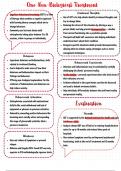
One Non-Biological Treatment
Irrational Thoughts:
Cognitive-behavioural treatment (CBT) is a form
of therapy that combines a cognitive approach Aim of CBT is to help clients identify irrational thoughts and
with learning theory concepts which aim to try to change them.
change behaviour. Reducing the stress of the situation by altering a way a
Commonly used to treat clients with person thinks can help prevent decompensation - a decline
schizophrenia taking place between 5 to 20 from normal functioning into a psychotic episode.
sessions, either in groups or individually. Therapist will build self-awareness into helping individuals
understand more about their condition.
Recognise specific situations which precede decompensation,
allowing them to initiate coping strategies such as stress
management techniques.
Delusions:
Experience delusions and hallucinations, both
Behavioural Experiments:
related to irrational thinking.
Delusions and hallucinations may be combatted by verbally
Can be helped to make sense of how their
challenging the clients’ perceived reality.
delusions and hallucinations impact on their
Reality testing - personal experiment where the client tests if
feelings and behaviour.
their delusions are real.
Offering non-biological explanations for the
Evidence collected in the experiments can then be discussed
existence of hallucinations and delusions can
and used to debunk erroneous beliefs.
help reduce anxiety.
Help individuals differentiate between the confirmed reality
and perceived reality.
Behavioural Activation:
Schizophrenia associated with motivational
deficits like social withdrawal and lack of Evaluation
enjoyment or pleasure in previous activities.
Reduced by rewarding positive behaviours like Strength:
becoming more socially active and expanding CBT is supported by the National Institute for Health and Care
the range of pleasurable activities that a Excellence - NICE.
person is involved in. Analysis showed CBT was effective in reducing hospitalisation
rates for up to 18 months and reduced time spent at
hospitals.
Weakness: Also reduced symptom severity and improved psychosocial
Does not reduce all symptoms or prevent functioning, both at the end of treatment and 12 months
relapse. later.
McKenna and Kingdon 2014 found CBT was only
superior in 2/9 methodologically rigorous trials.
Irrational Thoughts:
Cognitive-behavioural treatment (CBT) is a form
of therapy that combines a cognitive approach Aim of CBT is to help clients identify irrational thoughts and
with learning theory concepts which aim to try to change them.
change behaviour. Reducing the stress of the situation by altering a way a
Commonly used to treat clients with person thinks can help prevent decompensation - a decline
schizophrenia taking place between 5 to 20 from normal functioning into a psychotic episode.
sessions, either in groups or individually. Therapist will build self-awareness into helping individuals
understand more about their condition.
Recognise specific situations which precede decompensation,
allowing them to initiate coping strategies such as stress
management techniques.
Delusions:
Experience delusions and hallucinations, both
Behavioural Experiments:
related to irrational thinking.
Delusions and hallucinations may be combatted by verbally
Can be helped to make sense of how their
challenging the clients’ perceived reality.
delusions and hallucinations impact on their
Reality testing - personal experiment where the client tests if
feelings and behaviour.
their delusions are real.
Offering non-biological explanations for the
Evidence collected in the experiments can then be discussed
existence of hallucinations and delusions can
and used to debunk erroneous beliefs.
help reduce anxiety.
Help individuals differentiate between the confirmed reality
and perceived reality.
Behavioural Activation:
Schizophrenia associated with motivational
deficits like social withdrawal and lack of Evaluation
enjoyment or pleasure in previous activities.
Reduced by rewarding positive behaviours like Strength:
becoming more socially active and expanding CBT is supported by the National Institute for Health and Care
the range of pleasurable activities that a Excellence - NICE.
person is involved in. Analysis showed CBT was effective in reducing hospitalisation
rates for up to 18 months and reduced time spent at
hospitals.
Weakness: Also reduced symptom severity and improved psychosocial
Does not reduce all symptoms or prevent functioning, both at the end of treatment and 12 months
relapse. later.
McKenna and Kingdon 2014 found CBT was only
superior in 2/9 methodologically rigorous trials.


