
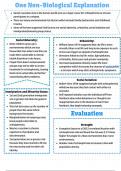
One Non-Biological Explanation
Social causation view is the human world acts as a major cause for schizophrenia or at least
participates in a relapse.
There are many environmental risk factors which include family dysfunction and childhood
trauma.
Some of the best supported risk factors are social adversity, urbanicity, social isolation and
immigration/minority group status.
Social Adversity: Urbanicity:
Some children grow up in William Eaton 1974 suggested that city life is more
environments which are less stressful than rural life and long term exposure to such
favourable than others and this can stress can trigger an episode of schizophrenia.
make them vulnerable to mental Stressors linked to city life: noise, light pollution,
health disorders in the future. criminality, faster pace and greater anonymity.
People from lower socioeconomic Increased population density makes life more
groups may not be able to access competitive which increases the chances of social defeat
treatment for schizophrenia, leaving - a stressor which may elicit schizophrenic symptoms.
them more vulnerable and further
exacerbating their problems.
Social Isolation:
Robert Fairs 1934 suggested people with schizophrenia
withdraw because they feel contact with others is
Immigration and Minority Status: stressful.
1st and 2nd generation immigrants Self imposed isolation cuts the individual off from
are at greater risk than the general feedback about what behaviours or thoughts are
population. inappropriate and, in the absence of corrective
This risk decreases as the number of feedback, they begin behaving strangely.
people from the same ethnic
background increases.
Marginalisation of outgroups may
Evaluation
leave people vulnerable to
schizophrenia. Strength:
May be a reaction to chronic Evangelos Vassos et al 2012 correlated location with
experience of prejudice and schizophrenia risk and found the risk was 2.37 times
discrimination. higher for people in urban environments than rural
2nd generation are at greater risk environments.
because they have started to fit into Relative risk of schizophrenia increases in line with
the new society and lost their old population density.
identity.
Social causation view is the human world acts as a major cause for schizophrenia or at least
participates in a relapse.
There are many environmental risk factors which include family dysfunction and childhood
trauma.
Some of the best supported risk factors are social adversity, urbanicity, social isolation and
immigration/minority group status.
Social Adversity: Urbanicity:
Some children grow up in William Eaton 1974 suggested that city life is more
environments which are less stressful than rural life and long term exposure to such
favourable than others and this can stress can trigger an episode of schizophrenia.
make them vulnerable to mental Stressors linked to city life: noise, light pollution,
health disorders in the future. criminality, faster pace and greater anonymity.
People from lower socioeconomic Increased population density makes life more
groups may not be able to access competitive which increases the chances of social defeat
treatment for schizophrenia, leaving - a stressor which may elicit schizophrenic symptoms.
them more vulnerable and further
exacerbating their problems.
Social Isolation:
Robert Fairs 1934 suggested people with schizophrenia
withdraw because they feel contact with others is
Immigration and Minority Status: stressful.
1st and 2nd generation immigrants Self imposed isolation cuts the individual off from
are at greater risk than the general feedback about what behaviours or thoughts are
population. inappropriate and, in the absence of corrective
This risk decreases as the number of feedback, they begin behaving strangely.
people from the same ethnic
background increases.
Marginalisation of outgroups may
Evaluation
leave people vulnerable to
schizophrenia. Strength:
May be a reaction to chronic Evangelos Vassos et al 2012 correlated location with
experience of prejudice and schizophrenia risk and found the risk was 2.37 times
discrimination. higher for people in urban environments than rural
2nd generation are at greater risk environments.
because they have started to fit into Relative risk of schizophrenia increases in line with
the new society and lost their old population density.
identity.


