

Liberty University SOWK Comprehensive Exam GRADED A LATEST
VERSION 2025
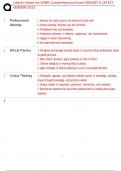
1. Professional 1. Advocate for client access to the services of social work
Identity 2. Practice personal reflection and self-correction
3. Professional roles and boundaries
4. Professional demeanor in behavior, appearance, and communication
5. Engage in career-long learning
6. Use supervision and consultation
6. Ethical Practice 1. Recognize and manage personal values in a way that allows professional values
to guide practice
2. Make ethical decisions, apply standards of Code of Ethics
3. Tolerate ambiguity in resolving ethical conflicts
4. Apply strategies of ethical reasoning to arrive at principled decisions
7. Critical Thinking 1. Distinguish, appraise, and integrate multiple sources of knowledge, including
research based knowledge, and practice wisdom
2. Analyze models of assessment, prevention, intervention, and evaluation
3. Demonstrate ettective oral and written communication in working with all pop-
ulations
8.
1/5
, Liberty University SOWK Comprehensive Exam GRADED A LATEST
VERSION 2025
Diversity in Prac- 1. Culture's structures and values may oppress, marginalize, alienate, or create or
tice enhance privilege and power
2. Gain suflcient self-awareness to eliminate the influence of personal biases and
values in working with diverse groups
3. Recognize and communicate their understanding of the importance of ditter-
ence in shaping life experiences
4. View self as learner and engage those who they work with as informants
9. Human Rights 1. Understand the forms and mechanism of oppression and discrimination
and Justice 2. Advocate for human rights and social and economic justice
3. Engage in practices that advance social and economic justice
10. Research Based 1. Use practice that advance social and economic justice
Practice 2. Use research evidence to inform practice
11. Human Behavior 1. Utilize conceptual frameworks to guide the processes of A, I, and E
2. Critique and apply knowledge to understand person and environment
12. Policy Practice 1. Analyze, formulate, and advocate for policies that advance social well-being
2. Collaborate with colleagues and clients for ettective policy action
13. Practice Contexts 1. Continuously discover, appraise, and attend to changing locales, populations,
scientific and technological developments, and emerging societal trends to provide
relevant services
2. Provide leadership in promoting sustainable changes in service delivery and
practice to improve the quality of social services
14. Engagement 1. Substantively and ettectively prepare for action with populations
2. Use empathy and other interpersonal skills
3. Develop mutually agreed-on focus of work and desired outcomes
15. Assessment 1. Collect, organize, and interpret client data
2. Assess client strengths and limitations
2/5
VERSION 2025
1. Professional 1. Advocate for client access to the services of social work
Identity 2. Practice personal reflection and self-correction
3. Professional roles and boundaries
4. Professional demeanor in behavior, appearance, and communication
5. Engage in career-long learning
6. Use supervision and consultation
6. Ethical Practice 1. Recognize and manage personal values in a way that allows professional values
to guide practice
2. Make ethical decisions, apply standards of Code of Ethics
3. Tolerate ambiguity in resolving ethical conflicts
4. Apply strategies of ethical reasoning to arrive at principled decisions
7. Critical Thinking 1. Distinguish, appraise, and integrate multiple sources of knowledge, including
research based knowledge, and practice wisdom
2. Analyze models of assessment, prevention, intervention, and evaluation
3. Demonstrate ettective oral and written communication in working with all pop-
ulations
8.
1/5
, Liberty University SOWK Comprehensive Exam GRADED A LATEST
VERSION 2025
Diversity in Prac- 1. Culture's structures and values may oppress, marginalize, alienate, or create or
tice enhance privilege and power
2. Gain suflcient self-awareness to eliminate the influence of personal biases and
values in working with diverse groups
3. Recognize and communicate their understanding of the importance of ditter-
ence in shaping life experiences
4. View self as learner and engage those who they work with as informants
9. Human Rights 1. Understand the forms and mechanism of oppression and discrimination
and Justice 2. Advocate for human rights and social and economic justice
3. Engage in practices that advance social and economic justice
10. Research Based 1. Use practice that advance social and economic justice
Practice 2. Use research evidence to inform practice
11. Human Behavior 1. Utilize conceptual frameworks to guide the processes of A, I, and E
2. Critique and apply knowledge to understand person and environment
12. Policy Practice 1. Analyze, formulate, and advocate for policies that advance social well-being
2. Collaborate with colleagues and clients for ettective policy action
13. Practice Contexts 1. Continuously discover, appraise, and attend to changing locales, populations,
scientific and technological developments, and emerging societal trends to provide
relevant services
2. Provide leadership in promoting sustainable changes in service delivery and
practice to improve the quality of social services
14. Engagement 1. Substantively and ettectively prepare for action with populations
2. Use empathy and other interpersonal skills
3. Develop mutually agreed-on focus of work and desired outcomes
15. Assessment 1. Collect, organize, and interpret client data
2. Assess client strengths and limitations
2/5


