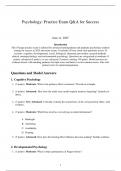
Psychology: Exam-Ready Q&A for Top Grades
June 11, 2025
Introduction
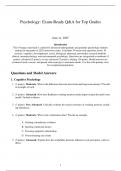
This 10-page exam bank is crafted for advanced undergraduate and graduate psychology students
aiming for top grades in 2025 university exams. It includes 50 exam-style questions across 10
sections: cognitive, developmental, social, biological, abnormal, personality, research methods,
clinical, neuropsychology, and environmental psychology. Questions are categorized as moderate (3
points), advanced (5 points), or very advanced (7 points), totaling 130 points. Model answers are
evidence-based, concise, and paired with exam tips to maximize marks. Use this with primary texts
for exceptional preparation.
Questions and Model Answers
1. Cognitive Psychology
1. (3 points) Moderate: What is the difference between short-term and long-term memory? Provide
an example of each.
2. (5 points) Advanced: How does Baddeleys working memory model improve upon the multi-store
model? Include evidence.
3. (7 points) Very Advanced: Critically evaluate the neural correlates of working memory, includ-
ing limitations.
4. (3 points) Moderate: What is the confirmation bias? Provide an example.
A. Seeking contradictory evidence
B. Ignoring situational factors
C. Favoring supportive information
D. Overestimating rare events
5. (5 points) Advanced: Explain how the availability heuristic influences risk perception, with evi-
dence.
1
, 2. Developmental Psychology
1. (3 points) Moderate: What are two features of Piagets preoperational stage?
2. (5 points) Advanced: Compare Vygotskys and Piagets views on cognitive development, focusing
on social influences.
3. (7 points) Very Advanced: Evaluate the empirical support for Vygotskys ZPD in modern educa-
tion, including one critique.
4. (3 points) Moderate: What is Eriksons industry vs. inferiority stage?
5. (5 points) Advanced: How does Bronfenbrenners ecological systems theory explain adolescent
behavior?
3. Social Psychology
1. (3 points) Moderate: Define conformity and provide an example.
2. (5 points) Advanced: Explain how the elaboration likelihood model (ELM) accounts for attitude
change, with an example.
3. (7 points) Very Advanced: Critically assess the ELMs application in social media persuasion,
with evidence.
4. (3 points) Moderate: What is social loafing?
A. Reduced effort in groups
B. Increased group conflict
C. Overestimating group ability
D. Seeking group approval
5. (5 points) Advanced: How does social identity theory explain intergroup conflict?
4. Biological Psychology
1. (3 points) Moderate: What is the role of the hippocampus in memory?
2. (5 points) Advanced: Explain the role of the HPA axis in stress responses, with health implica-
tions.
Page 2
June 11, 2025
Introduction
This 10-page exam bank is crafted for advanced undergraduate and graduate psychology students
aiming for top grades in 2025 university exams. It includes 50 exam-style questions across 10
sections: cognitive, developmental, social, biological, abnormal, personality, research methods,
clinical, neuropsychology, and environmental psychology. Questions are categorized as moderate (3
points), advanced (5 points), or very advanced (7 points), totaling 130 points. Model answers are
evidence-based, concise, and paired with exam tips to maximize marks. Use this with primary texts
for exceptional preparation.
Questions and Model Answers
1. Cognitive Psychology
1. (3 points) Moderate: What is the difference between short-term and long-term memory? Provide
an example of each.
2. (5 points) Advanced: How does Baddeleys working memory model improve upon the multi-store
model? Include evidence.
3. (7 points) Very Advanced: Critically evaluate the neural correlates of working memory, includ-
ing limitations.
4. (3 points) Moderate: What is the confirmation bias? Provide an example.
A. Seeking contradictory evidence
B. Ignoring situational factors
C. Favoring supportive information
D. Overestimating rare events
5. (5 points) Advanced: Explain how the availability heuristic influences risk perception, with evi-
dence.
1
, 2. Developmental Psychology
1. (3 points) Moderate: What are two features of Piagets preoperational stage?
2. (5 points) Advanced: Compare Vygotskys and Piagets views on cognitive development, focusing
on social influences.
3. (7 points) Very Advanced: Evaluate the empirical support for Vygotskys ZPD in modern educa-
tion, including one critique.
4. (3 points) Moderate: What is Eriksons industry vs. inferiority stage?
5. (5 points) Advanced: How does Bronfenbrenners ecological systems theory explain adolescent
behavior?
3. Social Psychology
1. (3 points) Moderate: Define conformity and provide an example.
2. (5 points) Advanced: Explain how the elaboration likelihood model (ELM) accounts for attitude
change, with an example.
3. (7 points) Very Advanced: Critically assess the ELMs application in social media persuasion,
with evidence.
4. (3 points) Moderate: What is social loafing?
A. Reduced effort in groups
B. Increased group conflict
C. Overestimating group ability
D. Seeking group approval
5. (5 points) Advanced: How does social identity theory explain intergroup conflict?
4. Biological Psychology
1. (3 points) Moderate: What is the role of the hippocampus in memory?
2. (5 points) Advanced: Explain the role of the HPA axis in stress responses, with health implica-
tions.
Page 2