

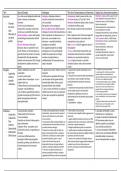
Topic Sex and Gender Androgyny The role of chromosomes and hormones Atypical sex chromosome patterns
Key points Sex: what you are biologically male/female Androgyny: displaying a balance of Chromosomes: found in nucleus of cells, carry Klinefelter’s syndrome affects around 1 in 600
based on anatomy, chromosomes, masculine and feminine characteristics in info in form of genes, 23rd pair XX=F, XY=M males, additional X chromosomes (XXY), less
hormones one’s personality Hormones: biochemical substance that circulates testosterone more LH and FSH leading to
- Theorists feminine characteristics
Gender: based on behavioural Both genders can be androgynous in the blood only affects organs
- Key terms Physical characteristics: reduced body hair,
characteristics, masculine and feminine Bem’s Sex Role Inventory (BSRI) measures ROC: SRY gene causes the testes to develop XY breast development, long limbs
- Stats and the way one identifies themselves. Androgyny it consists of 60 characteristics on embryo Psychological characteristics: poorly developed
- What does it Gender dysphoria: a person with typically which respondents rate themselves on a 7- ROH: at puberty a burst of hormones trigger the language skills and reading ability, passive, shy
say about female biological characteristics will still point scale, scores translate to two activity of development of secondary sexual Turner’s syndrome affects 1 in 2000 females,
gender feel male dimensions – masculinity-femininity, characteristics such as pubic hair XO chromosome structure, caused by absence
Sex role stereotypes: ideas about androgynous-unclassified High testosterone linked to aggression due to it of one X chromosome
behaviours that are expected for males Bem suggested people who are highly being adaptive Physical characteristics: webbed neck,
infertility, shield chest
and for females, sex-role stereotypes are androgynous are more psychologically Oestrogen affects female characteristics and
Psychological characteristics: higher than
generally shared by members of a society, healthy than people who are strongly menstruation and has been link to emotional average reading ability, reduced spatial
developed either through observation, masculine, strongly feminine or behaviour as in pre-menstrual syndrome memory, social immaturity
imitation and reinforcement (SLT); through undifferentiated, this is because they can Oxytocin higher in females => give birth,
development of cognitive awareness of adapt to situations stimulates lactation, reduces stress hormone
gender. cortisol
Strengths -Allow an individual to reach self- P. appeared to be valid + reliable at the time P. supports ROH in gender development even in P. contribution to nature-nurture debate
mature males E. comparing ppl with conditions to ppl without
- Supporting actualisation developed becomes possible to see psychological and
-remain in societal order, E. BSRI results corresponded with the pps E. Wang et al found results showed improvements in
evidence behavioural differences between 2 groups (females
-positive effects of stereotypes – act as a own description of their gender identity sexual function, muscle strength, body shape with Turner’s more talkative than typical)
- Scientific proving link between testosterone and sexual T. inferred that these differences have a biological
cognitive short-cut, demonstrating validity, follow up study
- Usefulness behaviour basis and directly caused by atypical conditions,
-relative influences of learning and biology demonstrated test-retest reliability supports view innate nature influences have a
on gender; cultural differences T. Gives us reason to believe it was valid and T. testosterone exerts powerful and direct influence
powerful effect on psychology and behaviour
on male sexual arousal as well as physical
-use of evidence supporting the existence reliable however the scale was created over P. RWA to managing condition
development in adulthood, increases our E. research likely to earlier and accurate diagnoses of
of gender stereotypes eg Smith and Lloyd – 40 years ago, and gender has significantly
understanding of the role hormones play in gender Turner’s and Klinefelter’s as well as more positive
gender stereotyping by adults when changed outcomes
development
playing with babies P. David Reimer – evidence
T. suggests increased awareness does have useful
RWA and can be used to help sufferers of the
condition and increase quality of life.
Limitations -Unrepresentative of genders E. Made-up of stereotypical ideas of masculinity P. other evidence is less convincing P. description of Klinefelter’s may be
-Make people feel self-conscious and femininity, scale came from US concepts of E. O’Connor found no significant effects aggression and distorted due to a sampling issue
- Gender bias
-Can be misleading maleness and femaleness may not be shared anger levels E. Boada et al found that individuals with
- Cultural bias across all cultures T. suggests additional testosterone may have no effect
-Restrictive as they don’t allow people to XXY chromosome pattern have no
- Poor T. lacks temporal validity and generalisability, not on aggressive behaviour, decreasing our understanding
express themselves a suitable measure lacks universality and cannot of hormones in gender development. significant cognitive or psychological
evidence
-Negative effects - assumption can be successfully measure androgyny P. Biological explanation of gender are reductionist issues and lead successful lives
- Deterministic reinforced by schools, an expectation put T. Common perceptions of Klinefelter’s
P. People may not have insight into their own E. cognitive approach emphasises thought processes
- Reductionist into place degree of masculinity femininity or androgyny like schemas whilst psychodynamic highlights childhood syndrome may overemphasise difficulties
- Ethical issues -norms have shifted towards less E. BSRI relies on individuals to understand their experiences and family interactions potentially leading to unnecessary
stereotypical child-rearing and gender personality+ behaviour, gender is a social T. gender is more complex than biological influences concern misrepresentation or stigmas
neutrality, eg clothing, toys therefore sex- construct which may be more open to alone, both cog and psych suggest gender development
interpretation than sex, self-report method is is shaped by more than just chromosomes and
role stereotypes have less temporal
subjective, and people's application may differ hormones, decreasing out understanding of gender
validity T. May not be an objective scientific way of development
assessing masculinity femininity or androgyny
suggesting that BSRI may not be the best approach
Key points Sex: what you are biologically male/female Androgyny: displaying a balance of Chromosomes: found in nucleus of cells, carry Klinefelter’s syndrome affects around 1 in 600
based on anatomy, chromosomes, masculine and feminine characteristics in info in form of genes, 23rd pair XX=F, XY=M males, additional X chromosomes (XXY), less
hormones one’s personality Hormones: biochemical substance that circulates testosterone more LH and FSH leading to
- Theorists feminine characteristics
Gender: based on behavioural Both genders can be androgynous in the blood only affects organs
- Key terms Physical characteristics: reduced body hair,
characteristics, masculine and feminine Bem’s Sex Role Inventory (BSRI) measures ROC: SRY gene causes the testes to develop XY breast development, long limbs
- Stats and the way one identifies themselves. Androgyny it consists of 60 characteristics on embryo Psychological characteristics: poorly developed
- What does it Gender dysphoria: a person with typically which respondents rate themselves on a 7- ROH: at puberty a burst of hormones trigger the language skills and reading ability, passive, shy
say about female biological characteristics will still point scale, scores translate to two activity of development of secondary sexual Turner’s syndrome affects 1 in 2000 females,
gender feel male dimensions – masculinity-femininity, characteristics such as pubic hair XO chromosome structure, caused by absence
Sex role stereotypes: ideas about androgynous-unclassified High testosterone linked to aggression due to it of one X chromosome
behaviours that are expected for males Bem suggested people who are highly being adaptive Physical characteristics: webbed neck,
infertility, shield chest
and for females, sex-role stereotypes are androgynous are more psychologically Oestrogen affects female characteristics and
Psychological characteristics: higher than
generally shared by members of a society, healthy than people who are strongly menstruation and has been link to emotional average reading ability, reduced spatial
developed either through observation, masculine, strongly feminine or behaviour as in pre-menstrual syndrome memory, social immaturity
imitation and reinforcement (SLT); through undifferentiated, this is because they can Oxytocin higher in females => give birth,
development of cognitive awareness of adapt to situations stimulates lactation, reduces stress hormone
gender. cortisol
Strengths -Allow an individual to reach self- P. appeared to be valid + reliable at the time P. supports ROH in gender development even in P. contribution to nature-nurture debate
mature males E. comparing ppl with conditions to ppl without
- Supporting actualisation developed becomes possible to see psychological and
-remain in societal order, E. BSRI results corresponded with the pps E. Wang et al found results showed improvements in
evidence behavioural differences between 2 groups (females
-positive effects of stereotypes – act as a own description of their gender identity sexual function, muscle strength, body shape with Turner’s more talkative than typical)
- Scientific proving link between testosterone and sexual T. inferred that these differences have a biological
cognitive short-cut, demonstrating validity, follow up study
- Usefulness behaviour basis and directly caused by atypical conditions,
-relative influences of learning and biology demonstrated test-retest reliability supports view innate nature influences have a
on gender; cultural differences T. Gives us reason to believe it was valid and T. testosterone exerts powerful and direct influence
powerful effect on psychology and behaviour
on male sexual arousal as well as physical
-use of evidence supporting the existence reliable however the scale was created over P. RWA to managing condition
development in adulthood, increases our E. research likely to earlier and accurate diagnoses of
of gender stereotypes eg Smith and Lloyd – 40 years ago, and gender has significantly
understanding of the role hormones play in gender Turner’s and Klinefelter’s as well as more positive
gender stereotyping by adults when changed outcomes
development
playing with babies P. David Reimer – evidence
T. suggests increased awareness does have useful
RWA and can be used to help sufferers of the
condition and increase quality of life.
Limitations -Unrepresentative of genders E. Made-up of stereotypical ideas of masculinity P. other evidence is less convincing P. description of Klinefelter’s may be
-Make people feel self-conscious and femininity, scale came from US concepts of E. O’Connor found no significant effects aggression and distorted due to a sampling issue
- Gender bias
-Can be misleading maleness and femaleness may not be shared anger levels E. Boada et al found that individuals with
- Cultural bias across all cultures T. suggests additional testosterone may have no effect
-Restrictive as they don’t allow people to XXY chromosome pattern have no
- Poor T. lacks temporal validity and generalisability, not on aggressive behaviour, decreasing our understanding
express themselves a suitable measure lacks universality and cannot of hormones in gender development. significant cognitive or psychological
evidence
-Negative effects - assumption can be successfully measure androgyny P. Biological explanation of gender are reductionist issues and lead successful lives
- Deterministic reinforced by schools, an expectation put T. Common perceptions of Klinefelter’s
P. People may not have insight into their own E. cognitive approach emphasises thought processes
- Reductionist into place degree of masculinity femininity or androgyny like schemas whilst psychodynamic highlights childhood syndrome may overemphasise difficulties
- Ethical issues -norms have shifted towards less E. BSRI relies on individuals to understand their experiences and family interactions potentially leading to unnecessary
stereotypical child-rearing and gender personality+ behaviour, gender is a social T. gender is more complex than biological influences concern misrepresentation or stigmas
neutrality, eg clothing, toys therefore sex- construct which may be more open to alone, both cog and psych suggest gender development
interpretation than sex, self-report method is is shaped by more than just chromosomes and
role stereotypes have less temporal
subjective, and people's application may differ hormones, decreasing out understanding of gender
validity T. May not be an objective scientific way of development
assessing masculinity femininity or androgyny
suggesting that BSRI may not be the best approach


