
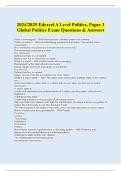
2024/2025 Edexcel A Level Politics, Paper 3 Global Politics Exam Questions & Answers
2024/2025 Edexcel A Level Politics, Paper 3 Global Politics Exam Questions & Answers What is sovereignty? - ANS-Absolute and unlimited power and authority. What is a nation? - ANS-Self-identifying community that doesn't necessarily have sovereignty Not necessarily recognized by the international community Not necessarily possessing a state E.g. the Kurds Defined territory is not needed Nations can live in more than one state What is a state? - ANS-Political entity with sovereignty Recognized by the international community Could contain more than one nation or community E.g. the U.K. Defined territory is needed States cannot cross the boundaries into other states What is a nation-state? - ANS-The nation state is the prime political entity of the modern era At its most basic a nation state is a nation with its own state, but this can be further developed. A nation state is: a state that represents the political wishes of a nation, and thus gains authority and legitimacy a self-governing state a state that is based on the principle of self-determination. Although there are problems with both the identification of nations and the recognition of states, the nation state is now the dominant model. The UN recognizes 193 states in the world, which are best described as nation states. Name 5 factors that drive globalisation - ANS-People Countries Culture Technology Institutions Economics Politics Name three impacts of globalisation on the state system - ANS-Widening and deepening interconnectedness and interdependence challenge to state control over citizens The development of international law humanitarian intervention What do hyperglobalisers believe? - ANS-Hyperglobalisers see the inevitability of globalisation as a consequence of advances in technology, and feel that humankind is entering a new age. There is no going back from growing globalisation; the world can only become more interconnected and interdependent. The borderless world will become a reality as states become irrelevant. Theorists differ on whether hyperglobalist will be a good or a bad thing. What do globalisation sceptics believe? - ANS-Sceptics see much of globalisation as a myth and argue that the so-called integrated global economy does not exist. In reality, regional, national and local economies are more significant. Sceptics also argue that international trade and capital flows are not new phenomena. What do transformationalists believe? - ANS-Transformationalists tread a middle path between hyperglobalisers and sceptics. Yes, significant changes have occurred due to globalisation but they have not fundamentally changed the basic international system. National governments are changing, perhaps becoming less important. Interconnectedness has increased in terms of breadth, intensity and speed. What do realists believe? - ANS-Realists are essentially sceptics. They believe that the state is still the main actor in the global system, and that globalisation has been made by states for states. Globalisation can make the world a more unstable place due to increasing competition and conflict. What do liberals believe? - ANS-Liberals have a positive view of globalization and its ability to bring trade, prosperity, peace, democracy, political freedoms and human rights. It is a win win. Liberals are also glad to see a decline in nation states and an increase in international co operation. What are the main 6 UN bodies? - ANS-The General Assembly The Security Council The Economic and Social Council The International Court of Justice (|CJ) The Secretariat The Trusteeship Council Name two strengths of the UN - ANS-The UN is a unique global organisation, as every state in the world is a member. The UN is often reduced in the public mind to the Security Council, but this ignores the many elements that enable states, corporations and people to interact on a daily basis. The existence of the UN shows the interconnectedness and interdependencies of the modern world. One great strength of the UN is that it represents the states of the world as equals, irrespective of their power, size, wealth, dominant religion, culture or system of government. Name two weaknesses of the UN - ANS-193 sovereign states with competing national interests and outlooks will sometimes disagree. The UN does not take sovereignty away from states, so there is no compulsion. ...
Documentinformatie
- Geüpload op
- 9 juni 2025
- Aantal pagina's
- 9
- Geschreven in
- 2024/2025
- Type
- Tentamen (uitwerkingen)
- Bevat
- Vragen en antwoorden


