

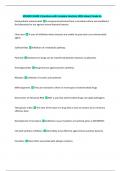
MCB2010 EXAM 1 Questions with Complete Solutions 100% Solved| Grade A+
Semisynthetic antimicrobial A compound extracted from a microbial culture and modified in
the laboratory for use against several bacterial species.
Clear area A zone of inhibition where bacteria are unable to grow due to an antimicrobial
agent.
Sulfonamides Inhibition of a metabolic pathway.
Plasmids Resistance to drugs can be transferred between bacteria via plasmids.
Aminoglycosides Drugs that act against protein synthesis
Rifampin Inhibition of nucleic acid synthesis
MDR organisms They are resistant to three or more types of antimicrobial drugs
Destruction of ribosomal RNA NOT a way that antimicrobial drugs can target pathogens
Therapeutic index The ratio of the dose of a drug that is toxic to humans to its minimum
effective dose
Development of resistance Antibiotics cause mutations in bacterial genes is INCORRECT
Cell wall synthesis inhibitors Most likely to be effective against Gram-positive bacteria
Penicillins Most often associated with allergic reactions
, Mechanisms of antibiotic resistance Inhibition of protein synthesis is EXCEPT
Ideal antimicrobial agent It only arrests growth of pathogens is NOT a desirable
characteristic
Resistance spread Through horizontal gene transfer
Cell wall synthesis inhibitors Will result in cells becoming more susceptible to osmotic
pressure
Erythromycin Inhibition of protein synthesis
DNA replication The process is described as semiconservative
Drug-resistant populations Arise when exposure to drugs selectively kills sensitive cells,
allowing overgrowth of resistant cells
Gamma rays Used for microbial control in fresh fruits and vegetables
Flash pasteurization Heating at 72°C for 15 seconds
Transformation Bacteria acquire new DNA from the environment
Nucleic acid damaging agents Also affect protein synthesis
Pregnant women medications Sulfonamides and tetracyclines should NOT be prescribed
Semisynthetic antimicrobial A compound extracted from a microbial culture and modified in
the laboratory for use against several bacterial species.
Clear area A zone of inhibition where bacteria are unable to grow due to an antimicrobial
agent.
Sulfonamides Inhibition of a metabolic pathway.
Plasmids Resistance to drugs can be transferred between bacteria via plasmids.
Aminoglycosides Drugs that act against protein synthesis
Rifampin Inhibition of nucleic acid synthesis
MDR organisms They are resistant to three or more types of antimicrobial drugs
Destruction of ribosomal RNA NOT a way that antimicrobial drugs can target pathogens
Therapeutic index The ratio of the dose of a drug that is toxic to humans to its minimum
effective dose
Development of resistance Antibiotics cause mutations in bacterial genes is INCORRECT
Cell wall synthesis inhibitors Most likely to be effective against Gram-positive bacteria
Penicillins Most often associated with allergic reactions
, Mechanisms of antibiotic resistance Inhibition of protein synthesis is EXCEPT
Ideal antimicrobial agent It only arrests growth of pathogens is NOT a desirable
characteristic
Resistance spread Through horizontal gene transfer
Cell wall synthesis inhibitors Will result in cells becoming more susceptible to osmotic
pressure
Erythromycin Inhibition of protein synthesis
DNA replication The process is described as semiconservative
Drug-resistant populations Arise when exposure to drugs selectively kills sensitive cells,
allowing overgrowth of resistant cells
Gamma rays Used for microbial control in fresh fruits and vegetables
Flash pasteurization Heating at 72°C for 15 seconds
Transformation Bacteria acquire new DNA from the environment
Nucleic acid damaging agents Also affect protein synthesis
Pregnant women medications Sulfonamides and tetracyclines should NOT be prescribed


