

Written by students who passed Immediately available after payment Read online or as PDF Wrong document? Swap it for free 4.6 TrustPilot
logo-home
Document preview thumbnail
Preview 4 out of 42 pages
Exam (elaborations)

Mental Health Exam Questions and Correct Answers (multiple choices) Updated version.

Document preview thumbnail
Preview 4 out of 42 pages

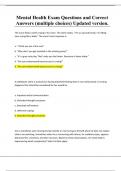
Mental Health Exam Questions and Correct Answers (multiple choices) Updated version. The nurse finds a client crying in his room. The client states, "I'm so sad and lonely. I'm sitting here crying like a baby." The nurse's best response is: a. "I think you are a fine man". b. "Why don't you get involved in the activity group?" c. "It's a gray rainy day. That's why you feel down. Everyone is down today." d. "Are you embarrassed because you're crying?" d. "Are you embarrassed because you're crying?" A withdrawn client is assessed as having distorted thinking that is not reality based. A nursing diagnosis that should be considered for her would be a. impaired verbal communication. b. disturbed thought processes. c. disturbed self-esteem. d. defensive coping. b. disturbed thought processes Jim is sometimes seen moving his lips silently or murmuring to himself when he does not realize others are watching. Sometimes when he is conversing with others, he suddenly stops, appears distracted for a moment, and then resumes. Based on these observations, Jim most likely is experiencing which symptom(s)? Select all that apply: a. Illusions. b. Paranoia. c. Delusional thinking. d. Auditory hallucinations. e. Impaired reality testing. f. Stereotyped behaviors. d. Auditory hallucinations. e. Impaired reality testing. Looseness of associations in a person with schizophrenia indicate a. paranoia. b. mood instability. c. depersonalization. d. poorly organized thinking. d. poorly organized thinking. Which assessment finding represents a negative symptom of schizophrenia? a. Apathy b. Delusion c. Motor tic d. Hallucination a. Apathy In general, when a nurse admitting a client experiencing an acute schizophrenia episode, she would most likely assess which of the following? a. Open and outgoing personality b. Loss of contact with reality c. Feelings of guilt and worthlessness d. Logical and precise thinking b. Loss of contact with reality While the nurse was doing the assessment, Jeffery turned to an empty chair talking as if someone was sitting there. The nurse was unable to understand what he was mumbling. This, in fact, indicates that the patient has: a. Delusions. b. Hallucinations. c. Illusions. d. Flight of ideas. b. Hallucinations. According to the previous scenario, which of the following symptoms is considered a negative symptom of schizophrenia? a. The patient was mumbling. b. The patient shouted; "They're coming! They're coming!" c. The patient has anergia. d. The patient believes that everything in the environment refer to him c. The patient has anergia. -lack of energy which should be present -a,b,d are all unwanted symptoms that shouldn't be present The client is prescribed a first- generation neuroleptic for his schizophrenia. Discharge teaching by the nurse should include contacting the health provider if which of the following occurs? a. Elevated temperature b. Blurred vision c. Difficulty concentrating d. Inability to remain seated for long period of time a. Elevated temperature -Neuroleptic malignant syndrome The client has been on Haldol since admission. Which assessment by the nurse would best determine the effectiveness of a client's antipsychotic medication? a. The client no longer has hallucinations b. The client is no longer depressed c. The client has made a friend on the unit d. The client requested discharge a. The client no longer has hallucinations -first generation antipsychotic A client has developed neuroleptic malignant syndrome. A priority nursing intervention would be which of the following? a. Provide comfort and rest b. Measure intake and output c. Encourage client to remain active d. Monitor vital signs and blood pressure d. Monitor vital signs and blood pressure 1A client is admitted to the emergency room with complains of sore throat and fever. The client's mother informs the nurse that the client has been taking Clozaril. Which of the following laboratory tests is a priority at this time? a. Fasting blood sugar b. Cholesterol level c. Blood urea nitrogen d. White blood cell count d. White blood cell count 8. A new graduate has been assigned four patients whom she must perform an assessment on. Her assessment reveals several clients complain. Which client complains should receive priority? a. A client receiving Cogentin who states, "I can't read my book, everything seems blurred." b. The client receiving Clozapine who states, "I think I might be getting the flu, my throat is sore and I feel very tired." c. A client who was admitted for alcoholism and states, " I took my valium but I still feel nervous. d. A client receiving Prozac who states "This medicine makes me sleepy. Is that that normal?" b. The client receiving Clozapine who states, "I think I might be getting the flu, my throat is sore and I feel very tired." During a one-to-one session with a client, the nurse notes that the client is unable to stop moving. He frequently stands-up and begins pacing while answering the nurse's questions. The nurse assesses the client's need to be in constant motion as which of the following? a. Akathesia b. Flight-of-ideas c. Echopraxia d. Neuroleptic syndrome a. Akathesia 1. Jeffery is encouraged to attend groups but stays in his room instead. Staff and peers encourage his participation, but his hygiene remains poor. He does not seem to care that others wish that he would behave differently. Which is the most likely explanation for Jeffery failure to respond to others efforts to help him behave in more adaptive fashion? Select all that apply: a. He is avolitional. -drained of energy, goals and tasks b. He is displaying anergia. -lack of energy c. He is displaying negativism -has symptoms that would not normally be present d. He is experiencing social withdrawal. e. He is apathetic due to his schizophrenia- lack of energy towards condition a, b, c, d, e Currently what is understood to be the causation of schizophrenia? A. A combination of inherited and nongenetic factors B. Deficient amounts of the neurotransmitter dopamine C. Excessive amounts of the neurotransmitter serotonin D. Stress related and ineffective stress management skills A. A combination of inherited and nongenetic factors Which of the following would be assessed as a negative symptom of schizophrenia? A. Anhedonia B. Hostility C. Agitation D. Hallucinations A. Anhedonia - inability to experience pleasure in activities that usually produce it Which side effect of antipsychotic medication is generally nonreversible? A. Anticholinergic effects B. Pseudoparkinsonism C. Dystonic reaction D. Tardive dyskinesia D. Tardive dyskinesia The most common course of schizophrenia is an initial episode followed by what course of events? A. Recurrent acute exacerbations and deterioration B. Recurrent acute exacerbations C. Continuous deterioration D. Complete recovery A. Recurrent acute exacerbations and deterioration A client diagnosed with paranoid schizophrenia tells the nurse, "I have to get away. The volmers are coming to execute me." The term "volmers" can be assessed as A. a neologism. B. clang association. C. blocking. D. a delusion. A. a neologism -a relatively recent or isolated term, word, or phrase that may be in the process of entering common use, but that has not yet been fully accepted into mainstream language. A client diagnosed with paranoid schizophrenia refuses food, stating the voices are saying the food is contaminated and deadly. Which response should the nurse provide to this client statement? A. "You are safe here in the hospital; nothing bad will happen to you." B. "The voices are wrong about the hospital food. It is not contaminated." C. "I understand that the voices are very real to you, but I do not hear them." D. "Other people are eating the food, and nothing is happening to them." C. "I understand that the voices are very real to you, but I do not hear them." A client, who has been prescribed clozapine 6 weeks ago, reports flulike symptoms including a fever and a very sore throat, the nurse should initiate which nursing intervention? A. Suggest that the client take something for the fever and get extra rest. B. Advise the physician that the client should be admitted to the hospital. C. Arrange for the client to have blood drawn for a white blood cell count. D. Consider recommending a change of antipsychotic medication. C. Arrange for the client to have blood drawn for a white blood cell count. When a client diagnosed with paranoid schizophrenia tells the nurse, "I have to get away. The volmers are coming to execute me," an appropriate response for the nurse would be: A. "You are safe here. This is a locked unit, and no one can get in." B. "I do not believe I understand the word volmers. Tell me more about them." C. "Why do you think someone or something is going to harm you?" D. "It must be frightening to think something is going to harm you." D. "It must be frightening to think something is going to harm you." The purpose of the Abnormal Involuntary Movement Scale (AIMS) assessment on a persistently mentally ill client who has been diagnosed with schizophrenia is early detection of A. acute dystonia. B. tardive dyskinesia. C. cholestatic jaundice. D. pseudoparkinsonism. B. tardive dyskinesia. Nico, a 22-year-old patient, is diagnosed with schizophrenia. Which of the following symptoms would alert a provider to a possible diagnosis of schizophrenia in a 22-year-old male client? A. Excessive sleeping with disturbing dreams B. Hearing voices telling him to hurt his roommate C. Withdrawal from college because of failing grades D. Chaotic and dysfunctional relationships with his family and peers B. Hearing voices telling him to hurt his roommate A teenaged client is being discharged from the psychiatric unit with a prescription for risperidone. The nurse providing medication teaching to the client's mother should provide which response when asked about the risk her son faces for extrapyramidal side effects (EPSs)? A. All antipsychotic medications have an equal chance of producing EPSs. B. Newer antipsychotic medications have a higher risk for EPSs. C. Risperidone is a newer antipsychotic medication and has a lower risk of EPSs than older antipsychotics. D. Advise the mother to ask the provider to change the medication to clozapine instead of risperidone. C. Risperidone is a newer antipsychotic medication and has a lower risk of EPSs than older antipsychotics. Which characteristic presents the greatest risk for injury to others by the patient diagnosed with schizophrenia? A) Depersonalization B) Pressured speech C) Negative symptoms D) Paranoia D) Paranoia A bipolar client tells the nurse "I have the finest tenor voice in the world. The three tenors who do all those TV concerts are going to retire because they can't compete with me." The nurse would make the assessment that the client is displaying A. flight of ideas. B. Distractibility. C. limit testing. D. Grandiosity. D. Grandiosity. 1. The nurse is caring for a patient experiencing mania. Which is the most appropriate nursing intervention? A. Provide consistency among staff members when working with the patient. B. Negotiate limits so the patient has a voice in the plan of care. C. Allow only certain staff members to interact with the patient. D. Attempt to control the patient's emotions. A. Provide consistency among staff members when working Prevention of ______and ________from sudden cardiac collapse are essential during acute mania. exhaustion; death The nurse is planning care for a patient experiencing the acute phase of mania. Which is the priority intervention? A. Maintain stable cardiac status. B. Prevent injury. C. Get the patient to demonstrate thought self-control. D. Ensure that the patient get sufficient sleep and rest. B. Prevent injury. Formulate three nursing diagnosis appropriate for a patient with mania -Risk for injury -Risk for suicide -Risk for malnutrition Describe common medications used for bipolar disorders -Antipsychotics -Mood stabilizers -Anti-anxiety -Antidepressant 13. What critical information should the nurse provide about the use of lithium? A. "You will still have hypersexual tendencies. So be certain to use protection when engaging in intercourse". B. "Lithium will help you to only feel the euphoria of mania but not the anxiety" C. "It will take one to two weeks and may be longer for this medication to start working fully". D. "This medication is a cure for bipolar disorder" C. "It will take one to two weeks and may be longer for this medication to start working fully". The nurse has provided education for a patient in the continuation phase after discharge from the hospital. What indicates that the plan of care has been successful? Select all that apply: A. Patient identifies three signs and symptoms of relapse. B. Patient describes the purpose of each medication he has been prescribed. C. Patient states "I no longer have the disease" D. Patient identifies two ways to problem-solve a specific situation. A, B, D What is the first-line drug used to treat mania? A. Lithium carbonate B. Carbamazepine C. Lamotrigine D. Clonazepam A. Lithium carbonate An acute phase nursing intervention aimed at reducing hyperactivity is demonstrated by which intervention? A. Writing in a diary B. Exercising in the gym C. Directing unit activities D. Orienting a new client to the unit A. Writing in a diary What term is used to identify the condition demonstrated by a person who has numerous hypomanic and dysthymic episodes over a two-year period? A. Bipolar II disorder. B. Bipolar I disorder. C. Cyclothymia. D. Seasonal affective disorder. C. Cyclothymia. When a client reports that lithium causes an upset stomach, the nurse should make which suggestion associated with taking the medication? A. With meals B. With an antacid C. 30 minutes before meals D. 2 hours after meals A. With meals When a client experiences four or more mood episodes in a 12-month period, which term is used to describe this behavior? A. Dyssynchronous B. Incongruent C. Cyclothymic D. Rapid cycling D. Rapid cycling The nurse can expect a client demonstrating typical manic behavior to be attired in clothing that includes with characteristics? A. Dark colored and modest B. Colorful and outlandish C. Compulsively neat and clean D. Ill-fitted and ragged B. Colorful and outlandish Which behavior would be characteristic of a client during a manic episode? A. Going rapidly from one activity to another B. Taking frequent rest periods and naps during the day C. Being unwilling to leave home to see other people D. Watching others intently and talking little A. Going rapidly from one activity to another When a hyperactive manic client expresses the intent to strike another client, the initial nursing intervention would be to A. question the client's motive. B. set verbal limits. C. initiate physical confrontation. D. prepare the client for seclusion. B. set verbal limits. What action should the nurse take on learning that a manic client's serum lithium level is 1.8 mEq/L? A. Withhold medication and notify the physician. B. Continue to administer medication as ordered. C. Advise the client to limit fluids for 12 hours. D. Advise the client to curtail salt intake for 24 hours A. Withhold medication and notify the physician. What is the priority nursing diagnosis for a hyperactive manic client during the acute phase of treatment? A. Risk for injury B. Ineffective role performance C. Risk for other-directed violence D. Impaired verbal communication A. Risk for injury Which room placement would be best for a client experiencing a manic episode? A. A shared room with a client with dementia B. A single room near the unit activities area C. A single room near the nurses' station D. A shared room away from the unit entrance C. A single room near the nurses' station A bipolar client tells the nurse, "I have the finest tenor voice in the world. The three tenors who do all those TV concerts are going to retire because they can't compete with me." What term should the nurse use to identify this behavior? A. Flight of ideas B. Distractibility C. Limit testing D. Grandiosity D. Grandiosity A client hospitalized for a psychotic relapse is being discharged home to family. Which topic is important to address when teaching both the patient and the family to recognize possible signs of impending mania? A. Increased appetite B. Decreased social interaction C. Increased attention to bodily functions D. Decreased sleep D. Decreased sleep Prior to admission, a patient was directing traffic, shouting "to work, you jerk, for perks," and making obscene gestures at cars. The patient's spouse reports noncompliance with lithium therapy for 3 weeks and not sleeping for 3 days, saying, "I'm too busy." Features characteristic of bipolar disorder the nurse can identify are: A. Increased muscle tension and anxiety. B. Vegetative signs and poor grooming. C. Poor judgment and hyperactivity. D. Cognitive deficits and low mood C. Poor judgment and hyperactivity. The patient was directing traffic and shouting rhymes on a busy city street. The patient's spouse reports that the patient has not slept or eaten for 3 days. Which assessment findings have priority concern for this patient's plan of care? A. Pressured speech and grandiosity. B. Hyperactivity, not eating and sleeping. C. Poor concentration and decision making. D. Insulting, provocative behavior directed at staff. B. Hyperactivity, not eating and sleeping. .A patient with bipolar disorder, mania, relapsed after discontinuing lithium. The health care provider prescribes lithium 600 mg BID and olanzapine (Zyprexa) 10 mg BID. What is the rationale for addition of olanzapine to the lithium regime? It will: A. Minimize the side effects of lithium. B. Bring hyperactivity under rapid control. C. Potentiate the antimanic action of lithium. D. Be used for long-term control of hyperactivity B. Bring hyperactivity under rapid control. Laboratory results show a patient's lithium level is 1.0 mEq/L. Select the correct analysis. A. Within therapeutic limits. B. Below therapeutic limits. C. Above therapeutic limits. D. Above therapeutic limits; toxic A. Within therapeutic limits. The patient with acute mania undresses in the day room and dances. Select the best intervention. A. Quietly ask the patient, "Are you embarrassed? Don't you think you should put your clothes on?" B. Let the patient stay in the day room. Move other patients to a different area. C. Cover the patient with a blanket and walk with the patient to a quiet room. D. Tell the patient firmly, "Stop dancing and put on your clothing C. Cover the patient with a blanket and walk with the patient to a quiet room. A teaching plan for a patient taking lithium should include instructions to: A. Maintain normal salt and fluids in the diet. B. Drink twice the usual daily amount of fluid. C. Have regular laboratory studies of liver function. D. Avoid eating aged cheese, processed meats, and red wine A. Maintain normal salt and fluids in the diet. A patient takes lithium daily. The nurse should monitor the patient for: A. Pharyngitis, mydriasis, and dystonia. B. Alopecia, purpura, and drowsiness. C. Diaphoresis, weakness, and nausea. D. Ascites, dyspnea, and edema. C. Diaphoresis, weakness, and nausea. What critical information should the nurse provide about the use of lithium? A. "You will still have hypersexual tendencies, so be certain to use protection when engaging in intercourse". B. "Lithium will help you to only feel the euphoria of mania but not the anxiety." C. "It will take 1 to 2 weeks and maybe longer for this medication to start working fully." D. "This medication is a cure for bipolar disorder." C. "It will take 1 to 2 weeks and maybe longer for this medication to start working fully." A medication plan for Mary who receives lithium should include: A. Periodic monitoring for renal and thyroid function. B. Dietary teaching to restrict daily sodium intake. C. The importance of blood draws to monitor serum potassium level. D. Discontinuing the drug if weight gain and fine hand tremors are noticed. A. Periodic monitoring for renal and thyroid function. First line treatment for all types of depression is ________ except in psychotic depression which is ________ SSRI; ECT SSRI's are less dangerous when taken in overdose because they have a _________ therapeutic index HIGH Central serotonin syndrome is rare and life-threatening event caused by ____________ high dose or interactions with other drugs Risk of Central serotonin syndrome is higher is SSRI's are administered with ________ MAOI's Patient should discontinue SSRI ___________ weeks before starting MAOI? 2-5 weeks Adverse reactions of MAOIs is Hypertensive crisis, which occurs a few hours after ingestion of _________ Tyramine The nurse is planning care for a patient with depression who will be discharged to home soon. What aspects of teaching should be the priority on the nurse's discharge plan of care? A. Pharmacological teaching. B. Safety risk. C. Awareness of symptoms increasing depression. D. The need for interpersonal contact. B. Safety risk The nurse is reviewing orders given for a patient with depression. Which order should the nurse question? A. low starting dose of a tricyclic antidepressants. B. An SSRI given initially with an MAOI C. Electroconvulsive therapy to treat suicidal thoughts. D. Elavil to address the patient's agitation B. An SSRI given initially with an MAOI Which response by a 15-year-old demonstrates a common symptom observed in patients diagnosed with major depressive disorder? a. "I'm so restless. I can't seem to sit still." b. "I spend most of my time studying. I have to get into a good college." c. "I'm not trying to diet, but I've lost about 5 pounds in the past 5 months." d. "I go to sleep around 11 p.m. but I'm always up by 3 a.m. and can't go back to sleep." d. "I go to sleep around 11 p.m. but I'm always up by 3 a.m. and can't go back to sleep." Which assessment question asked by the nurse demonstrates an understanding of comorbid mental health conditions associated with major depressive disorder? Select all that apply. a. "Do rules apply to you?" b. "What do you do to manage anxiety?" c. "Do you have a history of disordered eating?" d. "Do you think that you drink too much?" e. "Have you ever been arrested for committing a crime?" b. "What do you do to manage anxiety?" c. "Do you have a history of disordered eating?" d. "Do you think that you drink too much?" Which nursing intervention focuses on managing a common characteristic of major depressive disorder associated with the older population? a. Conducting routine suicide screenings at a senior center. b. Identifying depression as a natural, but treatable result of aging. c. Identifying males as being at a greater risk for developing depression. d. Stressing that most individuals experience just a single episode of major depression in a lifetime. a. Conducting routine suicide screenings at a senior center. Which characteristic identified during an assessment serves to support a diagnosis of disruptive mood dysregulation disorder? Select all that apply. a. Female b. 7 years old c. Comorbid autism diagnosis d. Outbursts occur at least once a week e. Temper tantrums occur at home and in school b. 7 years old c. Comorbid autism diagnosis e. Temper tantrums occur at home and in school Which chronic medical condition is a common trigger for major depressive disorder? a. Pain b. Hypertension c. Hypothyroidism d. Crohn's disease a. Pain When a nurse uses therapeutic communication with a withdrawn patient who has major depression, an effective method of managing the silence is to: a. Meditate in the quiet environment b. Ask simple questions even if the patient will not answer c. Use the technique of making observations d. Simply sit quietly and leave when the patient falls asleep c. Use the technique of making observations A depressed client is noted to pace most of the time, pull at her clothes, and wring her hands. These behaviors are consistent with which term? A. Senile dementia B. Hypertensive crisis C. Psychomotor agitation D. Central serotonin syndrome C. Psychomotor agitation When the clinician mentions that a client has anhedonia, the nurse can expect that the client will demonstrate what behavior? A. Poor retention of recent events B. A weight loss from anorexia C. No pleasure from previously enjoyed activities D. Difficulty with tasks requiring fine motor skills C. No pleasure from previously enjoyed activities Beck's cognitive theory suggests that the etiology of depression is related to what factor? A. Sleep abnormalities B. Serotonin circuit dysfunction C. Negative processing of information D. belief that one has no control over outcomes C. Negative processing of information A client prescribed a monamine oxidase inhibitor (MOA) has a pass to go out to lunch. Given a choice of the following entrees, the client can safely eat A. avocado salad plate. B. fruit and cottage cheese plate. C. kielbasa and sauerkraut. D. liver and onion sandwich. B. fruit and cottage cheese plate. A depressed, socially withdrawn client tells the nurse, "There is no sense in trying. I am never able to do anything right!" The nurse can best address this cognitive distortion with which response? A. "Let's look at what you just said, that you can 'never do anything right.'" B. "Tell me what things you think you are not able to do correctly." C. "Is this part of the reason you think no one likes you?" D. "That is the most unrealistic thing I have ever heard." A. "Let's look at what you just said, that you can 'never do anything right.'" A client prescribed a selective serotonin reuptake inhibitor mentions taking the medication along with the St. John's wort daily. The nurse should provide the client with what information regarding this practice? A. Agreeing that this will help the client to remember the medications. B. Caution the client to drink several glasses of water daily. C. Suggest that the client also use a sun lamp daily. D. Explain the high possibility of an adverse reaction. D. Explain the high possibility of an adverse reaction. A depressed client tells the nurse, "There is no sense in trying. I am never able to do anything right!" The nurse should identify this cognitive distortion as what response? A. Self-blame B. Catatonia C. Learned helplessness D. Discounting positive attributes C. Learned helplessness Which statement about antidepressant medications, in general, can serve as a basis for client and family teaching? A. Onset of action is from 1 to 3 weeks or longer. B. They tend to be more effective for men. C. Recent memory impairment is commonly observed. D. They often cause the client to have diurnal variation. A. Onset of action is from 1 to 3 weeks or longer. What is the major reason for the hospitalization of a depressed patient? A. Inability to go to work B. Suicidal ideation C. Loss of appetite D. Psychomotor agitation B. Suicidal ideation When the nurse asks whether a client is having any thoughts of suicide, the client becomes angry and defensive, shouting, "I'm sick of you people! Are you ever do is ask me the same question over and over. Get out of here!" The nurse's response is based on what fact concerning hostility? A. The client is getting better and is able to be assertive. B. The client may be at high risk for self-harm. C. The client is probably experiencing transference. D. The client may be angry at someone else and projecting that anger to staff. B. The client may be at high risk for self-harm. A client prescribed fluoxetine demonstrates an understanding of the medication teaching when making which statement? A. "I will make sure to get plenty of sunshine and not use sunscreen to avoid a skin reaction." B. "I will not take any over-the-counter medication while on the fluoxetine." C. "I will report any symptoms of high fever, fast heartbeat, or abdominal pain to my provider right away." D. "I will report increased thirst and urination to my provider." C. "I will report any symptoms of high fever, fast heartbeat, or abdominal pain to my provider right away." -SSRI Depression neurotransmitters serotonin and norepinephrine bipolar neurotransmitters -Overactivity of norepinephrine. -may be linked to low serotonin activity -low serotonin activity accompanied by low norepinephrine activity may lead to depression -low serotonin activity accompanied by high norepinephrine activity may lead to mania -may be tied to abnormal activity of other neurotransmitters, such as GABA, as well. Symptom associated with panic attacks is a. Obsessions. b. Apathy. c. Drowsiness. d. Fear of impending doom. d. Fear of impending doom. An obsession is defined as a. Thinking of an action and immediately taking the action. b. A recurrent, persistent thought or impulse. c. An intense irrational fear of an object or situation. d. A recurrent behavior performed in the same manner. b. A recurrent, persistent thought or impulse. What defense mechanisms can only be used in healthy ways? A. Suppression and humor B. Altruism and sublimation C. Idealization and splitting D. Reaction formation and denial B. Altruism and sublimation A man continues to speak of his wife as though she were still alive, 3 years after her death. This behavior suggests the use of which ego defense mechanism? A. Altruism B. Denial C. Undoing D. Suppression B. Denial What can be said about the comorbidity of anxiety disorders? A. Anxiety disorders generally exist alone. B. Depression may occur prior to onset of anxiety. C. Anxiety disorders virtually never coexist with mood disorders. D. Substance abuse disorders rarely coexist with anxiety disorders. B. Depression may occur prior to onset of anxiety. Selective inattention is first noted when experiencing which level of anxiety? A. Mild B. Moderate C. Severe D. Panic B. Moderate A 20-year-old was sexually molested at age 10, but he can no longer remember the incident. Which ego defense mechanism is in use? A. Projection B. Repression C. Displacement D. Reaction formation B. Repression Delusionary thinking is a characteristic of which form of anxiety? A. Chronic anxiety B. Acute anxiety C. Severe anxiety D. Panic level anxiety D. Panic level anxiety Working to help the client view an occurrence in a more positive light is referred to by which term? A. Flooding B. Desensitization C. Response prevention D. Cognitive restructuring D. Cognitive restructuring Inability to leave one's home because of avoidance of severe anxiety suggests the existence of which anxiety disorder? A. Panic attacks with agoraphobia B. Obsessive-compulsive disorder C. Posttraumatic stress response D. Generalized anxiety disorder A. Panic attacks with agoraphobia A person who recently gave up smoking and now talks constantly about how smoking fouls the air, causes cancer, and "burns" money that could be better spent to feed the poor is demonstrating which ego defense mechanism? A. Projection B. Rationalization C. Reaction formation D. Undoing C. Reaction formation What is the major distinction between fear and anxiety? A. Fear is a universal experience; anxiety is neurotic. B. Fear enables constructive action; anxiety is dysfunctional. C. Fear is a psychological experience; anxiety is a physiological experience. D. Fear is a response to a specific danger; anxiety is a response to an unknown danger. D. Fear is a response to a specific danger; anxiety is a response to an unknown danger. What is a possible outcome criterion for a client diagnosed with anxiety disorder? A. Client demonstrates effective coping strategies. B. Client reports reduced hallucinations. C. Client reports feelings of tension and fatigue. D. Client demonstrates persistent avoidance behaviors. A. Client demonstrates effective coping strategies. Panic attacks in Latin American individuals often involve demonstration of which behavior? A. Repetitive involuntary actions B. Blushing C. Fear of dying D. Offensive verbalizations C. Fear of dying When prescribed lorazepam (Ativan) 1 mg po qid for 1 week for generalized anxiety disorder, the nurse should A. question the physician's order because the dose is excessive. B. explain the long-term nature of benzodiazepine therapy. C. teach the client to limit caffeine intake. D. tell the client to expect mild insomnia. C. teach the client to limit caffeine intake. A client is diagnosed with generalized anxiety disorder (GAD). The nursing assessment supports this diagnosis when the client reports which information? A. Symptoms started right after being robbed at gunpoint. B. Being unable to work for the last 12 months. C. Eating in public makes the client extremely uncomfortable. D. Repeated verbalizing prayers results in a relaxed feeling. B. Being unable to work for the last 12 months. A client experiencing a panic attack keeps repeating, "Im dying, I can't breathe.". What action by the nurse should be most therapeutic initially? A. Encouraging the client to take slow, deep breaths The plan of care for a client who has elaborate washing rituals specifies that response prevention is to be used. Which scenario is an example of response prevention? A. Having the client repeatedly touch "dirty" objects B. Not allowing the client to seek reassurance from staff C. Not allowing the client to wash hands after touching a "dirty" object D. Telling the client that he or she must relax whenever tension mounts A. Having the client repeatedly touch "dirty" objects A client who is demonstrating a moderate level of anxiety tells the nurse, "I am so anxious, and I do not know what to do." Which response should the nurse make initially? A. "What things have you done in the past that helped you feel more comfortable?" B. "Let's try to focus on that adorable little granddaughter of yours." C. "Why don't you sit down over there and work on that jigsaw puzzle?" D. "Try not to think about the feelings and sensations you're experiencing." A. "What things have you done in the past that helped you feel more comfortable?" The record mentions states that the client habitually relies on rationalization. The nurse might expect the client to present with what behavior? A. Makes jokes to relieve tension. B. Misses appointments. C. Justifies illogical ideas and feelings. D. Behaves in ways that are the opposite of his or her feelings. C. Justifies illogical ideas and feelings. The nurse caring for a client experiencing a panic attack anticipates that the psychiatrist would order a stat dose of which classification of medications? A short-acting benzodiazepine medication. A client frantically reports to the nurse that "You have got to help me! Something terrible is happening. I can't think. My heart is pounding, and my head is throbbing." The nurse should assess the client's level of anxiety as A. mild. B. moderate. C. severe. D. panic. C. severe. Which should the nurse be prepared to educate patients on when they are prescribed a selective serotonin reuptake inhibitor (SSRI) for panic attacks? A. Alprazolam (Xanax) B. Fluoxetine (Prozac) C. Clonazepam (Klonopin) D. Venlafaxine (Effexor) B. Fluoxetine (Prozac) The activity of gamma-aminobutyic acid (GABA) contributes to a slowing of neural activity. Which of the following drugs facilitates the action of GABA? A. Benzodiazepines B. Antihistamines C. Anticonvulsants D. Noradrenergic A. Benzodiazepines A recent diagnosis of cancer has caused a client severe anxiety. Which of the following interventions should the nurse include in the care plan? -Maintain a calm, non-threatening environment -Encourage the client to verbalize her concerns regarding the diagnosis -Encourage the client to use deep-breathing exercises and other relaxation techniques during periods of increased stress A parent is shopping with a 5-year-old child in a large, busy urban mall. The parent suddenly realizes the child is missing. Which level of anxiety would likely result? A. Mild B. Moderate C. Severe D. Panic D. Panic Each time a client is scheduled for a therapy session she develops headache and nausea. The nurse might interpret this behavior as: a. Conversion b. Reaction formation c. Projection d. Suppression a. Conversion - change anxiety into somatic symptoms, no organic cause Client sees no connection between her liver disorder and her alcohol intake. She believes that she drinks very little and that her family is making something out of nothing. The nurse interprets these behaviors as indicative of the client's use of which of the following defense mechanism? Denial A client reports becoming involved with legislation that promotes gun safety after the death of a child by accidental shooting. Which defense mechanism is the client exhibiting? Sublimation -redirecting feelings and drives into an acceptable channel A client diagnosed with substance dependence states to the nurse, "My wife causes me to abuse methamphetamines. She uses and expects me to." The client is using which defense mechanism? Projection An 11-year-old child whose father died recently asks his mother for help with picking out clothes for the day and zipping his coat. This behavior is an example of: Regression

Content preview

Mental Health Exam Questions and Correct
Answers (multiple choices) Updated version.
The nurse finds a client crying in his room. The client states, "I'm so sad and lonely. I'm sitting
here crying like a baby." The nurse's best response is:


a. "I think you are a fine man".

b. "Why don't you get involved in the activity group?"

c. "It's a gray rainy day. That's why you feel down. Everyone is down today."

d. "Are you embarrassed because you're crying?"

d. "Are you embarrassed because you're crying?"


A withdrawn client is assessed as having distorted thinking that is not reality based. A nursing
diagnosis that should be considered for her would be


a. impaired verbal communication.

b. disturbed thought processes.

c. disturbed self-esteem.

d. defensive coping.

b. disturbed thought processes


Jim is sometimes seen moving his lips silently or murmuring to himself when he does not realize
others are watching. Sometimes when he is conversing with others, he suddenly stops, appears
distracted for a moment, and then resumes. Based on these observations, Jim most likely is
experiencing which symptom(s)? Select all that apply:

,a. Illusions.

b. Paranoia.

c. Delusional thinking.

d. Auditory hallucinations.

e. Impaired reality testing.

f. Stereotyped behaviors.

d. Auditory hallucinations.


e. Impaired reality testing.


Looseness of associations in a person with schizophrenia indicate


a. paranoia.

b. mood instability.

c. depersonalization.

d. poorly organized thinking.

d. poorly organized thinking.


Which assessment finding represents a negative symptom of schizophrenia?


a. Apathy

b. Delusion

c. Motor tic

,d. Hallucination

a. Apathy


In general, when a nurse admitting a client experiencing an acute schizophrenia episode, she
would most likely assess which of the following?


a. Open and outgoing personality

b. Loss of contact with reality

c. Feelings of guilt and worthlessness

d. Logical and precise thinking

b. Loss of contact with reality


While the nurse was doing the assessment, Jeffery turned to an empty chair talking as if
someone was sitting there. The nurse was unable to understand what he was mumbling. This, in
fact, indicates that the patient has:


a. Delusions.

b. Hallucinations.

c. Illusions.

d. Flight of ideas.

b. Hallucinations.


According to the previous scenario, which of the following symptoms is considered a negative
symptom of schizophrenia?

, a. The patient was mumbling.

b. The patient shouted; "They're coming! They're coming!"

c. The patient has anergia.

d. The patient believes that everything in the environment refer to him

c. The patient has anergia.


-lack of energy which should be present

-a,b,d are all unwanted symptoms that shouldn't be present


The client is prescribed a first- generation neuroleptic for his schizophrenia. Discharge teaching
by the nurse should include contacting the health provider if which of the following occurs?


a. Elevated temperature

b. Blurred vision

c. Difficulty concentrating

d. Inability to remain seated for long period of time

a. Elevated temperature


-Neuroleptic malignant syndrome


The client has been on Haldol since admission. Which assessment by the nurse would best
determine the effectiveness of a client's antipsychotic medication?


a. The client no longer has hallucinations

Document information

Uploaded on
June 5, 2025
Number of pages
42
Written in
2024/2025
Type
Exam (elaborations)
Contains
Questions & answers
$10.49

Wrong document? Swap it for free Within 14 days of purchase and before downloading, you can choose a different document. You can simply spend the amount again.
Written by students who passed
Immediately available after payment
Read online or as PDF

Sold
0
Followers
0
Items
87
Last sold
-


Why students choose Stuvia

Created by fellow students, verified by reviews

Quality you can trust: written by students who passed their tests and reviewed by others who've used these notes.

Didn't get what you expected? Choose another document

No worries! You can instantly pick a different document that better fits what you're looking for.

Pay as you like, start learning right away

No subscription, no commitments. Pay the way you're used to via credit card and download your PDF document instantly.

Student with book image

“Bought, downloaded, and aced it. It really can be that simple.”

Alisha Student

Working on your references?

Create accurate citations in APA, MLA and Harvard with our free citation generator.

Working on your references?

Frequently asked questions
