
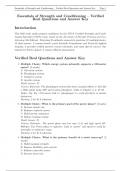
Essentials of Strength and Conditioning – Verified Real Questions and Answer Key Page 1
Essentials of Strength and Conditioning – Verified
Real Questions and Answer Key
Introduction
This 2025 study guide prepares candidates for the NSCA Certified Strength and Condi-
tioning Specialist (CSCS) exam, based on the Essentials of Strength Training and Con-
ditioning (4th Edition). Featuring 35 authentic exam-style questions (15 multiple-choice,
15 short-answer, 5 scenario-based) across Scientific Foundations and Practical/Applied
domains, it provides verified answers, concise rationales, and exam tips for success. Op-
timized for Stuvia upload, it ensures efficient preparation.
Verified Real Questions and Answer Key
1. Multiple Choice: Which energy system primarily supports a 100-meter
sprint? [2 marks]
A. Glycolytic system
B. Phosphagen system
C. Oxidative system
D. Aerobic system
Model Answer: B
Concise Rationale: The phosphagen system fuels short, maximal efforts (<15s) like
a 100m sprint using ATP and creatine phosphate. Links to Chapter 3, p. 67–68.
Helper Tip: For <10s bursts, link to “phosphagen” to avoid glycolytic or aerobic
distractors.
Marking: 2 for B; 0 otherwise.
2. Multiple Choice: What is the primary goal of the power phase? [2 marks]
A. Increase muscle size
B. Enhance explosive power
C. Build aerobic endurance
D. Reduce training volume
Model Answer: B
Concise Rationale: The power phase uses low reps (1–5) and high speed (85–
90Helper Tip: Power phase is explosive. Link to “power” and speed to avoid hy-
pertrophy or endurance traps.
Marking: 2 for B; 0 otherwise.
3. Multiple Choice: What is the primary benefit of a static warm-up? [2
marks]
A. Build maximal strength
B. Improve flexibility post-exercise
C. Enhance anaerobic power
D. Increase heart rate
, Essentials of Strength and Conditioning – Verified Real Questions and Answer Key Page 2
Model Answer: B
Concise Rationale: Static warm-ups (post-exercise stretches) improve flexibility
and aid recovery. Links to Chapter 16, p. 363.
Helper Tip: Static warm-ups are post-exercise. Link to “flexibility” to avoid power
or heart rate distractors.
Marking: 2 for B; 0 otherwise.
4. Multiple Choice: What does the T-Test assess? [2 marks]
A. Aerobic capacity
B. Agility and speed
C. Upper-body strength
D. Core endurance
Model Answer: B
Concise Rationale: The T-Test measures agility and speed through multidirectional
sprints. Links to Chapter 13, p. 290–291.
Helper Tip: T-Test is quick movement. Link to “agility” to avoid endurance or
strength traps.
Marking: 2 for B; 0 otherwise.
5. Multiple Choice: What is scoliosis? [2 marks]
A. Inward lumbar curvature
B. Outward thoracic curvature
C. Lateral spinal curvature
D. Flat spinal alignment
Model Answer: C
Concise Rationale: Scoliosis is lateral (side-to-side) spinal curvature, affecting pos-
ture. Links to Chapter 14, p. 317.
Helper Tip: Scoliosis is side-to-side. Link to “lateral” to avoid kyphosis or lordosis
distractors.
Marking: 2 for C; 0 otherwise.
6. Multiple Choice: What is the role of beta-alanine supplementation? [2
marks]
A. Enhance aerobic endurance
B. Buffer lactic acid for performance
C. Reduce muscle soreness
D. Improve flexibility
Model Answer: B
Concise Rationale: Beta-alanine buffers lactic acid, delaying fatigue in high-intensity
efforts. Links to Chapter 11, p. 230–231.
Helper Tip: Beta-alanine is for intensity. Link to “lactic acid” to avoid endurance
or recovery traps.
Marking: 2 for B; 0 otherwise.
7. Multiple Choice: What is the purpose of the strength phase? [2 marks]
A. Enhance sport-specific skills
Essentials of Strength and Conditioning – Verified
Real Questions and Answer Key
Introduction
This 2025 study guide prepares candidates for the NSCA Certified Strength and Condi-
tioning Specialist (CSCS) exam, based on the Essentials of Strength Training and Con-
ditioning (4th Edition). Featuring 35 authentic exam-style questions (15 multiple-choice,
15 short-answer, 5 scenario-based) across Scientific Foundations and Practical/Applied
domains, it provides verified answers, concise rationales, and exam tips for success. Op-
timized for Stuvia upload, it ensures efficient preparation.
Verified Real Questions and Answer Key
1. Multiple Choice: Which energy system primarily supports a 100-meter
sprint? [2 marks]
A. Glycolytic system
B. Phosphagen system
C. Oxidative system
D. Aerobic system
Model Answer: B
Concise Rationale: The phosphagen system fuels short, maximal efforts (<15s) like
a 100m sprint using ATP and creatine phosphate. Links to Chapter 3, p. 67–68.
Helper Tip: For <10s bursts, link to “phosphagen” to avoid glycolytic or aerobic
distractors.
Marking: 2 for B; 0 otherwise.
2. Multiple Choice: What is the primary goal of the power phase? [2 marks]
A. Increase muscle size
B. Enhance explosive power
C. Build aerobic endurance
D. Reduce training volume
Model Answer: B
Concise Rationale: The power phase uses low reps (1–5) and high speed (85–
90Helper Tip: Power phase is explosive. Link to “power” and speed to avoid hy-
pertrophy or endurance traps.
Marking: 2 for B; 0 otherwise.
3. Multiple Choice: What is the primary benefit of a static warm-up? [2
marks]
A. Build maximal strength
B. Improve flexibility post-exercise
C. Enhance anaerobic power
D. Increase heart rate
, Essentials of Strength and Conditioning – Verified Real Questions and Answer Key Page 2
Model Answer: B
Concise Rationale: Static warm-ups (post-exercise stretches) improve flexibility
and aid recovery. Links to Chapter 16, p. 363.
Helper Tip: Static warm-ups are post-exercise. Link to “flexibility” to avoid power
or heart rate distractors.
Marking: 2 for B; 0 otherwise.
4. Multiple Choice: What does the T-Test assess? [2 marks]
A. Aerobic capacity
B. Agility and speed
C. Upper-body strength
D. Core endurance
Model Answer: B
Concise Rationale: The T-Test measures agility and speed through multidirectional
sprints. Links to Chapter 13, p. 290–291.
Helper Tip: T-Test is quick movement. Link to “agility” to avoid endurance or
strength traps.
Marking: 2 for B; 0 otherwise.
5. Multiple Choice: What is scoliosis? [2 marks]
A. Inward lumbar curvature
B. Outward thoracic curvature
C. Lateral spinal curvature
D. Flat spinal alignment
Model Answer: C
Concise Rationale: Scoliosis is lateral (side-to-side) spinal curvature, affecting pos-
ture. Links to Chapter 14, p. 317.
Helper Tip: Scoliosis is side-to-side. Link to “lateral” to avoid kyphosis or lordosis
distractors.
Marking: 2 for C; 0 otherwise.
6. Multiple Choice: What is the role of beta-alanine supplementation? [2
marks]
A. Enhance aerobic endurance
B. Buffer lactic acid for performance
C. Reduce muscle soreness
D. Improve flexibility
Model Answer: B
Concise Rationale: Beta-alanine buffers lactic acid, delaying fatigue in high-intensity
efforts. Links to Chapter 11, p. 230–231.
Helper Tip: Beta-alanine is for intensity. Link to “lactic acid” to avoid endurance
or recovery traps.
Marking: 2 for B; 0 otherwise.
7. Multiple Choice: What is the purpose of the strength phase? [2 marks]
A. Enhance sport-specific skills


