

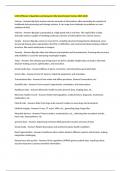
LCHI 478 Exam 2 Questions and Answers Fully Solved Latest Version 2025-2026
Volume - Answers Big data involves massive amounts of information, often exceeding the capacity of
traditional data processing and storage systems. It can range from terabytes to petabytes or even
exabytes of data.
Velocity - Answers Big data is generated at a high speed and in real time. This rapid influx of data
demands systems capable of handling continuous streams of information from various sources.
Variety - Answers Big data comes in many forms, including structured (organized in databases), semi-
structured (having some organization, like XML or JSON files), and unstructured data (lacking a defined
structure, like social media posts or images).
Veracity - Answers Big data often has inherent uncertainties and inconsistencies. Ensuring data accuracy
and reliability is crucial for extracting meaningful insights.
Value - Answers The ultimate goal of big data is to derive valuable insights that can lead to informed
decision-making, process optimization, and innovation.
Social media data - Answers Billions of posts, comments, and interactions generated daily.
Sensor data - Answers From IoT devices, industrial equipment, and wearables.
Transactional data - Answers From online and offline purchases, financial transactions, etc.
Scientific data - Answers From research experiments, simulations, and observations.
Healthcare data - Answers Electronic health records, genomic data, imaging data, etc.
Electronic health records - Answers Patient demographics, medical history, diagnoses, treatments,
medications, etc.
Clinical trials - Answers Data from large-scale research studies on new drugs and treatments
Medical imaging - Answers X-rays, CT scans, MRIs, etc., generating large image files
Wearable devices - Answers Fitness trackers, smartwatches, etc., collecting data on patient activity,
heart rate, sleep patterns, etc.
genomic data - Answers Sequencing of human DNA generates massive amounts of data
Social media - Answers Patient discussions and sentiments about health conditions
Data fragmentation - Answers Healthcare data is often siloed in different systems and formats, making
integration challenging
Data privacy and security - Answers Strict regulations (HIPAA) govern patient data, requiring robust
security measures to protect sensitive information
, Data quality and standardization - Answers Inconsistent data formats and terminologies can hinder data
analysis and interpretation
Data storage and processing - Answers Big data requires significant storage capacity and powerful
computing resources
Personalized medicine - Answers Tailoring treatments based on individual patient characteristics and
genetic makeup
Disease prediction and prevention - Answers Identifying high-risk individuals and enabling early
interventions
Population Health Management - Answers Analyzing large datasets to understand disease patterns and
improve public health
Drug discovery and development - Answers Accelerating the identification and development of new
medications
Clinical decision support - Answers Providing real-time insights to clinicians at the point of care
operational efficiency - Answers Optimizing resource allocation and improving hospital workflows
Mayo clinic - Answers Uses big data to predict patient outcomes and personalize treatments
Flatiron health - Answers Oncology data platform that helps accelerate cancer research
Google deepmind health - Answers AI-powered tools for diagnosing diseases and improving patient care
Continued growth - Answers The volume and complexity of healthcare data will keep increasing
Advanced analytics - Answers Machine learning and AI will play a crucial role in extracting insights
Patient empowerment - Answers Individuals will have more access and control over their health data
Ethical considerations - Answers Balancing innovation with patient privacy and data security will be
essential
Clinical trials - Answers ●Rigorous evaluation of new drugs, devices, and treatments.
●Statistics: Design, analysis, and interpretation of results.
●Key concepts: Randomization, blinding, sample size.
Epidemiology - Answers ●Study of health and disease patterns in populations.
●Statistics: Identification of risk factors and disease outbreaks.
Key concepts: Incidence, prevalence, odds ratio
Volume - Answers Big data involves massive amounts of information, often exceeding the capacity of
traditional data processing and storage systems. It can range from terabytes to petabytes or even
exabytes of data.
Velocity - Answers Big data is generated at a high speed and in real time. This rapid influx of data
demands systems capable of handling continuous streams of information from various sources.
Variety - Answers Big data comes in many forms, including structured (organized in databases), semi-
structured (having some organization, like XML or JSON files), and unstructured data (lacking a defined
structure, like social media posts or images).
Veracity - Answers Big data often has inherent uncertainties and inconsistencies. Ensuring data accuracy
and reliability is crucial for extracting meaningful insights.
Value - Answers The ultimate goal of big data is to derive valuable insights that can lead to informed
decision-making, process optimization, and innovation.
Social media data - Answers Billions of posts, comments, and interactions generated daily.
Sensor data - Answers From IoT devices, industrial equipment, and wearables.
Transactional data - Answers From online and offline purchases, financial transactions, etc.
Scientific data - Answers From research experiments, simulations, and observations.
Healthcare data - Answers Electronic health records, genomic data, imaging data, etc.
Electronic health records - Answers Patient demographics, medical history, diagnoses, treatments,
medications, etc.
Clinical trials - Answers Data from large-scale research studies on new drugs and treatments
Medical imaging - Answers X-rays, CT scans, MRIs, etc., generating large image files
Wearable devices - Answers Fitness trackers, smartwatches, etc., collecting data on patient activity,
heart rate, sleep patterns, etc.
genomic data - Answers Sequencing of human DNA generates massive amounts of data
Social media - Answers Patient discussions and sentiments about health conditions
Data fragmentation - Answers Healthcare data is often siloed in different systems and formats, making
integration challenging
Data privacy and security - Answers Strict regulations (HIPAA) govern patient data, requiring robust
security measures to protect sensitive information
, Data quality and standardization - Answers Inconsistent data formats and terminologies can hinder data
analysis and interpretation
Data storage and processing - Answers Big data requires significant storage capacity and powerful
computing resources
Personalized medicine - Answers Tailoring treatments based on individual patient characteristics and
genetic makeup
Disease prediction and prevention - Answers Identifying high-risk individuals and enabling early
interventions
Population Health Management - Answers Analyzing large datasets to understand disease patterns and
improve public health
Drug discovery and development - Answers Accelerating the identification and development of new
medications
Clinical decision support - Answers Providing real-time insights to clinicians at the point of care
operational efficiency - Answers Optimizing resource allocation and improving hospital workflows
Mayo clinic - Answers Uses big data to predict patient outcomes and personalize treatments
Flatiron health - Answers Oncology data platform that helps accelerate cancer research
Google deepmind health - Answers AI-powered tools for diagnosing diseases and improving patient care
Continued growth - Answers The volume and complexity of healthcare data will keep increasing
Advanced analytics - Answers Machine learning and AI will play a crucial role in extracting insights
Patient empowerment - Answers Individuals will have more access and control over their health data
Ethical considerations - Answers Balancing innovation with patient privacy and data security will be
essential
Clinical trials - Answers ●Rigorous evaluation of new drugs, devices, and treatments.
●Statistics: Design, analysis, and interpretation of results.
●Key concepts: Randomization, blinding, sample size.
Epidemiology - Answers ●Study of health and disease patterns in populations.
●Statistics: Identification of risk factors and disease outbreaks.
Key concepts: Incidence, prevalence, odds ratio


