

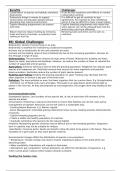
Benefits Challenges
Conservation of species and habitats maintains It can be very expensive and difficult to monitor
biodiversity. conservation scheme.
Ecotourism brings in money to support It is difficult to get all countries to sign
conservation and educates people without agreements, for example to stop overfishing,
disrupting their natural environment. and so it may be difficult to have a large impact.
Captive breeding programmes can prevent Captive breeding programmes may mean that
extinction. some species can not be released back into the
wild as they cant hunt efficiently.
Nature reserves reduce hunting by removing Removing tusks and horns can be seen as
tusks and horns of animals, so poachers have unethical.
nothing to hunt for.
B6: Global Challenges
Biodiversity: Variety of living things in an area.
Biodiversity is essential for maintaining a balanced ecosystem.
Humans rely on biodiversity for the raw materials we need.
Humans are the leading cause of loss of biodiversity due to the increasing population. Humans do
this through a range of ways:
Deforestation: The permanent removal of large areas of forest. Materials for building and fuels;
Space for roads, agriculture and buildings. However, we reduce the number of trees so reduced the
number of supported animal species.
Agriculture: Intensive farming of land to feed the growing population. Hedgerow loss reduces plant
species and hedgerows etc. Pesticides remove food sources for some organisms and possible
bioaccumulation. Herbicides reduce the number of plant species present.
Hunting and Fishing: Feeding the growing population or sport. Hunting may decrease food for
other organism or remove a key part of the food chain.
Pollution: The more polluted an area, the fewer organism that can survive there. E.g. Eutrophication
– Fertilisers run off fields onto rivers and lakes. This leads to an algal bloom which blocks light so
plants in the river die. As they decomposed by microorganisms, the oxygen level drop leading to fish
death.
Increasing Biodiversity:
Endangered Species: Low numbers of the species left, at risk of extinction (All members of the
species are dead)
Conservation: Protecting a natural environment to ensure that habitats are not lost. Uses active
management of habitats. Resources can be still used in a sustainable way.
- Creating Nature Reserves. E.g. Marine, aquatic.
- Active Management: Controlled grazing, Restricted human access, Feeding animals, Reintroduction
of species.
- Captive breeding programs aim to:
• Create a stable and healthy population of a species
• Gradually reintroduce the species into the natural habitat
Problems: Maintaining genetic diversity may be difficult due to few breeding partners, Organisms
born in captivity may not be suitable for release.
-Seed Banks: Conserve pants, Seeds are stored to allow the plant to be grown in the future. They are
examples of a gene bank as they store genetic material.
Environmental changes affect the distribution of species in an ecosystem:
• Temperature: Climate change may lead to insects migrating to places in the world which are
becoming hotter.
• Water availability: Populations will migrate to find water.
• Atmospheric gas composition: Certain pollutants can affect the distribution of organisms, e.g.
lichen cannot grow in places where sulphur dioxide is present.
Feeding the human race:
, Food Security is the ability of human populations to access affordable food of sufficient quality and
quantity.
Factors that threaten food security:
• Increasing population of humans.
• Changing diets – more varied and more meat
• Climate change – drought; expanding deserts
• New pathogens/ pests evolve.
The area we have to produce food is limited.
To maximise production:
- Maximising photosynthesis – Glasshouse used that control light intensity, temperature and water.
- Use fertilisers, replacing lost minerals.
- Remove competition and pests, Herbicides, fungicides, insecticides.
Intensive farming: Using techniques to produce the maximum yield of food from the minimum area
of land by:
- Using fertilisers and pesticides
- Maximise animal growth rates
- Minimise labour by using machinery
Organic farming: Using natural methods of producing crops and animals avoiding the use of
chemicals.
Sustainable food production: Producing food in ways that can be continued indefinitely.
Hydroponics: Growing crops in glasshouses by replacing soil with a mineral solution, allowing for
careful control of growth by adjusting temperature etc.
Biological control: release a natural predator into the area where crops are being grown. However,
may affect other organisms in the food web and the predator might by hard to control.
Gene technology: modifying crops or animals to have better yields, e.g. plants producing bigger
fruits.
Herbicides: Used to get rid of competing plants so that the maximum amount of energy and mass
is conserved. However, reduces biodiversity and may have unintentional health consequences.
Insecticides and pesticides: Get rid of animals that eat the crops so that the maximum amount of
energy and mass is conserved. However, reduces biodiversity, may pass up the food chain to birds
and may have unintentional health consequences.
Selective Breeding: the process when humans breed certain plants or animals which have desirable
characteristics.
Process:
1. Select individuals with desirable characteristics and breed together.
2. Choose the best offsprings and breed them together.
3. Repeat process over many generations until all the offsprings have the desired characteristics.
Desirable characteristics in a plant: disease resistance, large flower, large fruits.
Desirable characteristics in animals: animals producing lots of meat, chickens that lay large eggs.
Advantages Disadvantages
Can produce varieties that can produce more of Reduced gene pool – leads organisms
better-quality food to meet the demands of a vulnerable to new pathogens and can increases
growing population. chances of inherited recessive defects.
Can create animals that are more gentle, e.g. Unforeseen physical problems, e.g. large
domestic dogs chickens are sometimes unable to walk.
Genetic Engineering: process where the genome of an organism is modified by introducing desirable
characteristics.
Process:
1. Genes from chromosomes are “cut out” using restriction enzymes leaving ‘sticky ends’.
2. A virus or bacterial plasmid is cut using the same restriction enzyme to also create stick ends. This
also contains an antibiotic marker gene.
Conservation of species and habitats maintains It can be very expensive and difficult to monitor
biodiversity. conservation scheme.
Ecotourism brings in money to support It is difficult to get all countries to sign
conservation and educates people without agreements, for example to stop overfishing,
disrupting their natural environment. and so it may be difficult to have a large impact.
Captive breeding programmes can prevent Captive breeding programmes may mean that
extinction. some species can not be released back into the
wild as they cant hunt efficiently.
Nature reserves reduce hunting by removing Removing tusks and horns can be seen as
tusks and horns of animals, so poachers have unethical.
nothing to hunt for.
B6: Global Challenges
Biodiversity: Variety of living things in an area.
Biodiversity is essential for maintaining a balanced ecosystem.
Humans rely on biodiversity for the raw materials we need.
Humans are the leading cause of loss of biodiversity due to the increasing population. Humans do
this through a range of ways:
Deforestation: The permanent removal of large areas of forest. Materials for building and fuels;
Space for roads, agriculture and buildings. However, we reduce the number of trees so reduced the
number of supported animal species.
Agriculture: Intensive farming of land to feed the growing population. Hedgerow loss reduces plant
species and hedgerows etc. Pesticides remove food sources for some organisms and possible
bioaccumulation. Herbicides reduce the number of plant species present.
Hunting and Fishing: Feeding the growing population or sport. Hunting may decrease food for
other organism or remove a key part of the food chain.
Pollution: The more polluted an area, the fewer organism that can survive there. E.g. Eutrophication
– Fertilisers run off fields onto rivers and lakes. This leads to an algal bloom which blocks light so
plants in the river die. As they decomposed by microorganisms, the oxygen level drop leading to fish
death.
Increasing Biodiversity:
Endangered Species: Low numbers of the species left, at risk of extinction (All members of the
species are dead)
Conservation: Protecting a natural environment to ensure that habitats are not lost. Uses active
management of habitats. Resources can be still used in a sustainable way.
- Creating Nature Reserves. E.g. Marine, aquatic.
- Active Management: Controlled grazing, Restricted human access, Feeding animals, Reintroduction
of species.
- Captive breeding programs aim to:
• Create a stable and healthy population of a species
• Gradually reintroduce the species into the natural habitat
Problems: Maintaining genetic diversity may be difficult due to few breeding partners, Organisms
born in captivity may not be suitable for release.
-Seed Banks: Conserve pants, Seeds are stored to allow the plant to be grown in the future. They are
examples of a gene bank as they store genetic material.
Environmental changes affect the distribution of species in an ecosystem:
• Temperature: Climate change may lead to insects migrating to places in the world which are
becoming hotter.
• Water availability: Populations will migrate to find water.
• Atmospheric gas composition: Certain pollutants can affect the distribution of organisms, e.g.
lichen cannot grow in places where sulphur dioxide is present.
Feeding the human race:
, Food Security is the ability of human populations to access affordable food of sufficient quality and
quantity.
Factors that threaten food security:
• Increasing population of humans.
• Changing diets – more varied and more meat
• Climate change – drought; expanding deserts
• New pathogens/ pests evolve.
The area we have to produce food is limited.
To maximise production:
- Maximising photosynthesis – Glasshouse used that control light intensity, temperature and water.
- Use fertilisers, replacing lost minerals.
- Remove competition and pests, Herbicides, fungicides, insecticides.
Intensive farming: Using techniques to produce the maximum yield of food from the minimum area
of land by:
- Using fertilisers and pesticides
- Maximise animal growth rates
- Minimise labour by using machinery
Organic farming: Using natural methods of producing crops and animals avoiding the use of
chemicals.
Sustainable food production: Producing food in ways that can be continued indefinitely.
Hydroponics: Growing crops in glasshouses by replacing soil with a mineral solution, allowing for
careful control of growth by adjusting temperature etc.
Biological control: release a natural predator into the area where crops are being grown. However,
may affect other organisms in the food web and the predator might by hard to control.
Gene technology: modifying crops or animals to have better yields, e.g. plants producing bigger
fruits.
Herbicides: Used to get rid of competing plants so that the maximum amount of energy and mass
is conserved. However, reduces biodiversity and may have unintentional health consequences.
Insecticides and pesticides: Get rid of animals that eat the crops so that the maximum amount of
energy and mass is conserved. However, reduces biodiversity, may pass up the food chain to birds
and may have unintentional health consequences.
Selective Breeding: the process when humans breed certain plants or animals which have desirable
characteristics.
Process:
1. Select individuals with desirable characteristics and breed together.
2. Choose the best offsprings and breed them together.
3. Repeat process over many generations until all the offsprings have the desired characteristics.
Desirable characteristics in a plant: disease resistance, large flower, large fruits.
Desirable characteristics in animals: animals producing lots of meat, chickens that lay large eggs.
Advantages Disadvantages
Can produce varieties that can produce more of Reduced gene pool – leads organisms
better-quality food to meet the demands of a vulnerable to new pathogens and can increases
growing population. chances of inherited recessive defects.
Can create animals that are more gentle, e.g. Unforeseen physical problems, e.g. large
domestic dogs chickens are sometimes unable to walk.
Genetic Engineering: process where the genome of an organism is modified by introducing desirable
characteristics.
Process:
1. Genes from chromosomes are “cut out” using restriction enzymes leaving ‘sticky ends’.
2. A virus or bacterial plasmid is cut using the same restriction enzyme to also create stick ends. This
also contains an antibiotic marker gene.


