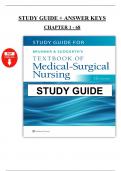
STUDY GUIDE + ANSWER KEYS
CHAPTER 1 - 68
STUDY GUIDE
,TABLE OF CONTENTS
o UNIT 1 Principles of Nursing Practice
o Chapter 1 Professional Nursing Practice
o Chapter 2 Medical-Surgical Nursing
o Chapter 3 Health Education and Health Promotion
o Chapter 4 Adult Health and Physical, Nutritional, and Cultural Assessment
o Chapter 5 Stress and Inflammatory Responses
o Chapter 6 Genetics and Genomics in Nursing
o Chapter 7 Disability and Chronic Illness
o Chapter 8 Management of the Older Adult Patient
o UNIT 2 Concepts and Principles of Patient Management
o Chapter 9 Pain Management
o Chapter 10 Fluid and Electrolytes
o Chapter 11 Shock, Sepsis, and Multiple Organ Dysfunction Syndrome
o Chapter 12 Oncologic Management
o Chapter 13 Palliative and End-of-Life Care
o UNIT 3 Perioperative Concepts and Nursing Management
o Chapter 14 Preoperative Nursing Management
o Chapter 15 Intraoperative Nursing Management
o Chapter 16 Postoperative Nursing Management
o UNIT 4 Gas Exchange and Respiratory Function
o Chapter 17 Assessment of Respiratory Function
o Chapter 18 Management of Patients With Upper Respiratory Tract
Disorders
o Chapter 19 Management of Patients With Chest and Lower Respiratory Tract
Disorders
o Chapter 20 Management of Patients With Chronic Pulmonary Disease
o UNIT 5 Cardiovascular and Circulatory Function
o Chapter 21 Assessment of Cardiovascular Function
o Chapter 22 Management of Patients With Arrhythmias and Conduction
Problems
o Chapter 23 Management of Patients With Coronary Vascular Disorders
o Chapter 24 Management of Patients With Structural, Infectious, and
Inflammatory Cardiac Disorders
o Chapter 25 Management of Patients With Complications From Heart Disease
o Chapter 26 Assessment and Management of Patients With Vascular
Disorders and Problems of Peripheral Circulation
o Chapter 27 Assessment and Management of Patients With Hypertension
,o UNIT 6 Hematologic Function
o Chapter 28 Assessment of Hematologic Function and Treatment Modalities
o Chapter 29 Management of Patients With Nonmalignant Hematologic
Disorders
o Chapter 30 Management of Patients With Hematologic Neoplasms
o UNIT 7 Immunologic Function
o Chapter 31 Assessment of Immune Function
o Chapter 32 Management of Patients With Immune Deficiency Disorders
o Chapter 33 Assessment and Management of Patients With Allergic Disorders
o Chapter 34 Assessment and Management of Patients With Inflammatory
Rheumatic Disorders
o UNIT 8 Musculoskeletal Function
o Chapter 35 Assessment of Musculoskeletal Function
o Chapter 36 Management of Patients With Musculoskeletal Disorders
o Chapter 37 Management of Patients With Musculoskeletal Trauma
o UNIT 9 Digestive and Gastrointestinal Function
o Chapter 38 Assessment of Digestive and Gastrointestinal Function
o Chapter 39 Management of Patients With Oral and Esophageal Disorders
o Chapter 40 Management of Patients With Gastric and Duodenal Disorders
o Chapter 41 Management of Patients With Intestinal and Rectal Disorders
o UNIT 10 Metabolic and Endocrine Function
o Chapter 42 Assessment and Management of Patients With Obesity
o Chapter 43 Assessment and Management of Patients With Hepatic Disorders
o Chapter 44 Management of Patients With Biliary Disorders
o Chapter 45 Assessment and Management of Patients With Endocrine
Disorders
o Chapter 46 Management of Patients With Diabetes
o UNIT 11 Kidney and Urinary Tract Function
o Chapter 47 Assessment of Kidney and Urinary Function
o Chapter 48 Management of Patients With Kidney Disorders
o Chapter 49 Management of Patients With Urinary Disorders
o UNIT 12 Reproductive Function
o Chapter 50 Assessment and Management of Patients With Female
Physiologic Processes
o Chapter 51 Management of Patients With Female Reproductive Disorders
o Chapter 52 Assessment and Management of Patients With Breast Disorders
o Chapter 53 Assessment and Management of Patients With Male
Reproductive Disorders
o Chapter 54 Assessment and Management of Patients Who Are LGBTQ
o UNIT 13 Integumentary Function
, o Chapter 55 Assessment of Integumentary Function
o Chapter 56 Management of Patients With Dermatologic Disorders
o Chapter 57 Management of Patients With Burn Injury
o UNIT 14 Sensory Function
o Chapter 58 Assessment and Management of Patients With Eye and Vision
Disorders
o Chapter 59 Assessment and Management of Patients With Hearing and
Balance Disorders
o UNIT 15 Neurologic Function
o Chapter 60 Assessment of Neurologic Function
o Chapter 61 Management of Patients With Neurologic Dysfunction
o Chapter 62 Management of Patients With Cerebrovascular Disorders
o Chapter 63 Management of Patients With Neurologic Trauma
o Chapter 64 Management of Patients With Neurologic Infections,
Autoimmune Disorders, and Neuropathies
o Chapter 65 Management of Patients With Oncologic or Degenerative
Neurologic Disorders
o UNIT 16 Acute Community Based Challenges
o Chapter 66 Management of Patients With Infectious Diseases
o Chapter 67 Emergency Nursing
o Chapter 68 Disaster Nursing
o ANSWERS
, Preface
This Study Guide was developed by Leigh W. Moore, MSN, RN,
CNOR, CNE, to accompany Brunner and Suddarth’s Textbook of
Medical-Surgical Nursing, 15th Edition, by Janice L. Hinkle, Kerry H.
Cheever, and Kristen
J. Overbaugh. The Study Guide is designed to help you review and
apply important concepts from the textbook to prepare for exams
as well as for your nursing career. The following types of exercises
are provided in each chapter of the Study Guide.
ASSESSING YOUR UNDERSTANDING
The first section of each Study Guide chapter reviews the basic
information of the textbook chapter and helps you to remember key
concepts, vocabulary, and principles.
Fill in the Blanks: Fill-in-the-blank exercises test important chapter
information, encouraging you to recall key points.
Short Answers: Short-answer questions cover facts, concepts,
procedures, and principles of the chapter. These questions ask
you to recall information as well as demonstrate your
comprehension of the information.
Matching: Matching questions test your knowledge of the definition
of key terms.
Labeling: Labeling exercises are used where you need to
remember certain visual representations of the concepts
presented in the textbook.
Sequencing: Sequencing exercises ask you to remember
particular sequences or orders, such as in normal or abnormal
physiologic processes.
,APPLYING YOUR KNOWLEDGE
The second section of each Study Guide chapter consists of case
study– based exercises that ask you to begin to apply the
knowledge you gained from the textbook chapter that was
reinforced in the first section of the Study Guide chapter. A case
study scenario based on the chapter’s content is presented,
followed by related short-answer questions. The questions could
cover topics such as lab values, next steps in nursing care, and
anticipated diagnoses.
PRACTICING FOR NCLEX
The third and final section of each Study Guide chapter helps you
practice NCLEX-style questions while further applying the
knowledge you have gained and reinforced through reading the
textbook chapter and completing the first two sections of the Study
Guide chapter. Including both multiple- choice and alternate-item
formats, the questions are scenario based, asking you to reflect,
consider, and apply what you know and to choose the best answer
out of those offered.
ANSWERS
The answers for all of the exercises and questions in the Study
Guide are provided at the back of the book, so you can assess
your own learning as you complete each chapter.
We hope that you will find this Study Guide to be helpful and
enjoyable, and we wish you every success in your studies and future
profession.
The Publisher
, UNIT
1
Principles of Nursing
Practice
, CHAPTER
1
Professional Nursing Practice
Learning Outcomes
1. Define nursing, patient, health, wellness, health promotion, and
health care.
2. Describe salient influences on the delivery of health care.
3. Discuss practices that improve quality and safety and ensure
the use of evidence-based practices within the health care
system.
4. Discuss behavioral competencies and characteristics of
professional nursing practice and the nurse’s role as a
collaborative member of the interprofessional health care
team.
5. Define the characteristics of critical thinking, the critical
thinking process, and clinical decision making.
6. Describe the components of the nursing process.
7. Identify strategies that can be implemented in ethical decision
making.
,SECTION I: ASSESSING YOUR
UNDERSTANDING
Activity A Fill in the blanks.
1. Quality and Safety Education for Nurses (QSEN) prepares future
nurses with the , , and to continuously
improve the quality and safety of the health care system.
2. Chronic diseases that account for 7 out of 10 leading causes
of death include , , , and .
3. When the nurse is performing an assessment for a patient: ,
, and will be used to determine the health
status and any actual or potential health problems.
4. Moral integrity is a virtue that is composed of , ,
, , and .
Activity B Briefly answer the following.
1. Wellness involves proactively working toward physical,
psychological, and spiritual well-being. Four components of
wellness are
2. List four significant changes that have impacted health care
delivery and the practice of nursing.
, 3. Choose four health and illness problems and write a human
response to each that would require nursing intervention. An
example is provided.
Health and Illness Problems Human Response Requiring Nursing Intervention
Fractured right arm (Example) Self-care limitations (Example)
1.
2.
3.
4.
4. The nursing process is a deliberate problem-solving approach for
meeting people’s health care and nursing needs. List the common
components of the nursing process in order:
1.
2.
3.
4.
5.
5. List Maslow hierarchy of needs, and give an example for each
need. The first need is provided as an example.
Need Example
Physiologic (Example) Food and water (Example)
CHAPTER 1 - 68
STUDY GUIDE
,TABLE OF CONTENTS
o UNIT 1 Principles of Nursing Practice
o Chapter 1 Professional Nursing Practice
o Chapter 2 Medical-Surgical Nursing
o Chapter 3 Health Education and Health Promotion
o Chapter 4 Adult Health and Physical, Nutritional, and Cultural Assessment
o Chapter 5 Stress and Inflammatory Responses
o Chapter 6 Genetics and Genomics in Nursing
o Chapter 7 Disability and Chronic Illness
o Chapter 8 Management of the Older Adult Patient
o UNIT 2 Concepts and Principles of Patient Management
o Chapter 9 Pain Management
o Chapter 10 Fluid and Electrolytes
o Chapter 11 Shock, Sepsis, and Multiple Organ Dysfunction Syndrome
o Chapter 12 Oncologic Management
o Chapter 13 Palliative and End-of-Life Care
o UNIT 3 Perioperative Concepts and Nursing Management
o Chapter 14 Preoperative Nursing Management
o Chapter 15 Intraoperative Nursing Management
o Chapter 16 Postoperative Nursing Management
o UNIT 4 Gas Exchange and Respiratory Function
o Chapter 17 Assessment of Respiratory Function
o Chapter 18 Management of Patients With Upper Respiratory Tract
Disorders
o Chapter 19 Management of Patients With Chest and Lower Respiratory Tract
Disorders
o Chapter 20 Management of Patients With Chronic Pulmonary Disease
o UNIT 5 Cardiovascular and Circulatory Function
o Chapter 21 Assessment of Cardiovascular Function
o Chapter 22 Management of Patients With Arrhythmias and Conduction
Problems
o Chapter 23 Management of Patients With Coronary Vascular Disorders
o Chapter 24 Management of Patients With Structural, Infectious, and
Inflammatory Cardiac Disorders
o Chapter 25 Management of Patients With Complications From Heart Disease
o Chapter 26 Assessment and Management of Patients With Vascular
Disorders and Problems of Peripheral Circulation
o Chapter 27 Assessment and Management of Patients With Hypertension
,o UNIT 6 Hematologic Function
o Chapter 28 Assessment of Hematologic Function and Treatment Modalities
o Chapter 29 Management of Patients With Nonmalignant Hematologic
Disorders
o Chapter 30 Management of Patients With Hematologic Neoplasms
o UNIT 7 Immunologic Function
o Chapter 31 Assessment of Immune Function
o Chapter 32 Management of Patients With Immune Deficiency Disorders
o Chapter 33 Assessment and Management of Patients With Allergic Disorders
o Chapter 34 Assessment and Management of Patients With Inflammatory
Rheumatic Disorders
o UNIT 8 Musculoskeletal Function
o Chapter 35 Assessment of Musculoskeletal Function
o Chapter 36 Management of Patients With Musculoskeletal Disorders
o Chapter 37 Management of Patients With Musculoskeletal Trauma
o UNIT 9 Digestive and Gastrointestinal Function
o Chapter 38 Assessment of Digestive and Gastrointestinal Function
o Chapter 39 Management of Patients With Oral and Esophageal Disorders
o Chapter 40 Management of Patients With Gastric and Duodenal Disorders
o Chapter 41 Management of Patients With Intestinal and Rectal Disorders
o UNIT 10 Metabolic and Endocrine Function
o Chapter 42 Assessment and Management of Patients With Obesity
o Chapter 43 Assessment and Management of Patients With Hepatic Disorders
o Chapter 44 Management of Patients With Biliary Disorders
o Chapter 45 Assessment and Management of Patients With Endocrine
Disorders
o Chapter 46 Management of Patients With Diabetes
o UNIT 11 Kidney and Urinary Tract Function
o Chapter 47 Assessment of Kidney and Urinary Function
o Chapter 48 Management of Patients With Kidney Disorders
o Chapter 49 Management of Patients With Urinary Disorders
o UNIT 12 Reproductive Function
o Chapter 50 Assessment and Management of Patients With Female
Physiologic Processes
o Chapter 51 Management of Patients With Female Reproductive Disorders
o Chapter 52 Assessment and Management of Patients With Breast Disorders
o Chapter 53 Assessment and Management of Patients With Male
Reproductive Disorders
o Chapter 54 Assessment and Management of Patients Who Are LGBTQ
o UNIT 13 Integumentary Function
, o Chapter 55 Assessment of Integumentary Function
o Chapter 56 Management of Patients With Dermatologic Disorders
o Chapter 57 Management of Patients With Burn Injury
o UNIT 14 Sensory Function
o Chapter 58 Assessment and Management of Patients With Eye and Vision
Disorders
o Chapter 59 Assessment and Management of Patients With Hearing and
Balance Disorders
o UNIT 15 Neurologic Function
o Chapter 60 Assessment of Neurologic Function
o Chapter 61 Management of Patients With Neurologic Dysfunction
o Chapter 62 Management of Patients With Cerebrovascular Disorders
o Chapter 63 Management of Patients With Neurologic Trauma
o Chapter 64 Management of Patients With Neurologic Infections,
Autoimmune Disorders, and Neuropathies
o Chapter 65 Management of Patients With Oncologic or Degenerative
Neurologic Disorders
o UNIT 16 Acute Community Based Challenges
o Chapter 66 Management of Patients With Infectious Diseases
o Chapter 67 Emergency Nursing
o Chapter 68 Disaster Nursing
o ANSWERS
, Preface
This Study Guide was developed by Leigh W. Moore, MSN, RN,
CNOR, CNE, to accompany Brunner and Suddarth’s Textbook of
Medical-Surgical Nursing, 15th Edition, by Janice L. Hinkle, Kerry H.
Cheever, and Kristen
J. Overbaugh. The Study Guide is designed to help you review and
apply important concepts from the textbook to prepare for exams
as well as for your nursing career. The following types of exercises
are provided in each chapter of the Study Guide.
ASSESSING YOUR UNDERSTANDING
The first section of each Study Guide chapter reviews the basic
information of the textbook chapter and helps you to remember key
concepts, vocabulary, and principles.
Fill in the Blanks: Fill-in-the-blank exercises test important chapter
information, encouraging you to recall key points.
Short Answers: Short-answer questions cover facts, concepts,
procedures, and principles of the chapter. These questions ask
you to recall information as well as demonstrate your
comprehension of the information.
Matching: Matching questions test your knowledge of the definition
of key terms.
Labeling: Labeling exercises are used where you need to
remember certain visual representations of the concepts
presented in the textbook.
Sequencing: Sequencing exercises ask you to remember
particular sequences or orders, such as in normal or abnormal
physiologic processes.
,APPLYING YOUR KNOWLEDGE
The second section of each Study Guide chapter consists of case
study– based exercises that ask you to begin to apply the
knowledge you gained from the textbook chapter that was
reinforced in the first section of the Study Guide chapter. A case
study scenario based on the chapter’s content is presented,
followed by related short-answer questions. The questions could
cover topics such as lab values, next steps in nursing care, and
anticipated diagnoses.
PRACTICING FOR NCLEX
The third and final section of each Study Guide chapter helps you
practice NCLEX-style questions while further applying the
knowledge you have gained and reinforced through reading the
textbook chapter and completing the first two sections of the Study
Guide chapter. Including both multiple- choice and alternate-item
formats, the questions are scenario based, asking you to reflect,
consider, and apply what you know and to choose the best answer
out of those offered.
ANSWERS
The answers for all of the exercises and questions in the Study
Guide are provided at the back of the book, so you can assess
your own learning as you complete each chapter.
We hope that you will find this Study Guide to be helpful and
enjoyable, and we wish you every success in your studies and future
profession.
The Publisher
, UNIT
1
Principles of Nursing
Practice
, CHAPTER
1
Professional Nursing Practice
Learning Outcomes
1. Define nursing, patient, health, wellness, health promotion, and
health care.
2. Describe salient influences on the delivery of health care.
3. Discuss practices that improve quality and safety and ensure
the use of evidence-based practices within the health care
system.
4. Discuss behavioral competencies and characteristics of
professional nursing practice and the nurse’s role as a
collaborative member of the interprofessional health care
team.
5. Define the characteristics of critical thinking, the critical
thinking process, and clinical decision making.
6. Describe the components of the nursing process.
7. Identify strategies that can be implemented in ethical decision
making.
,SECTION I: ASSESSING YOUR
UNDERSTANDING
Activity A Fill in the blanks.
1. Quality and Safety Education for Nurses (QSEN) prepares future
nurses with the , , and to continuously
improve the quality and safety of the health care system.
2. Chronic diseases that account for 7 out of 10 leading causes
of death include , , , and .
3. When the nurse is performing an assessment for a patient: ,
, and will be used to determine the health
status and any actual or potential health problems.
4. Moral integrity is a virtue that is composed of , ,
, , and .
Activity B Briefly answer the following.
1. Wellness involves proactively working toward physical,
psychological, and spiritual well-being. Four components of
wellness are
2. List four significant changes that have impacted health care
delivery and the practice of nursing.
, 3. Choose four health and illness problems and write a human
response to each that would require nursing intervention. An
example is provided.
Health and Illness Problems Human Response Requiring Nursing Intervention
Fractured right arm (Example) Self-care limitations (Example)
1.
2.
3.
4.
4. The nursing process is a deliberate problem-solving approach for
meeting people’s health care and nursing needs. List the common
components of the nursing process in order:
1.
2.
3.
4.
5.
5. List Maslow hierarchy of needs, and give an example for each
need. The first need is provided as an example.
Need Example
Physiologic (Example) Food and water (Example)