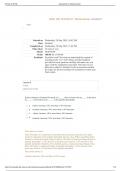
5/31/25, 8:05 PM Assessment 2: Attempt review
UNISA 2025 ECS1500-25-Y Welcome Message Assessment 2
QUIZ
Started on Wednesday, 28 May 2025, 10:42 PM
State Finished
Completed on Wednesday, 28 May 2025, 11:08 PM
Time taken 25 mins 41 secs
Marks 40.00/40.00
Grade 100.00 out of 100.00
Feedback Excellent work! You seem to understand the content of
Learning Units 3 to 5 well. Please read the feedback
provided for each question carefully and make sure you
agree with the explanations provided. Note that you are
allowed to submit 3 attempts for this assessment and that
the marks for the best attempt will contribute towards your
final credits.
Question 1
Correct
Mark 2.00 out of 2.00
If price elasticity of demand for good A is _____ then we know that an ____ in the price
by ______will result in a/an _____ in the quantity demanded.
a. elastic; increase; 10%; less than a 10% decrease
b. inelastic; decrease; 10%; more than a 10% decrease
c. elastic; increase; 10%; more than a 10% increase
d. inelastic; decrease; 10%; less than a 10% increase
Your answer is correct.
In the first place, it is important to remember that an increase in the price of a good
results in a decrease in the quantity demanded and vice versa. When a good has elastic
demand, a certain percentage change in prices will realise a larger percentage change in
quantity demanded– a 10% decrease in the price may result in a 15% increase in the
quantity demanded. Similarly, for an inelastic good, a certain percentage change in the
price will realise a smaller percentage in quantity demanded– a 10% increase in the
price may result in a 5% decrease in the quantity demanded.
The correct answer is:
inelastic; decrease; 10%; less than a 10% increase
https://mymodules.dtls.unisa.ac.za/mod/quiz/review.php?attempt=27813685&cmid=1077676 1/15
, 5/31/25, 8:05 PM Assessment 2: Attempt review
Question 2
Correct
Mark 2.00 out of 2.00
Market clearing takes place when….
Select one or more:
a. supply equals quantity demanded
b. demand equals quantity supplied
c. quantity demanded equals quantity supplied
d. demand equals supply
Your answer is correct.
The market is in equilibrium when the quantity demanded is equal to the quantity
supplied. In other words, market equilibrium takes place at the price where the plans of
households (demanders) coincide with the plans of firms/producers (suppliers). At this
point none of the participants has any incentive to change their behaviour because they
are totally content with the situation. Refer to section 3.4 of the study guide.
Demand and supply can, by definition, not be equal as this will imply that the demand
and supply curves look the same, which is not true.
The correct answer is: quantity demanded equals quantity supplied
Question 3
Correct
Mark 2.00 out of 2.00
When measuring the price elasticity of the demand for coal, using tons instead of
kilogram, the price elasticity of the demand for coal will …
a. increase.
b. not be affected.
c. impossible to say what will happen to the price elasticity of demand.
d. decrease.
Your answer is correct.
The elasticity will not be affected. Elasticity is measured, using percentage changes;
therefore, the unit of measurement does not affect the size of elasticity.
The correct answer is:
not be affected.
https://mymodules.dtls.unisa.ac.za/mod/quiz/review.php?attempt=27813685&cmid=1077676 2/15
UNISA 2025 ECS1500-25-Y Welcome Message Assessment 2
QUIZ
Started on Wednesday, 28 May 2025, 10:42 PM
State Finished
Completed on Wednesday, 28 May 2025, 11:08 PM
Time taken 25 mins 41 secs
Marks 40.00/40.00
Grade 100.00 out of 100.00
Feedback Excellent work! You seem to understand the content of
Learning Units 3 to 5 well. Please read the feedback
provided for each question carefully and make sure you
agree with the explanations provided. Note that you are
allowed to submit 3 attempts for this assessment and that
the marks for the best attempt will contribute towards your
final credits.
Question 1
Correct
Mark 2.00 out of 2.00
If price elasticity of demand for good A is _____ then we know that an ____ in the price
by ______will result in a/an _____ in the quantity demanded.
a. elastic; increase; 10%; less than a 10% decrease
b. inelastic; decrease; 10%; more than a 10% decrease
c. elastic; increase; 10%; more than a 10% increase
d. inelastic; decrease; 10%; less than a 10% increase
Your answer is correct.
In the first place, it is important to remember that an increase in the price of a good
results in a decrease in the quantity demanded and vice versa. When a good has elastic
demand, a certain percentage change in prices will realise a larger percentage change in
quantity demanded– a 10% decrease in the price may result in a 15% increase in the
quantity demanded. Similarly, for an inelastic good, a certain percentage change in the
price will realise a smaller percentage in quantity demanded– a 10% increase in the
price may result in a 5% decrease in the quantity demanded.
The correct answer is:
inelastic; decrease; 10%; less than a 10% increase
https://mymodules.dtls.unisa.ac.za/mod/quiz/review.php?attempt=27813685&cmid=1077676 1/15
, 5/31/25, 8:05 PM Assessment 2: Attempt review
Question 2
Correct
Mark 2.00 out of 2.00
Market clearing takes place when….
Select one or more:
a. supply equals quantity demanded
b. demand equals quantity supplied
c. quantity demanded equals quantity supplied
d. demand equals supply
Your answer is correct.
The market is in equilibrium when the quantity demanded is equal to the quantity
supplied. In other words, market equilibrium takes place at the price where the plans of
households (demanders) coincide with the plans of firms/producers (suppliers). At this
point none of the participants has any incentive to change their behaviour because they
are totally content with the situation. Refer to section 3.4 of the study guide.
Demand and supply can, by definition, not be equal as this will imply that the demand
and supply curves look the same, which is not true.
The correct answer is: quantity demanded equals quantity supplied
Question 3
Correct
Mark 2.00 out of 2.00
When measuring the price elasticity of the demand for coal, using tons instead of
kilogram, the price elasticity of the demand for coal will …
a. increase.
b. not be affected.
c. impossible to say what will happen to the price elasticity of demand.
d. decrease.
Your answer is correct.
The elasticity will not be affected. Elasticity is measured, using percentage changes;
therefore, the unit of measurement does not affect the size of elasticity.
The correct answer is:
not be affected.
https://mymodules.dtls.unisa.ac.za/mod/quiz/review.php?attempt=27813685&cmid=1077676 2/15