
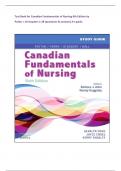
Test Bank for Canadian Fundamentals of Nursing 6th Edition by
Potter > all chapters 1-48 (questions & answers) A+ guide.
,Contents
Chapter 1, Introduction to Nursing ........................................................................................................... 4
Chapter 2, Theory, Research, and Evidence Based Practice ................................................................... 21
Chapter 3, Health, Illness, and Disparities .............................................................................................. 37
Chapter 4, Health of the Individual, Family, and Community................................................................. 53
Chapter 5, Cultural Diversity ................................................................................................................... 69
Chapter 6, Values, Ethics, and Advocacy ................................................................................................ 87
Chapter 7, Legal Dimensions of Nursing ............................................................................................... 105
Chapter 8 legal implications in nursing practice ................................................................................... 106
Chapter 9, Teaching and Counseling..................................................................................................... 140
Chapter 10, Leading, Managing and Care ............................................................................................. 156
Chapter 11, The Health Care Delivery System ...................................................................................... 173
Chapter 12, Collaborative Practice and Care Coordination Across Settings......................................... 189
Chapter 13, Blended Competencies ..................................................................................................... 206
Chapter 14, Assessing ........................................................................................................................... 223
Chapter 15, Diagnosing ......................................................................................................................... 240
Chapter 16, Outcome Identification and Planning ............................................................................... 256
Chapter 17, Implementing .................................................................................................................... 272
Chapter 18, Evaluating .......................................................................................................................... 290
Chapter 19, Documenting, Reporting, Conferring ................................................................................ 307
Chapter 20, Informatics ........................................................................................................................ 324
Chapter 21, Developing Concepts......................................................................................................... 330
Chapter 22, Conception Through Young Adult ..................................................................................... 349
Chapter 23, The Aging Adult ................................................................................................................. 365
Chapter 24, Asepsis and Infection Control ........................................................................................... 382
Chapter 25, Vital Signs .......................................................................................................................... 397
Chapter26, Health Assessment ............................................................................................................. 412
Chapter 27, Safety, Security, and Emergency Preparedness ................................................................ 428
Chapter 28, Complementary and Integrative Health ........................................................................... 445
Chapter 29, Medications....................................................................................................................... 461
Chapter 30, Perioperative Nursing ....................................................................................................... 479
Chapter 31,Hygiene .............................................................................................................................. 495
Chapter 32, Skin Integrity and Wound Care ......................................................................................... 511
,Chapter 33, Activity............................................................................................................................... 527
Chapter 34, Rest and Sleep ................................................................................................................... 542
Chapter 35, Comfort and Pain Management........................................................................................ 557
Chapter 36, Nutrition ............................................................................................................................ 572
Chapter 37, Urinary Elimination ........................................................................................................... 587
Chapter 38, Bowel Elimination ............................................................................................................. 603
Chapter 39, Oxygenation and Perfusion ............................................................................................... 619
Chapter 40, Fluid, Electrolyte, and Acid Base Balance.......................................................................... 635
Chapter 41, Self-Concept ...................................................................................................................... 650
Chapter 42, Stress and Adaptation ....................................................................................................... 668
Chapter 43, Loss, Grief, and Dying ........................................................................................................ 683
Chapter 44, Sensory Functioning .......................................................................................................... 698
Chapter 45, Sexuality ............................................................................................................................ 713
Chapter 46, Spirituality ......................................................................................................................... 729
,Chapter 1, Introduction to Nursing
An oncology nurse with 15 years of experience, certification in the area of oncology nursing, and a
master‘s degree is considered to be an expert in her area of practice and works on an oncology unit in
a large teaching hospital. Based upon this description, which of the following career roles best describes
this nurse‘s role, taking into account her
1. qualifications and experience?
A) Clinical nurse specialist
B) Nurse entrepreneur
C) Nurse practitioner
D) Nurse educator
Answer A
:
Feedback:
A clinical nurse specialist is a nurse with an advanced degree, education, or experience who is
considered to be an expert in a specialized area of nursing. The clinical nurse specialist carries out
direct patient care; consultation; teaching of patients, families, and staff; and research. A nurse
practitioner has an advanced degree and works in a variety of settings to deliver primary care. A
nurse educator usually has an advanced degree and teaches in the educational or clinical setting. A
nurse entrepreneur may manage a clinic or health-related business.
What guidelines do nurses follow to identify the patient‘s health care needs and strengths, to
2. establish and carry out a plan of care to meet those needs, and to evaluate the effectiveness of the
plan to meet established outcomes?
A) Nursing process
B) ANA Standards of Professional Performance
C) Evidence-based practice guidelines
D) Nurse Practice Acts
Answer
:A
,Feedback:
The nursing process is one of the major guidelines for nursing practice. Nurses implement their
roles through the nursing process. The nursing process is used by the nurse to identify the patient‘s
health care needs and strengths, to establish and carry out a plan of care to meet those needs, and
to evaluate the effectiveness of the plan to meet established outcomes.
Which of the following organizations is the best source of information when a nurse wishes to
3. determine whether an action is within the scope of nursing practice?
A) American Nurses Association (ANA)
B) American Association of Colleges in Nursing (AACN)
C) National League for Nursing (NLN)
D) International Council of Nurses (ICN)
Answer
:
A
Feedback:
The ANA produces the 2003 Nursing: Scope and Standards of Practice, which defines the activities
specific and unique to nursing. The AACN addresses educational standards, while the NLN promotes and
fosters various aspects of nursing.
The ICN provides a venue for national nursing organizations to collaborate, but does not define
standards and scope of practice.
4. Who is considered to be the founder of professional nursing?
A) Dorothea Dix
B) Lillian Wald
C) Florence Nightingale
D) Clara Barton
Answer: C
Feedback:
Florence Nightingale is considered to be the founder of professional nursing. She elevated the
status of nursing to a respected occupation, improved the quality of nursing care, and founded
, modern nursing education. Although the other choices are women who were important to the
development of nursing, none of them is considered the founder.
5. Which of the following nursing pioneers established the Red Cross in the United States in 1882?
A) Florence Nightingale
B) Clara Barton
C) Dorothea Dix
D) Jane Addams
Answer: B
Feedback:
Clara Barton volunteered to care for wounds and feed union soldiers during the civil war, served as
the supervisor of nurses for the Army of the James, organized hospitals and nurses, and established
the Red Cross in the United States in 1882.
A nurse practitioner is caring for a couple who are the parents of an infant diagnosed with Down
6. Syndrome. The nurse makes referrals for a parent support group for the family. This is an example
of which nursing role?
A) Teacher/Educator
B) Leader
C) Counselor
D) Collaborator
Answer: C
Feedback:
Counseling skills involve the use of therapeutic interpersonal communication skills to provide
information, make appropriate referrals, and facilitate the patient‘s problem-solving and decision-
making skills. The teacher/educator uses communication skills to assess, implement, and evaluate
individualized teaching plans were to meet learning needs of clients and their families. A leader displays
an assertive, self-confident practice of nursing when providing care, effecting change, and
functioning with groups. The collaborator uses skills in organization, communication, and
advocacy to facilitate the functions of all members of the health care team as they provide patient
care.
Potter > all chapters 1-48 (questions & answers) A+ guide.
,Contents
Chapter 1, Introduction to Nursing ........................................................................................................... 4
Chapter 2, Theory, Research, and Evidence Based Practice ................................................................... 21
Chapter 3, Health, Illness, and Disparities .............................................................................................. 37
Chapter 4, Health of the Individual, Family, and Community................................................................. 53
Chapter 5, Cultural Diversity ................................................................................................................... 69
Chapter 6, Values, Ethics, and Advocacy ................................................................................................ 87
Chapter 7, Legal Dimensions of Nursing ............................................................................................... 105
Chapter 8 legal implications in nursing practice ................................................................................... 106
Chapter 9, Teaching and Counseling..................................................................................................... 140
Chapter 10, Leading, Managing and Care ............................................................................................. 156
Chapter 11, The Health Care Delivery System ...................................................................................... 173
Chapter 12, Collaborative Practice and Care Coordination Across Settings......................................... 189
Chapter 13, Blended Competencies ..................................................................................................... 206
Chapter 14, Assessing ........................................................................................................................... 223
Chapter 15, Diagnosing ......................................................................................................................... 240
Chapter 16, Outcome Identification and Planning ............................................................................... 256
Chapter 17, Implementing .................................................................................................................... 272
Chapter 18, Evaluating .......................................................................................................................... 290
Chapter 19, Documenting, Reporting, Conferring ................................................................................ 307
Chapter 20, Informatics ........................................................................................................................ 324
Chapter 21, Developing Concepts......................................................................................................... 330
Chapter 22, Conception Through Young Adult ..................................................................................... 349
Chapter 23, The Aging Adult ................................................................................................................. 365
Chapter 24, Asepsis and Infection Control ........................................................................................... 382
Chapter 25, Vital Signs .......................................................................................................................... 397
Chapter26, Health Assessment ............................................................................................................. 412
Chapter 27, Safety, Security, and Emergency Preparedness ................................................................ 428
Chapter 28, Complementary and Integrative Health ........................................................................... 445
Chapter 29, Medications....................................................................................................................... 461
Chapter 30, Perioperative Nursing ....................................................................................................... 479
Chapter 31,Hygiene .............................................................................................................................. 495
Chapter 32, Skin Integrity and Wound Care ......................................................................................... 511
,Chapter 33, Activity............................................................................................................................... 527
Chapter 34, Rest and Sleep ................................................................................................................... 542
Chapter 35, Comfort and Pain Management........................................................................................ 557
Chapter 36, Nutrition ............................................................................................................................ 572
Chapter 37, Urinary Elimination ........................................................................................................... 587
Chapter 38, Bowel Elimination ............................................................................................................. 603
Chapter 39, Oxygenation and Perfusion ............................................................................................... 619
Chapter 40, Fluid, Electrolyte, and Acid Base Balance.......................................................................... 635
Chapter 41, Self-Concept ...................................................................................................................... 650
Chapter 42, Stress and Adaptation ....................................................................................................... 668
Chapter 43, Loss, Grief, and Dying ........................................................................................................ 683
Chapter 44, Sensory Functioning .......................................................................................................... 698
Chapter 45, Sexuality ............................................................................................................................ 713
Chapter 46, Spirituality ......................................................................................................................... 729
,Chapter 1, Introduction to Nursing
An oncology nurse with 15 years of experience, certification in the area of oncology nursing, and a
master‘s degree is considered to be an expert in her area of practice and works on an oncology unit in
a large teaching hospital. Based upon this description, which of the following career roles best describes
this nurse‘s role, taking into account her
1. qualifications and experience?
A) Clinical nurse specialist
B) Nurse entrepreneur
C) Nurse practitioner
D) Nurse educator
Answer A
:
Feedback:
A clinical nurse specialist is a nurse with an advanced degree, education, or experience who is
considered to be an expert in a specialized area of nursing. The clinical nurse specialist carries out
direct patient care; consultation; teaching of patients, families, and staff; and research. A nurse
practitioner has an advanced degree and works in a variety of settings to deliver primary care. A
nurse educator usually has an advanced degree and teaches in the educational or clinical setting. A
nurse entrepreneur may manage a clinic or health-related business.
What guidelines do nurses follow to identify the patient‘s health care needs and strengths, to
2. establish and carry out a plan of care to meet those needs, and to evaluate the effectiveness of the
plan to meet established outcomes?
A) Nursing process
B) ANA Standards of Professional Performance
C) Evidence-based practice guidelines
D) Nurse Practice Acts
Answer
:A
,Feedback:
The nursing process is one of the major guidelines for nursing practice. Nurses implement their
roles through the nursing process. The nursing process is used by the nurse to identify the patient‘s
health care needs and strengths, to establish and carry out a plan of care to meet those needs, and
to evaluate the effectiveness of the plan to meet established outcomes.
Which of the following organizations is the best source of information when a nurse wishes to
3. determine whether an action is within the scope of nursing practice?
A) American Nurses Association (ANA)
B) American Association of Colleges in Nursing (AACN)
C) National League for Nursing (NLN)
D) International Council of Nurses (ICN)
Answer
:
A
Feedback:
The ANA produces the 2003 Nursing: Scope and Standards of Practice, which defines the activities
specific and unique to nursing. The AACN addresses educational standards, while the NLN promotes and
fosters various aspects of nursing.
The ICN provides a venue for national nursing organizations to collaborate, but does not define
standards and scope of practice.
4. Who is considered to be the founder of professional nursing?
A) Dorothea Dix
B) Lillian Wald
C) Florence Nightingale
D) Clara Barton
Answer: C
Feedback:
Florence Nightingale is considered to be the founder of professional nursing. She elevated the
status of nursing to a respected occupation, improved the quality of nursing care, and founded
, modern nursing education. Although the other choices are women who were important to the
development of nursing, none of them is considered the founder.
5. Which of the following nursing pioneers established the Red Cross in the United States in 1882?
A) Florence Nightingale
B) Clara Barton
C) Dorothea Dix
D) Jane Addams
Answer: B
Feedback:
Clara Barton volunteered to care for wounds and feed union soldiers during the civil war, served as
the supervisor of nurses for the Army of the James, organized hospitals and nurses, and established
the Red Cross in the United States in 1882.
A nurse practitioner is caring for a couple who are the parents of an infant diagnosed with Down
6. Syndrome. The nurse makes referrals for a parent support group for the family. This is an example
of which nursing role?
A) Teacher/Educator
B) Leader
C) Counselor
D) Collaborator
Answer: C
Feedback:
Counseling skills involve the use of therapeutic interpersonal communication skills to provide
information, make appropriate referrals, and facilitate the patient‘s problem-solving and decision-
making skills. The teacher/educator uses communication skills to assess, implement, and evaluate
individualized teaching plans were to meet learning needs of clients and their families. A leader displays
an assertive, self-confident practice of nursing when providing care, effecting change, and
functioning with groups. The collaborator uses skills in organization, communication, and
advocacy to facilitate the functions of all members of the health care team as they provide patient
care.


