lOMoAR cPSD| 56342273
Parkinson's Disease
UNFOLDING Reasoning
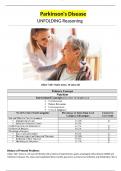
Lillian "Lilly" Marie Jones, 76 years old
History of Present Problem:
Lillian "Lilly" Jones is a 76-year-old female with a history of hypertension, gastro esophageal reflux disease (GERD) and
Parkinson's disease. Ms. Jones was hospitalized three months ago due to a urinary tract infection and dehydration. She is
, lOMoAR cPSD| 56342273
now a resident of Sunnyside Health Care Center, a local long-term care facility because her Parkinson's disease has
progressed and her son, Jack, is no longer able to care for her at home. Lilly has lost ten pounds (4.5 kg) in the past
month. She is 5 feet-6 inches (167.6 cm) weighs 110 pounds (49.9 kg) and has a BMI of 17.8. After one week of residing
at Sunnyside, Jack visits and is saddened when he finds his mother in her room alone. Jack approaches the nursing
station and states, "My mother is so thin and losing weight and sits just staring into space. I thought having her here was
going to help her get better!”
Personal/Social History:
Lilly was married to John for 54 years before he passed away two years ago. She has one son, Jack, who lives 30
minutes away. Jack has a medical power of attorney for Lilly's healthcare decisions. Lilly was a homemaker and an
active participant in her community. Her hobbies include knitting, playing the piano and reading. Lilly reluctantly has
agreed to go to Sunnyside Health Care Center after her son accepted a job that required him to travel.
What data from the histories are RELEVANT and must be interpreted as clinically significant by the nurse?
(Reduction of Risk Potential)
RELEVANT Data from Present Problem: Clinical Significance:
76-year-old female Physiological changes occur with aging in all organ systems.
Hx of hypertension, Hypertension increases the risk of heart disease, stroke, and other
cardiovascular disease
Hx of gastro esophageal reflux disease (GERD) GERD is a highly prevalent disease caused by the exposure of the esophagus to
refluxed gastric contents, PPIs are the mainstay of current treatment
Parkinson's disease The cardinal symptoms of Parkinson's disease are shaking, stiffness, and
slowness and poverty of movement. The condition leads to physical signs
including tremor at rest, rigidity on passive movement, slowness of movement
(bradykinesia), and poverty of movement (hypokinesia).
Lost ten pounds in the last month, 5 fett-6inches In patients with low body weight, the brain becomes starved and they can develop
weighs 110 lbs. and BMI of 17.8 symptoms that meet the criteria for depression. A BMI of 20-25 is ideal; 25-30 is
overweight and over 30 is obese. If the patient’s BMI is under 18.5, they
considered underweight
Son found his mother in her room alone staring into Chronic loneliness can have a significant impact on the overall health, including
space the mental health of the patient. Loneliness can increase the patient’s risk for
depression
RELEVANT Data from Social History: Clinical Significance:
Husband, John, passed away two years ago reluctantly agreed to go to Sunnyside Health Care Center after her son accepted
a job that required him to travel.
Coping with the death of a significant other isn’t easy. Grief can affect our
body, Medical power of attorney, the son Jack, lives 30 mind, emotions, and spirit. minutes away
A medical power of attorney is a legal document that names one person the
health care agent of another person. The agent has the ability to make health
care decisions and the responsibility to make sure doctors and other medical
personnel provide necessary and appropriate care according to the patient's
wishes. Due to the son living 30 mins away and at a new job it may be harder to
get a hold of him or take longer for him to get to the facility to make medical
Was a homemaker, an active participant in her decisions for his mother.
community, and had many hobbies. She
, lOMoAR cPSD| 56342273
Downloaded by Legit Actualexams ()
Knowing this can help show just how differently Abdomen: BS hypoactive in all four quadrants.
Lilly is acting now that she is at Sunnyside Health The patient’s slow response to questions and postural instability can be a
clinical Care Center. These changes in her behavior can be manifestation of her Parkinson Disease. Flat affect is a severe reduction in
a sign of depression. emotional expressiveness which can be a sign of depression, which can also be a Patient Care
Begins:
Current VS: P-Q-R-S-T Pain Assessment:
T: 98.4 F/36.9 C (oral) Provoking/Palliative: "Better when walking a while."
P: 90 (regular) Quality: "ache"
R: 14 (regular) Region/Radiation: "Knees"
BP: 112/70 Severity: "3/10"
Timing:
O2 sat: 98% room air "When I wake up."
What VS data are RELEVANT and must be interpreted as clinically significant by the nurse?
(Reduction of Risk Potential/Health Promotion and Maintenance)
RELEVANT VS Data: Clinical Significance:
Pain: aching knee pain 3/10 Pain is part of the body's defense system, producing a reflexive retraction from the painful
stimulus, and after waking, better when tendencies to protect the affected body part while it heals, and avoid that harmful
situation in the future. walking a while Joint pain is common with aging and can be difficult to differentiate from conditions
like Arthritis and Parkinson's.
Current Assessment:
GENERAL SURVEY: Alert, flat affect and slow to respond to questions in a soft tone (hypophonia). Oriented
and in no acute distress, dress appropriate for the season, hygiene and grooming
normal for age and gender. Sitting with a forward leaning posture.
NEUROLOGICAL: Alert & oriented to person, place, time, and situation (x4); muscle strength 4/5 in both
upper and lower extremities bilaterally. Tremors noted at rest in hands.
HEENT: Head normocephalic with the symmetry of all facial features, but tremor noted.
PERRLA, sclera white bilaterally, conjunctival sac pink bilaterally. Lips, tongue, and oral
mucosa pink and tacky dry.
RESPIRATORY: Breath sounds clear with equal aeration on inspiration and expiration in all lobes
anteriorly, posteriorly, and laterally, nonlabored respiratory effort on room air.
CARDIAC: Pink, warm & dry, no edema, heart sounds regular, pulses strong, equal with palpation
at radial/pedal/post-tibial landmarks, brisk cap refill. Heart tones audible and regular,
S1 and S2, noted over A-P-E-T-M cardiac landmarks with no abnormal beats or
murmurs. No JVD noted at 30-45 degrees.
ABDOMEN: Abdomen round, soft, and nontender. BS hypoactive in all four quadrants.
GU: Urinary Incontinent episode x1, urine yellow
(Reduction of Risk Potential/Health Promotion & Maintenance)
RELEVANT Assessment Data: Clinical Significance:
General: Alert, flat affect and slow to respond to nonmotor clinical manifestation of her Parkinson Disease
questions. Sitting with a forward leaning posture.
The patient’s tremor is most likely a motor clinical manifestation of her Parkinson
Disease
Neuro: Tremors noted at rest in hands.
The patient s lips, tongue, and oral mucosa is tacky dry. This can be caused by not
HEENT: tremor noted. Lips, tongue, and oral drinking enough fluids, sleeping with mouth open, dry hot weather, eating dry
mucosa pink and tacky dry. foods, or medication side effects.
Parkinson's Disease
UNFOLDING Reasoning
Lillian "Lilly" Marie Jones, 76 years old
History of Present Problem:
Lillian "Lilly" Jones is a 76-year-old female with a history of hypertension, gastro esophageal reflux disease (GERD) and
Parkinson's disease. Ms. Jones was hospitalized three months ago due to a urinary tract infection and dehydration. She is
, lOMoAR cPSD| 56342273
now a resident of Sunnyside Health Care Center, a local long-term care facility because her Parkinson's disease has
progressed and her son, Jack, is no longer able to care for her at home. Lilly has lost ten pounds (4.5 kg) in the past
month. She is 5 feet-6 inches (167.6 cm) weighs 110 pounds (49.9 kg) and has a BMI of 17.8. After one week of residing
at Sunnyside, Jack visits and is saddened when he finds his mother in her room alone. Jack approaches the nursing
station and states, "My mother is so thin and losing weight and sits just staring into space. I thought having her here was
going to help her get better!”
Personal/Social History:
Lilly was married to John for 54 years before he passed away two years ago. She has one son, Jack, who lives 30
minutes away. Jack has a medical power of attorney for Lilly's healthcare decisions. Lilly was a homemaker and an
active participant in her community. Her hobbies include knitting, playing the piano and reading. Lilly reluctantly has
agreed to go to Sunnyside Health Care Center after her son accepted a job that required him to travel.
What data from the histories are RELEVANT and must be interpreted as clinically significant by the nurse?
(Reduction of Risk Potential)
RELEVANT Data from Present Problem: Clinical Significance:
76-year-old female Physiological changes occur with aging in all organ systems.
Hx of hypertension, Hypertension increases the risk of heart disease, stroke, and other
cardiovascular disease
Hx of gastro esophageal reflux disease (GERD) GERD is a highly prevalent disease caused by the exposure of the esophagus to
refluxed gastric contents, PPIs are the mainstay of current treatment
Parkinson's disease The cardinal symptoms of Parkinson's disease are shaking, stiffness, and
slowness and poverty of movement. The condition leads to physical signs
including tremor at rest, rigidity on passive movement, slowness of movement
(bradykinesia), and poverty of movement (hypokinesia).
Lost ten pounds in the last month, 5 fett-6inches In patients with low body weight, the brain becomes starved and they can develop
weighs 110 lbs. and BMI of 17.8 symptoms that meet the criteria for depression. A BMI of 20-25 is ideal; 25-30 is
overweight and over 30 is obese. If the patient’s BMI is under 18.5, they
considered underweight
Son found his mother in her room alone staring into Chronic loneliness can have a significant impact on the overall health, including
space the mental health of the patient. Loneliness can increase the patient’s risk for
depression
RELEVANT Data from Social History: Clinical Significance:
Husband, John, passed away two years ago reluctantly agreed to go to Sunnyside Health Care Center after her son accepted
a job that required him to travel.
Coping with the death of a significant other isn’t easy. Grief can affect our
body, Medical power of attorney, the son Jack, lives 30 mind, emotions, and spirit. minutes away
A medical power of attorney is a legal document that names one person the
health care agent of another person. The agent has the ability to make health
care decisions and the responsibility to make sure doctors and other medical
personnel provide necessary and appropriate care according to the patient's
wishes. Due to the son living 30 mins away and at a new job it may be harder to
get a hold of him or take longer for him to get to the facility to make medical
Was a homemaker, an active participant in her decisions for his mother.
community, and had many hobbies. She
, lOMoAR cPSD| 56342273
Downloaded by Legit Actualexams ()
Knowing this can help show just how differently Abdomen: BS hypoactive in all four quadrants.
Lilly is acting now that she is at Sunnyside Health The patient’s slow response to questions and postural instability can be a
clinical Care Center. These changes in her behavior can be manifestation of her Parkinson Disease. Flat affect is a severe reduction in
a sign of depression. emotional expressiveness which can be a sign of depression, which can also be a Patient Care
Begins:
Current VS: P-Q-R-S-T Pain Assessment:
T: 98.4 F/36.9 C (oral) Provoking/Palliative: "Better when walking a while."
P: 90 (regular) Quality: "ache"
R: 14 (regular) Region/Radiation: "Knees"
BP: 112/70 Severity: "3/10"
Timing:
O2 sat: 98% room air "When I wake up."
What VS data are RELEVANT and must be interpreted as clinically significant by the nurse?
(Reduction of Risk Potential/Health Promotion and Maintenance)
RELEVANT VS Data: Clinical Significance:
Pain: aching knee pain 3/10 Pain is part of the body's defense system, producing a reflexive retraction from the painful
stimulus, and after waking, better when tendencies to protect the affected body part while it heals, and avoid that harmful
situation in the future. walking a while Joint pain is common with aging and can be difficult to differentiate from conditions
like Arthritis and Parkinson's.
Current Assessment:
GENERAL SURVEY: Alert, flat affect and slow to respond to questions in a soft tone (hypophonia). Oriented
and in no acute distress, dress appropriate for the season, hygiene and grooming
normal for age and gender. Sitting with a forward leaning posture.
NEUROLOGICAL: Alert & oriented to person, place, time, and situation (x4); muscle strength 4/5 in both
upper and lower extremities bilaterally. Tremors noted at rest in hands.
HEENT: Head normocephalic with the symmetry of all facial features, but tremor noted.
PERRLA, sclera white bilaterally, conjunctival sac pink bilaterally. Lips, tongue, and oral
mucosa pink and tacky dry.
RESPIRATORY: Breath sounds clear with equal aeration on inspiration and expiration in all lobes
anteriorly, posteriorly, and laterally, nonlabored respiratory effort on room air.
CARDIAC: Pink, warm & dry, no edema, heart sounds regular, pulses strong, equal with palpation
at radial/pedal/post-tibial landmarks, brisk cap refill. Heart tones audible and regular,
S1 and S2, noted over A-P-E-T-M cardiac landmarks with no abnormal beats or
murmurs. No JVD noted at 30-45 degrees.
ABDOMEN: Abdomen round, soft, and nontender. BS hypoactive in all four quadrants.
GU: Urinary Incontinent episode x1, urine yellow
(Reduction of Risk Potential/Health Promotion & Maintenance)
RELEVANT Assessment Data: Clinical Significance:
General: Alert, flat affect and slow to respond to nonmotor clinical manifestation of her Parkinson Disease
questions. Sitting with a forward leaning posture.
The patient’s tremor is most likely a motor clinical manifestation of her Parkinson
Disease
Neuro: Tremors noted at rest in hands.
The patient s lips, tongue, and oral mucosa is tacky dry. This can be caused by not
HEENT: tremor noted. Lips, tongue, and oral drinking enough fluids, sleeping with mouth open, dry hot weather, eating dry
mucosa pink and tacky dry. foods, or medication side effects.