Science Medicine Nursing
NR599 midterm
Save
Students also studied
Flashcard sets Study guides
Chamberlain NR599 Midterm NR599: Final Exam Cancer nclex questio
34 terms 45 terms 26 terms
Preview briana_hogan Preview Preview
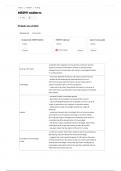
a specialty that integrates nursing science, computer science,
cognitive science, & information science to identify, define,
Nursing informatics
manage, & communicate data, information, knowledge & wisdom
in nursing practice
- 3 sources identified: (1) instinct, (2) reason, and (3) intuition.
- defined as the awareness & understanding of a set of
information & ways that information can be made useful to
Knowledge support a specific task or arrive at a decision.
- It abounds with others' thoughts & information or consists of
information that is synthesized so that relationships are identified
& formalized.
- valuable & viable knowledge applied
- application of knowledge to an appropriate situation
- uses knowledge & experience to heighten common sense &
insight to exercise sound judgment in practical matters.
- developed through knowledge, experience, insight, &
reflection
wisdom - sometimes thought of as the highest form of common sense,
resulting from accumulated knowledge or erudition (deep,
thorough learning) or enlightenment (education that results in
understanding & the dissemination of knowledge).
- the ability to apply valuable & viable knowledge, experience,
understanding, & insight while being prudent & sensible
- has been called the foundation of the art of nursing.
Humans are organic information systems; acquiring, processing,
generating, & disseminating information/knowledge.
- suggests the most important aspect of information discovery,
Foundation of knowledge
retrieval, & delivery is the ability to acquire, process, generate, &
model
disseminate knowledge in ways that help those managing the
knowledge reevaluate & rethink the way they understand & use
what they know & have learned.
, - studies the theory underpinning information & computation &
computer science their implementation in computer systems.
- Facets include hardware, software, communications.
- 4th of four basic building blocks used to understand
informatics
- studies the mind, intelligence, & behavior from an information-
Cognitive science
processing perspective
- the study of the mind & how information is processed in the
mind
The retrieval & management of information & human-computer
interaction.
Focus on how to gather, process and transform information into
knowledge. It also incorporates features from 5 other sciences
-communication science
-computer science
information science -social science
-library science
-cognitive science
- an interdisciplinary, people-oriented field that explores and
enhances the interchange of information to transform society,
communication science, computer science, cognitive science,
library science, and the social sciences.
terminology approved by appropriate authority such as ANA.
- contribute to the development of knowledge because they
ensure all professionals share the same understanding or
meaning of a given concept, to clarify communication, facilitate
research, & provide structure for decision support tools & EHRs
Standard terminology
- Support knowledge acquisition, dissemination, generation, &
processing
- structured controlled languages
- Also includes nomenclatures, classification systems, data sets,
code sets
- ability to figure out type of information you need, find that
information, evaluate it, and properly use it
- evaluation of online resources for quality
- able to search literature databases effectively
- the use of digital technology to locate, navigate, manage,
information literacy
integrate, evaluate, create, & effectively communicate in a rapidly
changing healthcare environment
- forms the basis for lifelong learning, serving as a commonality
among all learning environments, disciplines, and levels of
education
a person's capacity to learn about and understand basic health
health literacy information and services, and to use these resources to promote
one's health and wellness
NR599 midterm
Save
Students also studied
Flashcard sets Study guides
Chamberlain NR599 Midterm NR599: Final Exam Cancer nclex questio
34 terms 45 terms 26 terms
Preview briana_hogan Preview Preview
a specialty that integrates nursing science, computer science,
cognitive science, & information science to identify, define,
Nursing informatics
manage, & communicate data, information, knowledge & wisdom
in nursing practice
- 3 sources identified: (1) instinct, (2) reason, and (3) intuition.
- defined as the awareness & understanding of a set of
information & ways that information can be made useful to
Knowledge support a specific task or arrive at a decision.
- It abounds with others' thoughts & information or consists of
information that is synthesized so that relationships are identified
& formalized.
- valuable & viable knowledge applied
- application of knowledge to an appropriate situation
- uses knowledge & experience to heighten common sense &
insight to exercise sound judgment in practical matters.
- developed through knowledge, experience, insight, &
reflection
wisdom - sometimes thought of as the highest form of common sense,
resulting from accumulated knowledge or erudition (deep,
thorough learning) or enlightenment (education that results in
understanding & the dissemination of knowledge).
- the ability to apply valuable & viable knowledge, experience,
understanding, & insight while being prudent & sensible
- has been called the foundation of the art of nursing.
Humans are organic information systems; acquiring, processing,
generating, & disseminating information/knowledge.
- suggests the most important aspect of information discovery,
Foundation of knowledge
retrieval, & delivery is the ability to acquire, process, generate, &
model
disseminate knowledge in ways that help those managing the
knowledge reevaluate & rethink the way they understand & use
what they know & have learned.
, - studies the theory underpinning information & computation &
computer science their implementation in computer systems.
- Facets include hardware, software, communications.
- 4th of four basic building blocks used to understand
informatics
- studies the mind, intelligence, & behavior from an information-
Cognitive science
processing perspective
- the study of the mind & how information is processed in the
mind
The retrieval & management of information & human-computer
interaction.
Focus on how to gather, process and transform information into
knowledge. It also incorporates features from 5 other sciences
-communication science
-computer science
information science -social science
-library science
-cognitive science
- an interdisciplinary, people-oriented field that explores and
enhances the interchange of information to transform society,
communication science, computer science, cognitive science,
library science, and the social sciences.
terminology approved by appropriate authority such as ANA.
- contribute to the development of knowledge because they
ensure all professionals share the same understanding or
meaning of a given concept, to clarify communication, facilitate
research, & provide structure for decision support tools & EHRs
Standard terminology
- Support knowledge acquisition, dissemination, generation, &
processing
- structured controlled languages
- Also includes nomenclatures, classification systems, data sets,
code sets
- ability to figure out type of information you need, find that
information, evaluate it, and properly use it
- evaluation of online resources for quality
- able to search literature databases effectively
- the use of digital technology to locate, navigate, manage,
information literacy
integrate, evaluate, create, & effectively communicate in a rapidly
changing healthcare environment
- forms the basis for lifelong learning, serving as a commonality
among all learning environments, disciplines, and levels of
education
a person's capacity to learn about and understand basic health
health literacy information and services, and to use these resources to promote
one's health and wellness