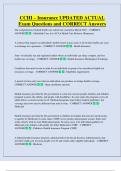
CCHI – Insurance UPDATED ACTUAL
Exam Questions and CORRECT Answers
The comprehensive federal health care reform law enacted in March 2010. - CORRECT
ANSWER - Affordable Care Act (ACA)/ Health Care Reform; Obamacare
A contract that requires an individual's health insurer to pay some or all of their health care costs
in exchange for a premium. - CORRECT ANSWER - Health Insurance
State- or federally run and regulated market where an individual can shop, compare, and buy
health care coverage. - CORRECT ANSWER - Health Insurance Marketplace/ Exchange
Conditions that must be met in order for an individual or group to be considered eligible for
insurance coverage. - CORRECT ANSWER - Eligibility requirements
A period of time each year when an individual can purchase or change health coverage. -
CORRECT ANSWER - Open enrollment (period)
Health insurance provided by the government to some low-income people, families and children,
pregnant women, the elderly, and people with disabilities. In some states the program covers all
adults below a certain income level. Medicaid programs must follow federal guidelines, but
coverage and costs may be different from state to state. - CORRECT ANSWER -
Medicaid
Health insurance provided by the government to children in families that earn too much money
to qualify for Medicaid. In some states, CHIP covers parents and pregnant women. Each state
works closely with its state Medicaid program. In many cases, if an individual qualifies for
Medicaid your children will qualify for either Medicaid or CHIP. - CORRECT
ANSWER - Children's Health Insurance Program (CHIP)
A federal health insurance program, administered by the Social Security Administration, that
provides health care for most people over 65 and certain other eligible individuals. - CORRECT
ANSWER - Medicare
, A benefit an individual's employer, union or other group sponsor provides to that individual to
pay for their health care services. - CORRECT ANSWER - Health plan
When a person is covered under more than one health insurance plan, this term describes the
health insurance plan that provides payment on claims after the primary coverage (i.e. main
plan). - CORRECT ANSWER - Secondary coverage
A general term used to describe a variety of health care and health insurance systems that attempt
to guide a patient's use of benefits, typically by requiring that a patient coordinate his or her
health care through a primary care physician, or by encouraging the use of a specific network of
healthcare providers. The management of health care is intended to keep costs -and monthly
premiums- as low as possible. Examples of managed care plans include:
• Health maintenance organizations (HMOs),
• Preferred provider organizations (PPOs),
• Exclusive provider organizations (EPOs), and
• Point of service plans (POSs). - CORRECT ANSWER - Managed care
The amount that must be paid for an individual's health insurance or plan. The individual and/or
their employer usually pay it monthly, quarterly or yearly. - CORRECT ANSWER -
Premium
A spouse, child, or domestic partner who is covered under a policyholder or subscriber's plan,
depending on applicable law and the plan's terms and conditions. - CORRECT
ANSWER - Dependent
Health care services that are included in and paid for by an individual's health insurance or plan.
- CORRECT ANSWER - Covered services
Health care services that an individual's health insurance or plan doesn't pay for or cover. -
CORRECT ANSWER - Excluded services
Exam Questions and CORRECT Answers
The comprehensive federal health care reform law enacted in March 2010. - CORRECT
ANSWER - Affordable Care Act (ACA)/ Health Care Reform; Obamacare
A contract that requires an individual's health insurer to pay some or all of their health care costs
in exchange for a premium. - CORRECT ANSWER - Health Insurance
State- or federally run and regulated market where an individual can shop, compare, and buy
health care coverage. - CORRECT ANSWER - Health Insurance Marketplace/ Exchange
Conditions that must be met in order for an individual or group to be considered eligible for
insurance coverage. - CORRECT ANSWER - Eligibility requirements
A period of time each year when an individual can purchase or change health coverage. -
CORRECT ANSWER - Open enrollment (period)
Health insurance provided by the government to some low-income people, families and children,
pregnant women, the elderly, and people with disabilities. In some states the program covers all
adults below a certain income level. Medicaid programs must follow federal guidelines, but
coverage and costs may be different from state to state. - CORRECT ANSWER -
Medicaid
Health insurance provided by the government to children in families that earn too much money
to qualify for Medicaid. In some states, CHIP covers parents and pregnant women. Each state
works closely with its state Medicaid program. In many cases, if an individual qualifies for
Medicaid your children will qualify for either Medicaid or CHIP. - CORRECT
ANSWER - Children's Health Insurance Program (CHIP)
A federal health insurance program, administered by the Social Security Administration, that
provides health care for most people over 65 and certain other eligible individuals. - CORRECT
ANSWER - Medicare
, A benefit an individual's employer, union or other group sponsor provides to that individual to
pay for their health care services. - CORRECT ANSWER - Health plan
When a person is covered under more than one health insurance plan, this term describes the
health insurance plan that provides payment on claims after the primary coverage (i.e. main
plan). - CORRECT ANSWER - Secondary coverage
A general term used to describe a variety of health care and health insurance systems that attempt
to guide a patient's use of benefits, typically by requiring that a patient coordinate his or her
health care through a primary care physician, or by encouraging the use of a specific network of
healthcare providers. The management of health care is intended to keep costs -and monthly
premiums- as low as possible. Examples of managed care plans include:
• Health maintenance organizations (HMOs),
• Preferred provider organizations (PPOs),
• Exclusive provider organizations (EPOs), and
• Point of service plans (POSs). - CORRECT ANSWER - Managed care
The amount that must be paid for an individual's health insurance or plan. The individual and/or
their employer usually pay it monthly, quarterly or yearly. - CORRECT ANSWER -
Premium
A spouse, child, or domestic partner who is covered under a policyholder or subscriber's plan,
depending on applicable law and the plan's terms and conditions. - CORRECT
ANSWER - Dependent
Health care services that are included in and paid for by an individual's health insurance or plan.
- CORRECT ANSWER - Covered services
Health care services that an individual's health insurance or plan doesn't pay for or cover. -
CORRECT ANSWER - Excluded services