MICROBIOLOGY EXAM 2 SET WITH 100% VERIFIED
SOLUTIONS |EXAMS OF NURSING
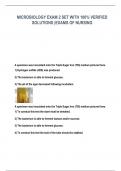
A specimen was inoculated onto the Triple Sugar Iron (TSI) medium pictured here.
1) Hydrogen sulfide (H2S) was produced.
2) The bacterium is able to ferment glucose.
3) The pH of the agar decreased following incubation.
A specimen was inoculated onto the Triple Sugar Iron (TSI) medium pictured here.
1) To conduct this test the slant must be streaked.
2) The bacterium is able to ferment lactose and/or sucrose.
3) The bacterium is able to ferment glucose.
4) To conduct this test the butt of the tube should be stabbed.
,A Catalase test was done on an unknown specimen. Observe the pictured result and
answer the following question.
1) The organism produces catalase.
2) The organism can convert hydrogen peroxide to water and oxygen.
A Catalase test was done on an unknown specimen. Observe the pictured result and
answer the following question.
1) The organism tested is probably an aerobe or a facultative anaerobe.
2) The image shows a positive test result.
3) The organism tested is protected against oxygen radicals.
Two different bacterial samples, A and B, were tested with an Oxidase dry slide. This
is a picture of the test results.
1) Specimen A does not produce cytochrome oxidase.
2) Specimen B produces cytochrome oxidase.
, Two different bacterial samples, A and B, were tested with an Oxidase dry slide. This
is a picture of the test results.
1) Specimen A shows a negative result
2) Specimen B shows a positive result
3) Specimen B most likely has a respiratory chain that uses oxygen as a final electron
acceptor.
Two different bacterial samples, A and B, were analyzed with the Voges-Proskauer
(VP) test. The results are pictured here.
1) Specimen B fermented glucose and formed acetoin (acetylmethylcarbinol).
2) Specimen B fermented glucose and formed neutral end-products.
3) Specimen B had a positive result for the VP test.
Two different bacterial samples, A and B, were inoculated into MR-VP (Methyl Red-
Voges Proskauer) broth. The following image shows what the tubes looked like for
the Methyl Red portion of the test.
1) Specimen A fermented glucose and formed low levels of acid end-products
SOLUTIONS |EXAMS OF NURSING
A specimen was inoculated onto the Triple Sugar Iron (TSI) medium pictured here.
1) Hydrogen sulfide (H2S) was produced.
2) The bacterium is able to ferment glucose.
3) The pH of the agar decreased following incubation.
A specimen was inoculated onto the Triple Sugar Iron (TSI) medium pictured here.
1) To conduct this test the slant must be streaked.
2) The bacterium is able to ferment lactose and/or sucrose.
3) The bacterium is able to ferment glucose.
4) To conduct this test the butt of the tube should be stabbed.
,A Catalase test was done on an unknown specimen. Observe the pictured result and
answer the following question.
1) The organism produces catalase.
2) The organism can convert hydrogen peroxide to water and oxygen.
A Catalase test was done on an unknown specimen. Observe the pictured result and
answer the following question.
1) The organism tested is probably an aerobe or a facultative anaerobe.
2) The image shows a positive test result.
3) The organism tested is protected against oxygen radicals.
Two different bacterial samples, A and B, were tested with an Oxidase dry slide. This
is a picture of the test results.
1) Specimen A does not produce cytochrome oxidase.
2) Specimen B produces cytochrome oxidase.
, Two different bacterial samples, A and B, were tested with an Oxidase dry slide. This
is a picture of the test results.
1) Specimen A shows a negative result
2) Specimen B shows a positive result
3) Specimen B most likely has a respiratory chain that uses oxygen as a final electron
acceptor.
Two different bacterial samples, A and B, were analyzed with the Voges-Proskauer
(VP) test. The results are pictured here.
1) Specimen B fermented glucose and formed acetoin (acetylmethylcarbinol).
2) Specimen B fermented glucose and formed neutral end-products.
3) Specimen B had a positive result for the VP test.
Two different bacterial samples, A and B, were inoculated into MR-VP (Methyl Red-
Voges Proskauer) broth. The following image shows what the tubes looked like for
the Methyl Red portion of the test.
1) Specimen A fermented glucose and formed low levels of acid end-products