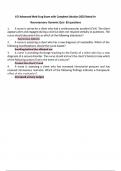
ATI Advanced Med-Surg Exam with Complete Solution 2025 Rated A+
Neurosensory- Dynamic Quiz- 85 questions 1. A nurse is caring for a client who had a cerebrovascular accident (CVA). The client appears alert and engaged during a visit but does not respond verbally to questions. The nurse should document this as which of the following alterations? · Expressive aphasia 2. A nurse is assessing a client who has a new diagnosis of mastoiditis. Which of the following manifestations should the nurse expect? · Swelling behind the affected ear 3. A nurse is providing discharge teaching to the family of a client who has a new diagnosis of a seizure disorder. The nurse should instruct the client’s family to take which of the following actions first in the event of a seizure? · Protect the client’s head 4. A nurse is assessing a client who has increased intracranial pressure and has received intravenous mannitol. Which of the following findings indicates a therapeutic effect of this medication? · Increased urinary output 5. During a neurological assessment, a nurse asks the client to name all of hischildren, their ages, and their birth dates. Which of the following types of memory is thenurse testing? · Remote 6. A nurse is providing teaching to a client who has a new diagnosis of multiple sclerosis (MS). The client asks the nurse about the usual cause of MS. Which of the following responses should the nurse make? · Acute episodes are usually followed by remissions, which can vary in duration 7. A nurse is caring for a client who experienced a traumatic brain injury. Which of the following findings indicates the client is experiencing increased intracranial pressure? · Dilated pupils 8. A nurse is caring for a client who has a cerebral lesion and develops hyperthermia. Which of the following areas of the client’s brain is affected? · Hypothalamus 9. A nurse is caring for a client who is postoperative following a frontal craniotomy. The nurse should place the client in which of the following positions? · Semi Fowlers 10. A nurse is preparing to test the function of cranial nerve X. Which of the following assessment procedures should the nurse use? · Have the client open their mouth and say “ahh” 11. An emergency room nurse is assessing a client who has a new traumatic brain injury. The nurse observes extension of the client’s arms and legs, pronation of the arms, and plantar flexion of the feet. Which of the following actions is the nurse's priority? · Provide supplemental oxygen 12. A nurse is providing teaching to a client who has a new diagnosis of Menière’s disease. Which of the following instructions should the nurse include in the teaching? · Avoid sudden movements 13. A nurse is providing teaching to the family of a client who has a new diagnosis of amyotrophic lateral sclerosis (ALS). Which of the following findings is an early manifestation of ALS? · Weakness of the distal extremities 14. A nurse is preparing a client for an electroencephalogram (EEG). Which of the following pieces of information should the nurse share with the client? · You’ll begin by lying still with your eyes closed 15. A nurse is assessing a client who is postoperative following a craniotomy and has a urine output of 600 mL/hr. The nurse suspects the client has manifestations of diabetes insipidus (DI). Which of the following laboratory values should the nurse plan to obtain to assess for DI? · Specific gravity 16. A nurse is preparing a client who has a brain tumor for computed tomography (CT). Which of the following factors affects the manner in which the nurse will prepare the client for the scan? · Development of hives when eating shrimp 17. A nurse in the emergency department has assessed a client’s airway, breathing, and circulation (ABC) following a head injury from a fall at work. Which of the following actions is the priority for the nurse to perform next? · Immobilize the client’s cervical spine 18. A nurse is assessing a client who has a head injury with a possible skull fracture. Which of the following findings should the nurse identify as an indication that the client might have a complication involving the eighth cranial nerve (CN VIII)? · Dizziness & hearing loss 19. A nurse is providing preoperative teaching for a client who will undergo laser- assisted in situ keratomileusis (LASIK) surgery. Which of the following pieces of information should the nurse include? · You might need glasses after the surgery 20. A nurse is caring for a client who has moderate Alzheimer's disease. Which of the following actions should the nurse take? · Add gestures when speaking with the client 21. A nurse is walking along the unit when she sees smoke coming from the central supply room. After activating the fire alarm, which of the following actions should the nurse take? · Turn off oxygen sources near the fire 22. A nurse is assessing a client who has a high-thoracic spinal cord injury. The nurse should identify which of the following findings as a manifestation of autonomic dysreflexia? · Report of a headache 23. A nurse in a clinic is providing teaching to an adolescent client who has recurrent external otitis. Which of the following instructions should the nurse include in the teaching? · Instill a diluted alcohol solution into the ear after swimming 24. A nurse is assessing a client who is unconscious. The client has a rhythmical breathing pattern of rapid deep respirations followed by rapid shallow respirations, alternating with periods of apnea. The nurse should document that the client is experiencing which of the following types of respirations? · Cheyne stokes 25. A nurse is assessing a client with a closed head injury who has received mannitol for manifestations of increased intracranial pressure (ICP). Which of the following findings indicates that the medication is having a therapeutic effect? · The client’s serum osmolarity is 310 26. A nurse is teaching a client about computed tomography (CT) scanning of the brain. Which of the following teaching points should the nurse include? · You’ll have to lie very still on a long narrow table during the test 27. A nurse is providing discharge teaching to a client who is postoperative following scleral buckling to repair a detached retina. Which of the following instructions should the nurse include in the teaching? · You should avoid reading for one week 28. A nurse is assessing a client who recently experienced a head injury. Which of the following findings should the nurse identify as an indication of short-term memory impairment? · Inability to locate eye glasses 29. A nurse is planning care for a client following a stroke. Which of the following interventions should the nurse identify as the priority in the client’s plan of care? · Monitor the client for ICP 30. A nurse is caring for a client who has expressive aphasia following a stroke. The nurse should identify that the stroke affected which of the following lobes of the client'sbrain? · Frontal 31. A nurse is reviewing the medical history of a client who is scheduled for a magnetic resonance imaging (MRI) examination of the cervical vertebra. Which of the following pieces of information in the client’s history is a contraindication to this procedure? · The client has a pacemaker 32. A nurse is caring for a client who has a traumatic brain injury and assumes a decerebrate posture in response to noxious stimuli. Which of the following reactions should the nurse anticipate when drawing a blood sample? · The client rigidly extends his arms 33. A nurse is teaching a class of new parents about otitis media. Which of the following manifestations should the nurse include in the teaching? · Feeling of fullness of the ear
Written for
- Institution
-
Santa Fe College, Gainesville Florida
- Course
-
ATI TEAS 7
Document information
- Uploaded on
- May 14, 2025
- Number of pages
- 10
- Written in
- 2024/2025
- Type
- Exam (elaborations)
- Contains
- Questions & answers
Subjects
- ati advanced med surg
- ati neurosensory
-
ati advanced med surg exam with complete solution
-
neurosensory dynamic quiz 85 questions

Also available in package deal