

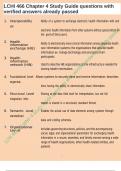
LCHI 466 Chapter 4 Study Guide questions with
verified answers already passed
1. Interoperability Ability of a system to exchange electronic health information with and
use
electronic health information from other systems without special ettort on
the part of the [user].
2. Health
information Ability to electronically move clinical information among disparate health
exchange (HIE) care information systems; the organizations that provide health
information ex- change technology and services to their
3. Health participants.
information
network (HIN) Used to describe HIE organizations or the infrastructure needed for
sharing health information.
4. Foundational Level Allows systems to securely send and receive information; describes
organiza-
tions having the ability to electronically share information.
5. Structural Level Sharing at the data field level for interpretation, but not full
integration; infor-
mation is shared in a structured, standard format.
6. Semantic Level Enables the actual use of data elements among systems through
standardized
data and coding schemes.
7. Organizational
Lev- el Includes governing structures, policies, and the accompanying
social, legal, and organizational parameters for exchanging health
information in a secure, seamless, and timely manner among a wide
range of health organizations, other health-related entities, and
patients.
1/
9
, LCHI 466 Chapter 4 Study Guide questions with
verified answers already passed
8. Directed HIE Ability to directly send and receive secure information electronically
between
care providers to support coordinated care.
9. Query-based HIE Ability for providers to find and/or request information on a patient
from other
providers.
10. Consumer
Mediat- ed HIE Ability for patients to aggregate and control the use of their health
information among providers.
2/
9
verified answers already passed
1. Interoperability Ability of a system to exchange electronic health information with and
use
electronic health information from other systems without special ettort on
the part of the [user].
2. Health
information Ability to electronically move clinical information among disparate health
exchange (HIE) care information systems; the organizations that provide health
information ex- change technology and services to their
3. Health participants.
information
network (HIN) Used to describe HIE organizations or the infrastructure needed for
sharing health information.
4. Foundational Level Allows systems to securely send and receive information; describes
organiza-
tions having the ability to electronically share information.
5. Structural Level Sharing at the data field level for interpretation, but not full
integration; infor-
mation is shared in a structured, standard format.
6. Semantic Level Enables the actual use of data elements among systems through
standardized
data and coding schemes.
7. Organizational
Lev- el Includes governing structures, policies, and the accompanying
social, legal, and organizational parameters for exchanging health
information in a secure, seamless, and timely manner among a wide
range of health organizations, other health-related entities, and
patients.
1/
9
, LCHI 466 Chapter 4 Study Guide questions with
verified answers already passed
8. Directed HIE Ability to directly send and receive secure information electronically
between
care providers to support coordinated care.
9. Query-based HIE Ability for providers to find and/or request information on a patient
from other
providers.
10. Consumer
Mediat- ed HIE Ability for patients to aggregate and control the use of their health
information among providers.
2/
9


