

Written by students who passed Immediately available after payment Read online or as PDF Wrong document? Swap it for free 4.6 TrustPilot
logo-home
Document preview thumbnail
Preview 4 out of 44 pages
Exam (elaborations)

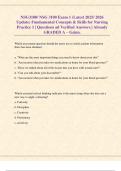
NSG3100/ NSG 3100 Exam 1 (Latest 2025/ 2026 Update) Fundamental Concepts & Skills for Nursing Practice 1 | Questions ad Verified Answers | Already GRADED A – Galen.

Document preview thumbnail
Preview 4 out of 44 pages

NSG3100/ NSG 3100 Exam 1 (Latest 2025/ 2026 Update) Fundamental Concepts & Skills for Nursing Practice 1 | Questions ad Verified Answers | Already GRADED A – Galen. Which assessment question should the nurse use to clarify patient information that's has been obtained a. "What are the most important things you need to know about your diet" b. "Am incorrect that you take two medications at home for your blood pressure?" c. "Have we talked about all of the tissues that you have with wound care?" d. "Can you talk about your discomfort?" b. "Am incorrect that you take two medications at home for your blood pressure?" Which essential critical thinking indicator is the nurse using when she tries out a new way to apply a dressing? a. Curiosity b. Discipline c. Creativity d. Persistence c. creativity The nurse on the surgical unit has a multiple patient assignment. On beginning the shift, the nurse determines that the first patient to see in the morning is the individual who: a. Has a blood pressure of 80/50 mm Hg b. Requires instruction four wound care c. Needs to be transferred from bed to chair d. Received pain medication 5 minutes ago. a. Has a blood pressure of 80/50 mm Hg For the process of reflection, the nurse ask him-or herself which of the following? a. "How I report the increase ball pressure reading?" b. "Why is the patient having pain now?" c. "Did the patient's respiratory status just change?" d. "How should I have taught the patient patient to do self-injection more efficiently?" d. "How should I have taught the patient patient to do self-injection more efficiently?" The nurse is using the personal critical thinking indicator of honesty when he or she does, which of the following? a. Feel certain about being able to perform the skill. b. Provides factual and true information to the patient. c. Considers all of the information before moving forward with the plan of care. d. Follows an orderly approach to completing the required interventions. b. Provides factual and true information to the patient. The nurse keeps working with the patient to help him ambulate, motivating him to reach his goal Of being independent. The nurse is demonstrating which critical thinking trait? a. Confidence. b. Humility. c. Persistance d. Fairness. c. Fairness On entering the room, the experience nurse has a sense that the patient's status has changed. The nurse is using which attribute of clinical judgment? a. Intuition b. Validation c. Inference d. Inductive reasoning a. Intuition According to the NCSBN-CJMM, in order to form hypotheses, the nurse needs to a. Analyze cues b. Generating solutions c. Taking action d. Evaluating outcomes b. Generating solutions The patient tells the nurse that she is not confident with self - injecting of insulin. The nurse should use which of the following to validate this information from the patient? a. Ask the family how the patient performed the self-injection b. Confer with the other staff member to see how the technique was taught to then patient. c. Determine what insulin was prescribed by the provider d. Observe the patient giving the insulin injection d. Observe the patient giving the insulin injection For a patient who has chronic obstructive pulmonary disease with an excess of secretions in the bronchioles, which nursing diagnosis is most appropriate? a. Incomplete airway clearance b. Ineffective respiratory pattern c. Potential for asphyxia d.Difficulty maintaining spontaneous ventilation a. Incomplete airway clearance Which of the following nursing interventions is most clearly stated, and will assist other staff members to provide safe care? a. Provide extra fluids b. Increased ambulating in hallway c. Reinforce use of incentive spirometer tid d. Complete assessment with patient in the a.m. c. Reinforce use of incentive spirometer tid The nurse is working with a patient who has the following signs and symptoms: weight gain, Adema to the lower extremities, increase blood pressure, and abdominal distention. On the basis of the information, which of the following is the most appropriate nursing diagnosis? a. Inadequate, nutritional intake. b. Increased fluid volume. c. Urinary reduce tension. d. Potential for trauma. b. Increased fluid volume In planning for the patient assignment, the nurse prioritizes his schedule on the basis of the patient's needs and conditions. In reviewing the nursing diagnoses, which of the following patients should be seen first in the morning? a. Altered urinary elimination b. Change in sleep pattern c. Reduce cardiac output d. Inability to perform self-care— grooming c. Reduce cardiac output Which of the following is the best example of a measurable patients goal? The patient will a. Ambulate independently at least 20 feet in the hallway by the end of the week. b. I be seen by the nurse for regular monitoring of blood pressure c. Increased intake of potassium-rich foods. d. Have less pain and anxiety a. Ambulate independently at least 20 feet in the hallway by the end of the week. For the patient with a nursing diagnosis, a potential for aspiration, the nurse anticipates that they will be goals and interventions related to safety observations during a. Eating b. Bathing c. Ambulating d. Transferring g Which of the following is the best example of a measurable patient goal? the patient will a. Sit out of bed in the chair b. Eat low -sodium foods c. Verbalize feelings about surgery at some point d. Identify the five major drug side effects before discharge tomorrow. d. Identify the five major drug side effects before discharge tomorrow Which of the following information is classified by the nurse as subjective data from the patient? a. "I feel dizzy" b. there is a red area on the abdomen. c. And oral temperature reading is 99°F. d. The hematocrit is less than expected level. a, " I feel dizzy" The new nursing staff member is observed by the unit manager during a patient interview. Which of the following behaviors should the manager identify to the new nurse to avoid in the future? a. Using a moderate tone of voice. b. Sitting close and leaning towards the c. Asking open - ended questions. d. Tapping her pen on the bedside table. d. Tapping her pen on the bedside table. During the termination fees of the patient interview, the nurse does which of the following? a. Prepares the environment. b. Performs a physical examination. c. Sets goals with the patient for care. d. Summarizes and validates information from the patient. d. Summarizes and validate information from the patient. For baby boomers, which of the following is a generational factor that may influence behavior? Love a. Being slow to warm up b. Expecting detailed information c. Being very technologically literate d. Having very short attention spans d. Having very short attention spans Which of the following actions can be safely delegated to unlicensed assistive personnel? a. Assessment of a patient who has just had surgery. b. Determination of the patients I hope you're not too comfortable level of stability when using crutches. c. Measurement of vital signs on a stable patient. d. Provision of analgesic medications c. Measurement of vital signs on a stable patient Which of the following physical assessment technique is used to determine skin moisture? a. Inspection. b. Palpation c. Percussion. d. Auscultation b. Palpation In a five-tier triage system, what finding is designated as level 2 - emergent? a. Cardiac arrest b. Possible stroke c. Dehydration d. Abrasion b. Possible stroke Which of the following questions will elect the most information from the patient during an interview? a. " Are you taking your medications?" b. "Have you been following the therapeutic diet?" c. "how are you managing your leg pain?" d. "did you go to the bathroom this morning?" c. "how are you managing your leg pain?" Nursing diagnoses are primarily used to do which of the following? a. Make All the patients problems easier to solve. b. Assist the medical provider to determine care c. Meet accreditation requirements d. Facilitate clear communication of patient need d. Facilitate clear communication of patient need Which of the following problem focused nursing diagnosis is best meets the criteria for a diagnostic statement? a. Impaired active range of motion associated with knee and ankle discomfort observed, and hesitant, unsteady gait. b. Increased fluid volume associated with a loss of body weight. c. Potential for constipation associated with fluid intake and movement. d. Readiness for learning associated with a lack of knowledge. a. Impaired active range of motion associated with knee and ankle discomfort observed, and hesitant, unsteady gait. The nurse is concerned that the patient has developed atelectasis after surgery. Which of the following is an appropriate diagnostic label for this problem? a. Insufficient airway clearance. b. In efficient, gas exchange. c. Diminished cardiac output. d. Lack of spontaneous ventilation. b. Inefficient gas exchange. For the nursing diagnosis altered speech associated with the recent neurological dis, the etiology is which of the following? a. Altered speech b. As observed c. Recent neurological disturbances d. Inability to speak coherently c. Recent neurological disturbances. To the following nursing diagnoses best meets the criteria for a diagnostic statement? a. Potential for diarrhea associated with the possible side effects of anabiotic therapy. b. Potential for heart disease with the risk factor of smoky. c. Potential for urinary retention. d. Potential for pneumonia. a. Potential for diarrhea associated with the possible side effects of anabiotic therapy. For the health, promotion, nursing diagnosis, ability to comprehend the need for enhanced nutrition, which of the following is the most likely an appropriate patient characteristic? a. Inability to feed self. b. Diminished oral intake. c. Reduction and body mass and strength. d. Identification of healthy food choices. d. Identification of healthy food choices. The patient with the nursing diagnosis, activity intolerance, the nurse expects that the patient will specifically demonstrate: a. Elevated body temperature. b. Disinterest and diversional activities. c. Dyspnea on exertion d. Erythema. c. dyspnea on exertion Which of the following is associated with specifically meeting, the quality and safety education for nurses (QSEN) teamwork, and collaboration competencies? a. Providing the patient with the schedule for diagnostic testing. b. Accessing the patient's level pain. c. Engaging the patient in conversation. d. Working with the patient and nutritionist. d. Working with the patient and nutritionist The nurse receives a patient assignment in the morning. Which of the patient should be seen first? The patient who a. Takes at hypnotic medication at bedtime. b. Has fluctuations and blood sugar readings. C. Needs assistance with morning care. d. Has an order for a daily dressing change. b. Has fluctuations in blood sugar readings. The patient works in a tailor shop and is having surgery to correct bilateral contract. If all of the following are realistic, which is a long-term goal for this patient? a. Return to his occupation. b. Prevention of ocular infection c. Independent performance of hygiene, care. d. Self - administration of eyedrops postoperatively a. Return to his occupation. A goal for a patient who is hypertensive is a return to expected vital sign limits. Which one of the following outcomes indicators is most appropriate? a. Patient expresses decreased discomfort q3h. b. Patient identifiers two things that reduce stress. c. Patient will not experience headaches. D. Patient's blood pressure is between 120/80. mm Hg and 130/90 mm Hg. D. Patient's blood pressure is between 120/80. mm Hg and 130/90 mm Hg. Which one of the following interventions is considered? Independent for nurse - initiated? a. Teaching a patient about the therapeutic diet. b. Giving an enema and preparation for a radiological testing c. Providing an analgesics for postoperative discomfort. d. Administering wound care. a. Teaching a patient about the therapeutic diet. Which one of the following best meets the criteria for a good statement? a. Respiratory rate remain within 20 to 24 breaths per minute through discharge. b. Patient will ambulate in the hallway frequently. c. Treatment regimen will be understood. d. Patient will describe actively restrictions. a. Respiratory remain within 20 to 24 breast per minute through discharge. Which of the following actions is considered direct patient care? a. Providing assistance with ambulation. b. Giving a patient update to the healthcare provider c. Making a change -of -shift report. d. Asking the pharmacist about the prescribed medication. a. Providing assistance with ambulation. For a patient with a nursing diagnosis of restricted physical mobility associated with bilateral arm cast, the nurse should select which of the following direct care interventions? a. Counseling. b. Teaching. c. Reassessment. d. Assisting with ADLs. d. Assisting with ADLs. The patient is seen in the clinic for her first prenatal visit. It is determined that, by the next visit, the patient should be able to identify five symptoms that indicate a possible problem with the pregnancy. On her return to the clinic, the patient can state three symptoms. The evaluation for this patient goal is which of the following? a. Goal met; patient able to state sufficient symptoms b. Goal partially met; patient able to state 3 of 5 symptoms. c. Goal not met; patient unable to state all 5 symptoms d. Goal not met; patient identifies three of the symptoms b. Goal partially met; patient able to state 3 of 5 symptoms The nurse is working with a post operative. Patient on the surgical unit. Which aspect of care demonstrates in manipulation of the patients environment? a. Providing wound care. B. Administering analgesic medication. c. Making sure that the room is warm enough. d. Measuring the patient's vital signs. c. Making sure that the room is warm enough. An antibiotic medication is administered to the patient shortly afterward, the patient develops itching and redness of the skin. If an antihistamine is given to the patient to counteract antibiotics effect, then the nurses during which of the following? a. Compensating for adverse reactions. b. Preparing for a special procedure. c. Assisting with ADLs. d. Using preventative measures. a. Compensating for adverse reactions Which of the following nursing actions is identified as indirect nursing care? a. Changing the wound dressing. b. Teaching a patient about coronary rehabilitation. c. Administering tube feedings d. Delegating a.m. care for the unlicensed personnel. d. Delegating a.m. care for the unlicensed personnel The nurse has investigated safety hazards, and recognizes that the leading cause of unintentional poisoning results from which of the following? a. Carbon monoxide. b. Contaminated food. c. Decorative plant. d. Lead. a. Carbon monoxide. An ambulatory patient is admitted to the extended care facility with a diagnosis of Alzheimer's disease. And using a fall assessment tool, the nurse knows that the greatest indicator of risk is. a. Confusion. b. Impaired judgment. c. Sensory deficits. d. History of falls. d. History of falls. The type of restraint used to prevent a patient from bending over in a wheelchair is a? a. Wrist restraint. b. Vest restraint. c. Elbow restraint. d. Mummy restraint. b. Vest restraint. Hey 79 year old resident in a long-term care facility is known to " wonder at night " and has fallen in the past. Which of the following is the most appropriate nursing intervention? a. The patient should be check frequently during the night. b. And a domino restraint should be placed on the patient during sleeping hours. c. A radio should we left playing at the bedside to assist in reality orientation d. The patient should be placed in a room away from the activity of the nurses station. a. The patient should be checked frequently during the night. Workman. Causes an electrical fire when installing a new piece of equipment in the intensive care unit. A patient near the fire is on a ventilator. What is the first action that the nurse should take? a. Pull the fire alarm b. Attempt to extinguish the fire. c. Use and Ambu bag or bag mask valve and remove the patient from the area. d. Call the healthcare provider to obtain orders to take the patient off the ventilator. c. Use and Ambu bag or bag mask valve and remove the patient from the area. A visiting nurse completes an assessment of the ambulatory patient in the home determines the nursing diagnosis risk for injury associated with decreased vision. On the basis of this assessment, the patient will benefit the most from which of the following actions? a. Installing fluorescent lighting throughout the house. b. Becoming oriented to the Position of the furniture and stairways. c. Maintaining complete bed rest in a hospital bed with side rails. d. Applying physical restraints. b. Becoming oriented to the Position of the furniture and stairways. Which of the following statements by the parent of a child indicates that further teaching by the nurse is required? a. " I make sure that my child wears a helmet when he rides his bicycle. " b. " I have spoken to my teenager about safe sex practices." c. " my child is taking swimming classes at the community center." d. " my 3 year old sit in the front seat of the car with me." d. " my 3 year old sit in the front seat of the car with me." The nurse assesses that the patient may need a restraint and recognizes that a. In order for a restraint may be implemented, and definitely until it is no longer required by the patient. b. Restraint should be ordered regulate to improve patient safety. c. No order or consent is necessary for restaurants in long-term care facilities. d. Restraints are to be periodically removed to have the patient reevaluated. d. Restraints are to be periodically removed to have the patient reevaluated. On entering the patient's room, the nurses a fire burning in the trash cans next to the bed. The nurse remove the patient and calls in the fire. What is the next action at the nurse should take? a. Extinguish the fire. b. Remove all of the other patients from the unit. c. Close all the doors of patients rooms. d. Move the trashcan into the bathroom. c. Close all the doors of patients rooms When applying every straight, the nurse knows that a. The padded side is always from the skin. b. It should be removed at least once each shift. c. The strap should be secured with a knot d. Two fingers with should fit between the skin and the restaurant. d. Two fingers with should fit between the skin and the restaurant. Mother of a young child under the kitchen in France, a child sitting on the floor next to an empty bottle of kitchen cleanser. There are particles of a substance around the child's mouth. The patients first action should be to. a. Provide ipecac syrup, b. Call the poison control unit. c. Give the child milk or orange juice. d. Remove the particles of cleanser from the mouth. b. Call the poison control unit. Which of the following is a vector borne disease? a. Rocky mountain spotted fever b. Pneumonia. c. Salmonella. d. Hepatitis. a. Rocky mountain spotted fever The patient has a 6 inch laceration on his right forearm. Am affection develops at the site. Which of the following is a sign of a local inflammatory response observed by the nurse? a. Blanching of the skin. b. Edema at the site. c. Decrease in temperature. d. Increase in the number of WBCs b. Edema at the site. An adult female patient has been undergoing diagnostic testing since admission to the medical unit in the hospital. The the results of blood testing or sent back to the unit. On viewing the results, the nurse reports which abdominal fighting to the physician? a. WBCs 14,000 cells/mm3 b. Lymphocytes 2000 cells/mm3 c. Neutrophils 65% d. Hemoglobin 14 g/dL a. WBCs 14,000 cells/mm3 A nurse is observing a new staff member work with a patient. Of the following activities, which one has the greatest possibility of contributing to an HAI and requires correction? a. Washing hands before applying addressing. b. Taping a plastic bag to the bed rail for tissue disposal. c. Placing a urinary catheter bag on the bed with the patient. d. Using an anti-septic to cleanse the skin before starting an intravenous line. c. Placing a urinary catheter bag on the bed with the patient. The nurse works in a small role hospital with a wide variety of patients. Of the patients admitted this afternoon, the nurse recognizes that the individual with the highest susceptibility's to infection is the individual with which of the following? a. Burns. b. Diabetes c. Pulmonary emphysema d. Peripheral vascular disease a. Burns The nurse employs surgical aseptic technique when a. Disposing of syringes and puncture - proof containers. b. Placing soiled linens and moisture - resistant bags. c. Washing hands before changing a dressing. d. Inserting an intravenous catheter. d. Inserting an intravenous catheter. The patient has a large, deep, abdominal incision that requires a dressing. When changing the dressing, the nurse accidentally drops of packaging onto the patient's abdomen. The nurse should do which of the following? a. Throughout the packing away and prepare a new one. b. Add alcohol to the packaging and insert it into the incision c. Pick up the packing we're sterile, forceps and gently place it into the incision d. Rents the packing with sterile water and put the packing into the incision with sterile gloves. a. Throughout the packing away and prepare a new one An adult patient has a viral infection. Which of the following vital signs is typical during the early stage of infection? a. Increase blood pressure. b. Normal temperature. c. Decreased respiratory rate. d. Increased oxygen saturation. a. Increased blood pressure The nurse recognizes that special care must be taken in the handling of which of the following to prevent the transmission of Hepatitis C? a. Feces B. Blood c. Saliva d. Vaginal secretions b. Blood The parent of a preschool age child asked the nurse how chickenpox( varicella zoster virus) is transmitted. The nurse identify as that the virus is transmitted a. By a vector organism. b. Through the air and droplets after sneezing or coughing c. Through person to person contact. d. By contact with contaminated objects. b. Through the air and droplets after sneezing or coughing The nurse is aware that it is important to break the chain of infection. Which of the following is an example of a nursing intervention that has committed to control the portion of exit of infection for a patient? a. Using hand sanitizer. b. Wearing disposable gloves. c. Changing soiled dressings d. Administering vaccines. a. Using hand sanitizer. The single most important technique to prevent and control the transmission of infection a. Handwashing b. The use of disposable c. Do use of isolation precautions d. Sterilization of equipment. a. Handwashing. A patient with active tuberculosis is admitted to the Medical Center. The nurse recognizes that admission of the patient to the unit will require the implementation by the staff of. a. Droplet precautions. b. Airborne precaution. c. Contact precautions. d. Protective, isolation. c. Contact precautions. The nurse recognizes the appropriate pre-seizures for sterile asepsis. Of the following, which action is consistent with surgical asepsis? a. Cleaned forceps, maybe used to move items on the sterile field. b. Sterile field may be prepared when in advance of the procedures c. Sterile items are kept well within a 1 inch outer border of the field. d. Wrapped sterile package should be open, starting with the flap closest to nurse. c. Sterile items are kept well within a 1 inch outer border of the field. The nurse suspects that an older adult patient may be experiencing hyper static pneumonia. Older adults may react differently to the factious processes, so the nurse is alert to win and atypical sign, such as which of the following? a. Hypertension. b. Confusion. c. Erythema d. Chills a. Hypertension. It patient requires a sterile dressing. Change for a midabdominal surgery incision. An appropriate intervention for the nurse to implement in maintaining still a sepsis is to? a. Put sterile gloves on before opening sterile packages. b. Place to cap of the sterile solution well within the sterile field. c. Place steril items on the edge of the sterile drape. d. Discard packages that may have been in contact with the area below which level. d. Discard packages that may have been in contact with the area below which level. The nurse is preparing to assist with a dressing change. Can I appropriate technique that the nurse include in performing correct hand hygiene is to. A. Wash the rest, then the b. Use a brush on the palms of the hands. c. Maintain the scrub for at least one minute. d. Wash well around watches and other jewelry. a. Wash the rest, then the hands. A patient is found to have MRSA. And appropriate isolation procedure for the nurse to implement when working with this patient is to. a. Leave all linen in the patient's room. b. Use personal protective equipment for contact precautions c. Wipe the stethoscope off before removing it from the room. D. Identify on the patient store to drop a precautions are in place. b. Use personal protective equipment for contact precautions The nurse is observing the student put on sterile gloves. Which of the following actions has contaminated the gloves? a. Keeping the package above waist level b. Pulling the inner package edges apart with thumbs and fingers. c. Grasping the second glove by the cuff. d. Adjusting the gloves by pinching, and shifting with the other hand. c. Grasping the second glove by the cuff. The unit manager observes the new staff nurse perform the following actions for a patient with isolation precautions. Which of the following action should the unit manager address incorrect with the new nurse? a. Keeping a thermometer, stethoscope and blood pressure cuff in the patient's room. b. Talk to any of the precautions required in the patient's. C. Using a particulate respiration mask for the patient who has tuberculosis d. Coming out of the room in the PPE to quickly get another dressing. d. Coming out of the room in the PPE to quickly get another dressing. Evaluating the infection control measures used by the patient and family in the home, which finding indicates the additional teaching is required? a. Using antimicrobial soap and disinfectants. b. Sharing a towel in the bathroom. c. Disposing of sharps in a jar with a screw top lid d. Avoiding breathing directly on others. b. Sharing a towel in the bathroom A patient has a red, raised skin rash. During a bath, the priority action of the nurse is to? a. Assess for additional inflammatory reaction. b. Discuss the body image problems, created by the presence of the rash. c. Wash the skin thoroughly with hot water and soap d. Washer is the skin to prevent drying a. Assess for additional inflammatory reaction. The nurses caring for a patient who has right excited paralysis after a cerebrovascular accident (stroke). Which of the following factors would be ,let likely to result in pressure injury for this patient? a. Pore nutrition. b. Reduce mobility. c. Excessive hydration. d. Skin secretions. b. Reduce mobility A nurse delegate the hydronic care of the male patient to the nursing assistant. In reviewing the patient assignment, the nurse instructs the assistant, to make sure to use an electric razor to shave the patient with. a. Thrombocytopenia. b. Congestive heart failure. c. Osteoarthritis. d. Pneumonia. a. Thrombocytopenia The nurse delegates morning care to a new shoulder, fight, nursing assistant. Which of the following actions by the assistant would be evaluated as appropriate. a. Placing some dentures in a tissue well not worn. b. Turning the patient's nails with scissors. c. Using soap to cleanse around the eyes. d. Washing the patient's leg from ankle to the knee d. Washing the patient's leg from ankle to the knee Patient with diabetes mellitus has physician orders for meticulous foot care. Which of the following is the best rationale for the order? a. Process causes increased skin breakdown b. There is. peripheral neuropathy with this condition that placed the patient at risk c. The patient probably has history for poor hygienic care. d. Oh, or extremities are difficult to see, and therefore hard to maintain with good hygiene b. There is. peripheral neuropathy with this condition that placed the patient at risk Nurse is instructing a patient with peripheral vascular disease about daily for care. The nurses instruction for the patient includes. a. Soaking my feet, 5 to 10 minutes each day. b. Finally the nails into a curve shape. c. Using commercial corn removers if needed. d. Applying lotion to the feet. d. applying lotion to the feet. To administer their oral care to a semi comatose patient, the nurse should place the patient in which of the following positions? a. Reverse Trendelenburg. b. High Fowlers with the head to the side. c. Side lying with head turned toward the nurse. d. Supine with the next slightly forward. c. Side lying with head turned toward the nurse. A patient has severe right sided weakness, and is unable to complete phasing independently. On the basis of this observation, the nurse identifies a nurse diagnosis that hypothesis of. a. Low self-esteem. b. Hygiene, self-care deficit c. Altered tissue integrity. d. Lack of understanding of proper hygiene practices. b. Hygiene, self-care deficit The nurse is preparing to assist the semiconscious adult female patient with perineal care. The position of choice for the patient is. a. Sitting b. Side lying c. Supine d. Prone c. Supine The nurse is completing a bed bath for a dependent adult male patient. During the perennial care, the patient has an erection. The nurse should. a. Tell the patient to just relax b. Indicate that the bath cannot be continued, c. Ask the patient to do the care as well as he can d. Defer the care until later in the the bath d. Defer the care until later in the the bath A patient on chemotherapy is experiencing stomatitis. The nurse advises the patient to use a. Baking soda, saline, and water rinse. b. A firm - Bristol toothbrush. c. A commercial mouthwash. d. An alcohol mixture. a. Baking soda, saline, and water rinse. A patient has been on bedrest for a prolonged period. She specifically promote do use of isotonic exercise, the nurse will instruct the patient to. a. Turn side to side In bed b. Perform pelvic floor exercises c. Repeatedly tighten the thigh muscle d. Right side and holding the gait belt at the patients back d. Right side and holding the gait belt at the patients back The nurse is working with a patient who has left sided weakness. After an instruction, the nurse observes the patient ambulate in order to evaluate the use of the cane. Which action indicates that the patient knows how to use the cane properly? a. The patient keeps the cane on the left side. b. Two points of support are kept on the floor at the same time c. There is a slight lean to the right when the patient is walking d. I'm sure advancing cane, the patient moves the right leg forward b. Two points of support are kept on the floor at the same time A patient with a fractured left femur has been using crutches for the past six weeks. The position tells the patient to begin putting full weight on the left foot when walking. Which of the following age should a patient be taught to use? a. Two-point. b. Three - point. c. Four - point. d. Swing - through. c. Four-point Call ambulating in the hallway of a hospital, the patient complains of extreme dizziness. The nurse, alerts to syncopal episode, should first a. Support the patient and walk quickly back to the room. b. Lane the patient against the wall until the episode passes. c. Lower the patient gently to the floor. d. Go for help. c. Lower the patient gently to the floor. The patient is admitted to the medical unit after a cerebrovascular accident (stroke). There is evidence of left side, hemiparesis, and the nurse will be following up on range of motion, and other exercises performed in physical therapy. The nurse correctly teaches a patient and family members which one of the following principles of range of motion exercise? a. Move the joints quickly. b. Work from the lower to upper body. c. Flex joint to the point of resistance. d. Provide support above and below joints. d. Provide support above and below joints. . Nurses need to implement appropriate body mechanics to decrease the case of injury to themselves and patient. Which principle of body mechanics, should the nurse incorporate into patient care? a. Flex the knees and keep the feet wide apart. b. Assume a position far enough away from the patient. c. Twist the body in the direction of movement. d. Use the strong back muscles for lifting or moving. a. Flex the knees and keep the feet wide apart. After an assessment of a patient, the nurse identifies the nursing diagnosis and tolerance to activity for the supporting evidence of increased weight gain, and an activity. The physician once the patient to improve endurance and increase activity. Which of the following is an outcome identified for the patient? a. Resting heart rate will be 90 to 100 /min b. Blood pressure will be maintained between 140/80 and 160/90. mmHg c. Exercise will be performed three times per day over the next two weeks. d. Accommodation will be made for excess weight and fatigue c. Exercise will be performed three times per day over the next two weeks Patient has been on for a long bed, rest, and the nurse observing croissant associated with and mobility. An assessment of the patient, the nurse is alert to a. Increase blood pressure. b. Decrease heart rate. c. Increased urinary output d. Decreased peristalsis d. Decreased peristalsis A patient is looking for surgery, and, because of perioperative sedation, needs complete assistance to transfer from the bed to the stretcher. Which of the following should the nurse do first? a. Evaluate the head of the bed. b. Obtain more assistance for the move. c. Please the patient and the prone position d. Determine the potential for postoperative complications. b. Obtain more assistance for the move Patient has sequential compression stockings in place. Which of the following indicates that they are being implemented correctly a. The ankle pressure is set at 40 mmHg b. Stockings are removed every hour during application. c. There's no space between the sleeve and a leg when the sleeve is not inflated. d. If there is no order for only one leg, the only sleep is disconnected from the machine. a. The ankle pressure is set at 40 mmHg The nurse assesses that the patient has right sided he,paresis after a stroke. This individual most likely have ischemia to the. a. Brainstem. b. Left side of the brain. c. Cerebellum. d. Medulla oblongata b. Left side of the brain And immobilized patient is suspected as having atelectasis. This is assessed by the nurse, on auscultation, as a. Harsh crackles. b. Wheezing on inspiration. c. Diminished breath sounds. d.Bronchovesicular whooshing c. Diminished breath sounds. The best approach for the nurse to use to assess the presence of DVT and immobilized patient is to do which of the following? a. Measure the calf and thigh diameters. b. Attempt to elicit the Homan Sign c. Palpate the tempature of the feet d. Observe for a loss of hair and skin turgor in the lower legs. a. Measure the calf and thigh diameters Patient is getting out for the first time after a period of bedrest. The nurse should first. a. Assess respiratory function. b. Obtain a baseline blood pressure. c. Assist the patient to sit at the edge of the bed. d. Ask the patient if she feels lightheaded. b. Obtain a baseline blood pressure. To promote respiratory function in the immobilized patient, the nurse should a. Encourage deep breathing and coughing every hour b. Use oxygen and nebulizer treatments regularly. c. Change the patient's position. q8h d. Suction the patient every hour. a. Encourage deep breathing and coughing every hour . Antiemolism hose (stocking) are ordered for the patient on bedrest after surgery. The nurse explained to the patient that the primary purpose for the elastic stocking.(Theomboembolic deterrent stocking, or TEDs) is to a. Keep the skin warm and dry b. Prevent abdominal joint flexion c. Apply external pressure d. Prevent bleeding c. Apply external pressure Provide for the psychosocial needs of an immobilized patient, which is an appropriate statement by the nurse? a. " the staff on my air visitors sure that you will not be bothered." b. " a roommate can be real bother. You'd probably rather have a private room." c. " let's discuss the routine to see if there are any changes we can make." d. " I think you should have your hair down and put on some make up." c. " let's discuss the routine to see if there are any changes we can make." Introduce the chance of external hip, quotation and a patient on prolonged bed rest, the nurse should implement the use of a. Footboard. b. Trapeze bar. c. Bedboard. d. Trochanter roll d. Trochanter roll Traders the chance of plantar flexion (Foot drop) and a patient on prolonged rest, the nurse should imoplement the use of a. Trapeze bars b. High-top sneakers c. Trochanter rolls d. 30 - degree lateral positioning b. High-top sneakers What is the phone observations from the nurse indicates the correct use by the patient of a walker without wheels? a. Moving forward with both feet and then advancing the walker b. Moving 1 foot forward, advancing a walker, and then moving the other foot. c. Sliding the walker wall shuffling both feel forward ' d. Lifting walk forward, one step, placing it on the ground, and then stepping forward into the Walker. d. Lifting walk forward, one step, placing it on the ground, and then stepping forward into the Walker. Which of the following is the best choice of protein for the immobile patient a. Hotdog b. Grilled chicken ' c. Macaroni and cheese. d. Grilled cheese sandwich. b. Grilled chicken. For the patient who is standing erect, which of the following indicates crutches of crutches? a. Auxiliary padding removed. b. Crutches place 10 to 12 inches to either side of each foot c. Elbow flexion of 60 degrees for the hand bar d. Three finger with between the axilla in the auxiliary piece of the crutch d. Three finger with between the axilla in the auxiliary piece of the crutch Which of the following is not accurate regarding the trapeze bar for an immobilizer patient? a. I can be used for repositioning. b. Bilateral upper extremity strength is required. c. It can be used for independent, nonweightbearing, transfer to a chair. d. It Use allows for increased musculoskeletal strength. c. It can be used for independent, nonweightbearing, transfer to a chair.

Content preview

NSG3100/ NSG 3100 Exam 1 (Latest 2025/ 2026
Update) Fundamental Concepts & Skills for Nursing
Practice 1 | Questions ad Verified Answers | Already
GRADED A – Galen.

Which assessment question should the nurse use to clarify patient information
that's has been obtained


a. "What are the most important things you need to know about your diet"
b. "Am incorrect that you take two medications at home for your blood pressure?"
c. "Have we talked about all of the tissues that you have with wound care?"
d. "Can you talk about your discomfort?"
b. "Am incorrect that you take two medications at home for your blood pressure?"


Which essential critical thinking indicator is the nurse using when she tries out a
new way to apply a dressing?
a. Curiosity
b. Discipline
c. Creativity
d. Persistence
c. creativity

,The nurse on the surgical unit has a multiple patient assignment. On beginning the
shift, the nurse determines that the first patient to see in the morning is the
individual who:


a. Has a blood pressure of 80/50 mm Hg
b. Requires instruction four wound care
c. Needs to be transferred from bed to chair
d. Received pain medication 5 minutes ago.
a. Has a blood pressure of 80/50 mm Hg


For the process of reflection, the nurse ask him-or herself which of the following?


a. "How I report the increase ball pressure reading?"
b. "Why is the patient having pain now?"
c. "Did the patient's respiratory status just change?"
d. "How should I have taught the patient patient to do self-injection more
efficiently?"
d. "How should I have taught the patient patient to do self-injection more
efficiently?"


The nurse is using the personal critical thinking indicator of honesty when he or
she does, which of the following?


a. Feel certain about being able to perform the skill.
b. Provides factual and true information to the patient.

,c. Considers all of the information before moving forward with the plan of care.
d. Follows an orderly approach to completing the required interventions.
b. Provides factual and true information to the patient.


The nurse keeps working with the patient to help him ambulate, motivating him to
reach his goal Of being independent. The nurse is demonstrating which critical
thinking trait?


a. Confidence.
b. Humility.
c. Persistance
d. Fairness.
c. Fairness


On entering the room, the experience nurse has a sense that the patient's status has
changed. The nurse is using which attribute of clinical judgment?


a. Intuition
b. Validation
c. Inference
d. Inductive reasoning
a. Intuition

, According to the NCSBN-CJMM, in order to form hypotheses, the nurse needs to


a. Analyze cues
b. Generating solutions
c. Taking action
d. Evaluating outcomes
b. Generating solutions


The patient tells the nurse that she is not confident with self - injecting of insulin.
The nurse should use which of the following to validate this information from the
patient?


a. Ask the family how the patient performed the self-injection
b. Confer with the other staff member to see how the technique was taught to then
patient.
c. Determine what insulin was prescribed by the provider
d. Observe the patient giving the insulin injection


For a patient who has chronic obstructive pulmonary disease with an excess of
secretions in the bronchioles, which nursing diagnosis is most appropriate?


a. Incomplete airway clearance
b. Ineffective respiratory pattern
c. Potential for asphyxia

Document information

Uploaded on
May 12, 2025
Number of pages
44
Written in
2024/2025
Type
Exam (elaborations)
Contains
Questions & answers
$11.99

Wrong document? Swap it for free Within 14 days of purchase and before downloading, you can choose a different document. You can simply spend the amount again.
Written by students who passed
Immediately available after payment
Read online or as PDF

Seller avatar
Reputation scores are based on the amount of documents a seller has sold for a fee and the reviews they have received for those documents. There are three levels: Bronze, Silver and Gold. The better the reputation, the more your can rely on the quality of the sellers work.
ProfGoodlucK
4.1
(19)
Sold
144
Followers
52
Items
2785
Last sold
1 month ago


Reviews from verified buyers

1 week ago

Thank you so much for your purchase! I’m glad you found the material helpful


Why students choose Stuvia

Created by fellow students, verified by reviews

Quality you can trust: written by students who passed their tests and reviewed by others who've used these notes.

Didn't get what you expected? Choose another document

No worries! You can instantly pick a different document that better fits what you're looking for.

Pay as you like, start learning right away

No subscription, no commitments. Pay the way you're used to via credit card and download your PDF document instantly.

Student with book image

“Bought, downloaded, and aced it. It really can be that simple.”

Alisha Student

Working on your references?

Create accurate citations in APA, MLA and Harvard with our free citation generator.

Working on your references?

Frequently asked questions

