

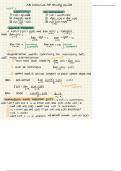
AB Calculus AP Study Guide
UNIT 1
continuity not continuous
& defined
f(x) =
① fal
L
=
undefined
② limf(x) value ② im
f(x) +
Uma-f(x)
=
X- a X-at
③ lim + (x)
=
f(a) ③ limf(x) + f(a)
* ->a X +a
SqueezeTheorem
If n(x) = f(x) =
g(x) and
limhx L
lmg
= =
,
then limf(x) =
L
am
HM
X - C =
1
X- 6
timx =
1
Jhorizonta
asymptote
a
timf(x) =
@J vertical
asymptote
UNIT 2
·
differentiation implies continuity but continuity does
# imply differentiation no sharp pt
_
① must have local linearity him f(x)
lm f(x)
=
+
X- a - a
& must be continuous him f(x) =
+(a)
*-a
③ cannot have a vertical tangent or place where slope und.
IROC derivative
Ex H f(x) f(x)
= = -
=
f (a) x) f(a)
I differencetient
1 a
= -
X -
a
AROC =
Slope (x+ h) f(x) =
= Yz Y
, -
-
U
X2 X , -
Intermediate value theorem (IVT) -
If f(x) is continuous
and +(a) #f(p) and c is in btwn fcal and f (b) , then +(c) =
K
D find f(a) and f(D) <
make sure f(x) is continuous
② is < btwn fla) and f(b) => are fca) and (b) different ?
③ find( values
& make sure c is in domain - answer format : +(a) <
K < f(b)
, differentiation rules
productRule
[] = 0 c = constant /
& (f(x)g(x)] = f(x)g(x) g(x) + (x)
+
* [KX] = K K = constant
Quotient Rule
& [x] =
-g(x
nx"nnteger =
& (k (x)] 1 8'(x)
-
=
+
.
& [f(x) = g(x) = f(x) =
g(x)
Transcendental derivatives
y sin(X)
=
y
= COS) y tan(X)
=
y =
sec(X
y
=
coS(X) y =
sin(X)
-
y cot (X)
=
y = -
es- (x)
=
sec(X) y =
sec(tan(*
) = ex y = eX
y y
cs(X) cS(X) co+ (x) y en(X) y=
' =
y
= -
y
Graphing Derivatives
& find local maximums a minimums (where t 0 =
② find recognizable shapes and use them to find a
↳ eX
: A
⑤ the more severe the slope ,
the bigger thenumberl will be
Absolute value
f(x) (x =
-
-
4) X
-
n= j
X= 4
↓
4) ;
S
-
(X -
X24
f(x) =
-
( -X 4) ; -
x 14
+ -
-
x+4 1 x -
4
f(x) = -
1 f(x) =
1
-
17 1
UNIT 3
·
differentiability must be continuous
UNIT 1
continuity not continuous
& defined
f(x) =
① fal
L
=
undefined
② limf(x) value ② im
f(x) +
Uma-f(x)
=
X- a X-at
③ lim + (x)
=
f(a) ③ limf(x) + f(a)
* ->a X +a
SqueezeTheorem
If n(x) = f(x) =
g(x) and
limhx L
lmg
= =
,
then limf(x) =
L
am
HM
X - C =
1
X- 6
timx =
1
Jhorizonta
asymptote
a
timf(x) =
@J vertical
asymptote
UNIT 2
·
differentiation implies continuity but continuity does
# imply differentiation no sharp pt
_
① must have local linearity him f(x)
lm f(x)
=
+
X- a - a
& must be continuous him f(x) =
+(a)
*-a
③ cannot have a vertical tangent or place where slope und.
IROC derivative
Ex H f(x) f(x)
= = -
=
f (a) x) f(a)
I differencetient
1 a
= -
X -
a
AROC =
Slope (x+ h) f(x) =
= Yz Y
, -
-
U
X2 X , -
Intermediate value theorem (IVT) -
If f(x) is continuous
and +(a) #f(p) and c is in btwn fcal and f (b) , then +(c) =
K
D find f(a) and f(D) <
make sure f(x) is continuous
② is < btwn fla) and f(b) => are fca) and (b) different ?
③ find( values
& make sure c is in domain - answer format : +(a) <
K < f(b)
, differentiation rules
productRule
[] = 0 c = constant /
& (f(x)g(x)] = f(x)g(x) g(x) + (x)
+
* [KX] = K K = constant
Quotient Rule
& [x] =
-g(x
nx"nnteger =
& (k (x)] 1 8'(x)
-
=
+
.
& [f(x) = g(x) = f(x) =
g(x)
Transcendental derivatives
y sin(X)
=
y
= COS) y tan(X)
=
y =
sec(X
y
=
coS(X) y =
sin(X)
-
y cot (X)
=
y = -
es- (x)
=
sec(X) y =
sec(tan(*
) = ex y = eX
y y
cs(X) cS(X) co+ (x) y en(X) y=
' =
y
= -
y
Graphing Derivatives
& find local maximums a minimums (where t 0 =
② find recognizable shapes and use them to find a
↳ eX
: A
⑤ the more severe the slope ,
the bigger thenumberl will be
Absolute value
f(x) (x =
-
-
4) X
-
n= j
X= 4
↓
4) ;
S
-
(X -
X24
f(x) =
-
( -X 4) ; -
x 14
+ -
-
x+4 1 x -
4
f(x) = -
1 f(x) =
1
-
17 1
UNIT 3
·
differentiability must be continuous


