

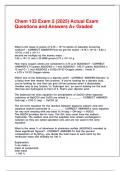
Chem 133 Exam 2 (2025) Actual Exam
Questions and Answers A+ Graded
What .is .the .mass .in .grams .of .9.76 .× .10^12 .atoms .of .naturally .occurring
.sodium? .- .CORRECT .ANSWER-First .we .get .the .moles .: .9.76 .x .10^12 ./ .6.02 .x
.10^23 .=1.62 .x .10^-11 .
second .we .multiply .by .the .atomic .mass .: .
1.62 .x .10^-11 .mol .x .22.9898 .g/mol=3.73 .x .10^-10 .g
How .many .oxygen .atoms .are .contained .in .2.74 .g .of .Al2(SO4)3? .- .CORRECT
.ANSWER-2.74 .grams .Al2(SO4)3 .x .1 .mol .Al2(SO4)3 ./ .342.17 .grams .Al2(SO4)3 .x .
12 .mol .O ./ .1 .mol .Al2(SO4)3 .x .6.022x10^23 .Oxygen .atoms ./ .1mole .O .
= .5.79 .x .10^22 .Oxygen .atoms
Which .one .of .the .following .is .a .diprotic .acid? .- .CORRECT .ANSWER-Diprotic' .is
.a .fancy .term .that .means .'two .protons.' .If .you're .looking .for .a .diprotic .acid,
.you're .looking .for .one .that .can .give .off .two .protons .when .it .dissociates.
.Another .way .to .say .'proton,' .is .'hydrogen .ion,' .so .you're .looking .for .the .acid
.that .has .two .hydrogens .in .front .of .it. .That's .your .diprotic .acid.
The .balanced .net .ionic .equation .for .precipitation .of .CaCO3 .when .aqueous
.solutions .of .Na2CO3 .and .CaCl2 .are .mixed .is .________. .- .CORRECT .ANSWER-
Ca2+(aq) .+ .CO3 .2- .(aq) .→ .CaCO3 .(s)
The .net .ionic .equation .for .the .reaction .between .aqueous .sulfuric .acid .and
.aqueous .sodium .hydroxide .is .________. .- .CORRECT .ANSWER-e .ionic .equation
.for .any .acid .reacting .with .any .base .is: .H+(aq) .+ .OH-(aq) .--> .H2O(l) .
The .H2SO4 .provides .the .H+ .ions. .The .OH- .ions .come .from .the .sodium
.hydroxide. .The .sodium .ions .and .the .sulphate .ions .remain .unchanged .in
.solution .so .they .are .called .spectator .ions .and .are .not .used .in .the .ionic
.equation
What .is .the .mass .% .of .aluminum .in .aluminum .sulfate .(Al2(SO4)3) .rounded .to
.three .significant .figures? .- .CORRECT .ANSWER-To .find .the .percent
.composition .of .Al₂(SO₄)₃, .you .divide .the .total .mass .of .each .atom .by .the
.molecular .mass .and .multiply .by .100 .%.
Explanation:
% .by .mass .= .
mass .of .component/
total .mass
.× .100 .%
, Mass .of .2 .Al .atoms .= .2 .Al .atoms .× .
26.98
/
1
Al .atom
.= .53.96 .u.
Mass .of .3 .S .atoms .= .3 .S .atoms .× .
32.06
/
1
S .atom
.= .96.18 .u
Mass .of .12 .O .atoms .= .12 .O .atoms .× .
16.00
/
1
O .atom
.= .192.0 .u
Mass .of .1 .Al₂(SO₄)₂ .formula .unit .= .(53.96 .+ .96.18 .+ .192.0) .u .= .342.1 .u
% .of .Al .= .
mass .of .Al
total .mass
.× .100 .% .= .
53.96
/
342.1
u
.× .100 .% .=15.77 .%
% .of .S .= .
mass .of .S
total .mass
.× .100 .% .= .
96.18
/
342.14
u
.× .100 .% .=28.11 .%
% .of .O .= .
mass .of .O
total .mass
.× .100 .% .= .
192.0
/
Questions and Answers A+ Graded
What .is .the .mass .in .grams .of .9.76 .× .10^12 .atoms .of .naturally .occurring
.sodium? .- .CORRECT .ANSWER-First .we .get .the .moles .: .9.76 .x .10^12 ./ .6.02 .x
.10^23 .=1.62 .x .10^-11 .
second .we .multiply .by .the .atomic .mass .: .
1.62 .x .10^-11 .mol .x .22.9898 .g/mol=3.73 .x .10^-10 .g
How .many .oxygen .atoms .are .contained .in .2.74 .g .of .Al2(SO4)3? .- .CORRECT
.ANSWER-2.74 .grams .Al2(SO4)3 .x .1 .mol .Al2(SO4)3 ./ .342.17 .grams .Al2(SO4)3 .x .
12 .mol .O ./ .1 .mol .Al2(SO4)3 .x .6.022x10^23 .Oxygen .atoms ./ .1mole .O .
= .5.79 .x .10^22 .Oxygen .atoms
Which .one .of .the .following .is .a .diprotic .acid? .- .CORRECT .ANSWER-Diprotic' .is
.a .fancy .term .that .means .'two .protons.' .If .you're .looking .for .a .diprotic .acid,
.you're .looking .for .one .that .can .give .off .two .protons .when .it .dissociates.
.Another .way .to .say .'proton,' .is .'hydrogen .ion,' .so .you're .looking .for .the .acid
.that .has .two .hydrogens .in .front .of .it. .That's .your .diprotic .acid.
The .balanced .net .ionic .equation .for .precipitation .of .CaCO3 .when .aqueous
.solutions .of .Na2CO3 .and .CaCl2 .are .mixed .is .________. .- .CORRECT .ANSWER-
Ca2+(aq) .+ .CO3 .2- .(aq) .→ .CaCO3 .(s)
The .net .ionic .equation .for .the .reaction .between .aqueous .sulfuric .acid .and
.aqueous .sodium .hydroxide .is .________. .- .CORRECT .ANSWER-e .ionic .equation
.for .any .acid .reacting .with .any .base .is: .H+(aq) .+ .OH-(aq) .--> .H2O(l) .
The .H2SO4 .provides .the .H+ .ions. .The .OH- .ions .come .from .the .sodium
.hydroxide. .The .sodium .ions .and .the .sulphate .ions .remain .unchanged .in
.solution .so .they .are .called .spectator .ions .and .are .not .used .in .the .ionic
.equation
What .is .the .mass .% .of .aluminum .in .aluminum .sulfate .(Al2(SO4)3) .rounded .to
.three .significant .figures? .- .CORRECT .ANSWER-To .find .the .percent
.composition .of .Al₂(SO₄)₃, .you .divide .the .total .mass .of .each .atom .by .the
.molecular .mass .and .multiply .by .100 .%.
Explanation:
% .by .mass .= .
mass .of .component/
total .mass
.× .100 .%
, Mass .of .2 .Al .atoms .= .2 .Al .atoms .× .
26.98
/
1
Al .atom
.= .53.96 .u.
Mass .of .3 .S .atoms .= .3 .S .atoms .× .
32.06
/
1
S .atom
.= .96.18 .u
Mass .of .12 .O .atoms .= .12 .O .atoms .× .
16.00
/
1
O .atom
.= .192.0 .u
Mass .of .1 .Al₂(SO₄)₂ .formula .unit .= .(53.96 .+ .96.18 .+ .192.0) .u .= .342.1 .u
% .of .Al .= .
mass .of .Al
total .mass
.× .100 .% .= .
53.96
/
342.1
u
.× .100 .% .=15.77 .%
% .of .S .= .
mass .of .S
total .mass
.× .100 .% .= .
96.18
/
342.14
u
.× .100 .% .=28.11 .%
% .of .O .= .
mass .of .O
total .mass
.× .100 .% .= .
192.0
/


