

NR509- Midterm Exam
Leave the first rating
Save
Terms in this set (376)
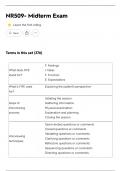
F: Feelings
What does FIFE I: Ideas
stand for? F: Function
E: Expectations
What is FIFE used Exploring the patient's perspective
for?
Initiating the session
steps of Gathering information
interviewing Physical examination
process Explanation and planning
Closing the session
Open-ended questions or comments
Closed questions or comments
Validating questions or comments
interviewing
Clarifying questions or comments
techniques
Reflective questions or comments
Sequencing questions or comments
Directing questions or comments
, Explaining point for point what the
examination will entail, preparing, privacy,
Setting the stage awareness of the setting in which the
for examination exam is taking place, do not assume it is
ok to have others in the room, being
aware of disabilities.
A key component to effective
communication with a patient is:
How you greet them and others in the
Establishing rapport
room
Provide them with comfort
Arrange the physical setting
How a person would like to be referred
Gender pronouns to. Ex: "She/Her" "He/Him" "They/Them"
etc.
Recognizes the importance of patients
expressions of personal concerns,
Patient centered
feelings and emotions and evokes the
medical care
personal context of the patient's
symptoms and disease
Active or attentive Listening
Empathetic response
guided questioning
Appropriate nonverbal communication
validation
Fundamentals of
reassurance
skilled interviewing
partnering
summarization
transitions
empowering patient
Appropriate verbal communication
, Use understandable language (simple,
verbal recognizable, and clear words)
communication Use nonstigmatizing language (people-
first language)
Body orientation toward and physical
proximity to patient
Gaze orientation toward patients (eye
contact)
nonverbal Head nodding with facial animation
communication Head nodding with gesture
Posture
Tone and use of voice
Use of silence
Use of touch
a. Silent
b. Talkative
c. With confusing narrative
d. With altered state or cognition
e. With emotional lability
f. Angry or aggressive
g. Flirtatious
Challenging patient h. Discriminatory
situations and i. With hearing loss
behaviors j. With low or impaired vision
k. With limited intelligence
l. Burdened by personal problems
m. Nonadherent
n. With low literacy
o. With low health literacy
p. With limited language proficiency
q. With terminal illness or dying
Leave the first rating
Save
Terms in this set (376)
F: Feelings
What does FIFE I: Ideas
stand for? F: Function
E: Expectations
What is FIFE used Exploring the patient's perspective
for?
Initiating the session
steps of Gathering information
interviewing Physical examination
process Explanation and planning
Closing the session
Open-ended questions or comments
Closed questions or comments
Validating questions or comments
interviewing
Clarifying questions or comments
techniques
Reflective questions or comments
Sequencing questions or comments
Directing questions or comments
, Explaining point for point what the
examination will entail, preparing, privacy,
Setting the stage awareness of the setting in which the
for examination exam is taking place, do not assume it is
ok to have others in the room, being
aware of disabilities.
A key component to effective
communication with a patient is:
How you greet them and others in the
Establishing rapport
room
Provide them with comfort
Arrange the physical setting
How a person would like to be referred
Gender pronouns to. Ex: "She/Her" "He/Him" "They/Them"
etc.
Recognizes the importance of patients
expressions of personal concerns,
Patient centered
feelings and emotions and evokes the
medical care
personal context of the patient's
symptoms and disease
Active or attentive Listening
Empathetic response
guided questioning
Appropriate nonverbal communication
validation
Fundamentals of
reassurance
skilled interviewing
partnering
summarization
transitions
empowering patient
Appropriate verbal communication
, Use understandable language (simple,
verbal recognizable, and clear words)
communication Use nonstigmatizing language (people-
first language)
Body orientation toward and physical
proximity to patient
Gaze orientation toward patients (eye
contact)
nonverbal Head nodding with facial animation
communication Head nodding with gesture
Posture
Tone and use of voice
Use of silence
Use of touch
a. Silent
b. Talkative
c. With confusing narrative
d. With altered state or cognition
e. With emotional lability
f. Angry or aggressive
g. Flirtatious
Challenging patient h. Discriminatory
situations and i. With hearing loss
behaviors j. With low or impaired vision
k. With limited intelligence
l. Burdened by personal problems
m. Nonadherent
n. With low literacy
o. With low health literacy
p. With limited language proficiency
q. With terminal illness or dying


