Florida Claims Adjuster Exam, 6-20 All Lines Adjuster- Florida- Review
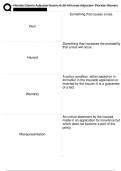
Something that causes a loss.
Peril
Something that increases the probability
that a loss will occur.
Hazard
A policy condition, either based on in-
formation in the insureds application or
inserted by the insurer. It is a guarantee
of a fact.
Warranty
An untrue statement by the insured,
made in an application for insurance but
which does not become a part of the
policy.
Misrepresentation
,Florida Claims Adjuster Exam, 6-20 All Lines Adjuster- Florida- Review
The failure of the insured to reveal rele-
vant facts known to the insured in apply-
ing for insurance.
Concealment
Property insurance policies usually con-
tain an abandonment clause, stating the
insured cannot dump damaged property
on the insurer and demand its full value.
Abandonment
The insurance applies separately to each
insured as if other insureds did not exist.
Severability
Proximate Cause
, Florida Claims Adjuster Exam, 6-20 All Lines Adjuster- Florida- Review
The cause having the most significant
impact in bringing about the loss under
a first-party property insurance policy,
when two or more independent perils op-
erate at the same time (i.e., concurrently)
to produce a loss. Courts employ a set of
rules to resolve causation disputes when
a property policy states that it covers or
excludes losses "caused by" a peril and
there is more than one peril at work in a
fact pattern. Under common law, whether
the policy provides coverage depends on
which peril is chosen as the proximate
cause.
Physical harm to tangible property.
Direct Loss
Economic loss which flows as a result of
direct loss.
Indirect Loss
Actual Cash Value(ACV)
, Florida Claims Adjuster Exam, 6-20 All Lines Adjuster- Florida- Review
Replacement Cost minus Depreciation
The amount, generally expressed as a
fixed percentage, an insured must pay
against a claim after the deductible is sat-
isfied. It's ultimately a way for the insured
and insurer to share responsibility for the
risk. It can also help reduce the cost of
the insurance policy premium. Coinsur-
Coinsurance ance can be written on an 80/20, 90/100,
or 100% rule.
Policies cover people who own and oper-
ate things, such as automobiles.
Personal Contract
Conditional Contract
Something that causes a loss.
Peril
Something that increases the probability
that a loss will occur.
Hazard
A policy condition, either based on in-
formation in the insureds application or
inserted by the insurer. It is a guarantee
of a fact.
Warranty
An untrue statement by the insured,
made in an application for insurance but
which does not become a part of the
policy.
Misrepresentation
,Florida Claims Adjuster Exam, 6-20 All Lines Adjuster- Florida- Review
The failure of the insured to reveal rele-
vant facts known to the insured in apply-
ing for insurance.
Concealment
Property insurance policies usually con-
tain an abandonment clause, stating the
insured cannot dump damaged property
on the insurer and demand its full value.
Abandonment
The insurance applies separately to each
insured as if other insureds did not exist.
Severability
Proximate Cause
, Florida Claims Adjuster Exam, 6-20 All Lines Adjuster- Florida- Review
The cause having the most significant
impact in bringing about the loss under
a first-party property insurance policy,
when two or more independent perils op-
erate at the same time (i.e., concurrently)
to produce a loss. Courts employ a set of
rules to resolve causation disputes when
a property policy states that it covers or
excludes losses "caused by" a peril and
there is more than one peril at work in a
fact pattern. Under common law, whether
the policy provides coverage depends on
which peril is chosen as the proximate
cause.
Physical harm to tangible property.
Direct Loss
Economic loss which flows as a result of
direct loss.
Indirect Loss
Actual Cash Value(ACV)
, Florida Claims Adjuster Exam, 6-20 All Lines Adjuster- Florida- Review
Replacement Cost minus Depreciation
The amount, generally expressed as a
fixed percentage, an insured must pay
against a claim after the deductible is sat-
isfied. It's ultimately a way for the insured
and insurer to share responsibility for the
risk. It can also help reduce the cost of
the insurance policy premium. Coinsur-
Coinsurance ance can be written on an 80/20, 90/100,
or 100% rule.
Policies cover people who own and oper-
ate things, such as automobiles.
Personal Contract
Conditional Contract