
DEVELOPMENTAL PSYCHOLOGY
WHAT IS DEVELOPMENT?
- A logical sequence of age-related changes that occur as an
individual progresses from conception to death
- Important developmental concepts and debates:
1. Stability vs. change
2. Nature vs. nurture
3. Continuity vs. discontinuity
4. Ontology vs. phylogeny
5. Normative vs. non-normative
- Development happens in a context [biological, cultural, social, historical and
economic]
- The context of the individual → RESILIENCE: the process of adapting well in the
face of adversity, trauma or significant sources of stress
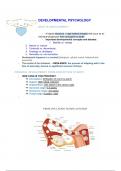
PRENATAL DEVELOPMENT: FROM CONCEPTION TO BIRTH
- HOW LONG IS THIS PROCESS?:
➔ Conception: fertilisation of ovum by sperm
➔ Zygote: ONE celled organism
➔ Implantation: cells attach to the uterine walls
➔ Germinal stage: 0-2 weeks
➔ Embryonic stage: 3-8 weeks
➔ Foetal stage: 9 weeks - birth
-
, - GERMINAL STAGE
➔ Conception to end of 2nd week
➔ Rapid cell division
➔ Egg + sperm + zygote
➔ Migration along the fallopian tube
➔ Implantation on the 7th day
➔ ⅕ zygotes are rejected
➔ The placenta begins to form
- EMBRYONIC STAGE
➔ From 2 weeks to the end of the 8th week
➔ Highly sensitive period: vital organs and bodily systems develop
➔ Highly vulnerable
➔ Week 3: brain and spinal cord develop heart, kidneys, digestive system, eyes
➔ Week 4: heart starts to beat, facial formation, endocrine system
➔ Week 5: arms, legs, cornea, lungs
➔ Weeks 6-8: liver and spleen, digestive and urinary systems, neural linking
➔ 8th week: App 1.2cm in length
- FOETAL STAGE
➔ From the 9th week – birth
➔ 3rd and 4th months: sex organs
➔ 4th month: begins to move
➔ End of the 5th month: cerebral cortex formed
➔ 6th month: eyes move, can breathe and cry
➔ End of 7th month: can see, hear, smell and taste
➔ Beginning of the 9th month: moves into the downward position
➔ ZONE OF VIABILITY: BETWEEN 22-26 WEEKS
PRENATAL RISKS: TERATOGENS
- TERRA → substances that can damage an embryo or foetus = MONSTER
- Gains access through the placenta
-
WHAT IS DEVELOPMENT?
- A logical sequence of age-related changes that occur as an
individual progresses from conception to death
- Important developmental concepts and debates:
1. Stability vs. change
2. Nature vs. nurture
3. Continuity vs. discontinuity
4. Ontology vs. phylogeny
5. Normative vs. non-normative
- Development happens in a context [biological, cultural, social, historical and
economic]
- The context of the individual → RESILIENCE: the process of adapting well in the
face of adversity, trauma or significant sources of stress
PRENATAL DEVELOPMENT: FROM CONCEPTION TO BIRTH
- HOW LONG IS THIS PROCESS?:
➔ Conception: fertilisation of ovum by sperm
➔ Zygote: ONE celled organism
➔ Implantation: cells attach to the uterine walls
➔ Germinal stage: 0-2 weeks
➔ Embryonic stage: 3-8 weeks
➔ Foetal stage: 9 weeks - birth
-
, - GERMINAL STAGE
➔ Conception to end of 2nd week
➔ Rapid cell division
➔ Egg + sperm + zygote
➔ Migration along the fallopian tube
➔ Implantation on the 7th day
➔ ⅕ zygotes are rejected
➔ The placenta begins to form
- EMBRYONIC STAGE
➔ From 2 weeks to the end of the 8th week
➔ Highly sensitive period: vital organs and bodily systems develop
➔ Highly vulnerable
➔ Week 3: brain and spinal cord develop heart, kidneys, digestive system, eyes
➔ Week 4: heart starts to beat, facial formation, endocrine system
➔ Week 5: arms, legs, cornea, lungs
➔ Weeks 6-8: liver and spleen, digestive and urinary systems, neural linking
➔ 8th week: App 1.2cm in length
- FOETAL STAGE
➔ From the 9th week – birth
➔ 3rd and 4th months: sex organs
➔ 4th month: begins to move
➔ End of the 5th month: cerebral cortex formed
➔ 6th month: eyes move, can breathe and cry
➔ End of 7th month: can see, hear, smell and taste
➔ Beginning of the 9th month: moves into the downward position
➔ ZONE OF VIABILITY: BETWEEN 22-26 WEEKS
PRENATAL RISKS: TERATOGENS
- TERRA → substances that can damage an embryo or foetus = MONSTER
- Gains access through the placenta
-


