

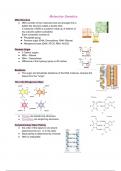
Molecular Genetics
DNA Structure
● DNA consists of two molecules that are arranged into a
ladder-like structure called a double helix.
A molecule of DNA is a polymer made up of millions of
tiny subunits called nucleotides
Each nucleotide consists of:
➔ Phosphate group
➔ Pentose sugar (DNA: Deoxyribose, RNA: Ribose)
➔ Nitrogenous base (DNA: ATCG, RNA: AUCG)
Pentose Sugar
● 5 Carbon sugars
● RNA – Ribose
● DNA – Deoxyribose
● Difference is the hydroxyl group on #2 carbon
Backbone
● The sugar and phosphate backbone of the DNA molecule, whereas the
bases form the “rungs”.
The 4 (5) Nitrogenous Base
● Purines are double-ring structures
● Pyrimidines are single-ring structures
Complementary Base Pairing
● the order of the bases in one strand
determines the ord er in the other
● Base pairing is determined by H-bonds
● DNA is antiparallel
,Sense and Antisense
Gene
● a sequence of nucleotides in DNA that performs a specific function, such as coding for a
particular protein
Transcription
● the process in which DNA is used as a template for the production of complementary
messenger RNA
Translation
● the process by which a ribosome assembles amino acids in a specific sequence to
synthesize a specific polypeptide coded by messenger RNA
Semiconservative Replication
● Involves separating the two parent strands and building a new complementary
replacement for each strand. The new molecules would consist of one parent and one
new strand
, DNA Replication
Step 1 - Strand Separation
DNA must be unwound:
● Starts with sequences called replication origins,
which act as a starting point for the replication
● Enzyme: helicase – binds to rings and unwinds
the two strands of DNA by breaking hydrogen
bonds between complementary base pairs
● As the two strands separate, they form a Y-shaped
structure known as a “replication fork”
Tension must be relieved
● Enzyme: topoisomerase/gyrase relieves tension of
unwinding DNA so there are no twists or tangles in
the DNA
● This tension is relieved by cutting one or two
strands near the replication fork, allowing the
strand to untangle, and then rejoining the cut
strands
Must prevent re-annealing
● Because complementary base pairs will reattach right away. Single-strand binding
proteins (SSBs) prevent annealing by attaching to the DNA strands to stabilize them and
keep them separated
● Helicase complexes can separate DNA strands in both directions from a replication
origin. After separation, new complementary nucleotides are added to the naked
strands.
● As two replication forks proceed in opposite directions, the space between them that is
filled with newly replicated DNA is called a “replication bubble”.
Step 2 - Building Complementary Strands
DNA Polymerase III
● New nucleotides are added to the 3’ end of a new strand
● Adds new nucleotides in a 5’-3’ direction only (can only add nucleotides to the 3’ end of
an existing DNA or RNA)
● DNA polymerase builds new strands of DNA using adenosine triphosphate (ATP)
● Will only start making new strands if there is something to add to (a primer)
● Primer is made by RNA primase
RNA Primase
● Primers are made of RNA
● These begin the process of replication by building small complementary RNA segments.
These short pieces of RNA are called “RNA primers”
● As the replication fork continues to open and separate the parent strands are oriented in
the 3’ to 5’ direction while the other is oriented in the opposite 5’ to 3’ direction
DNA Structure
● DNA consists of two molecules that are arranged into a
ladder-like structure called a double helix.
A molecule of DNA is a polymer made up of millions of
tiny subunits called nucleotides
Each nucleotide consists of:
➔ Phosphate group
➔ Pentose sugar (DNA: Deoxyribose, RNA: Ribose)
➔ Nitrogenous base (DNA: ATCG, RNA: AUCG)
Pentose Sugar
● 5 Carbon sugars
● RNA – Ribose
● DNA – Deoxyribose
● Difference is the hydroxyl group on #2 carbon
Backbone
● The sugar and phosphate backbone of the DNA molecule, whereas the
bases form the “rungs”.
The 4 (5) Nitrogenous Base
● Purines are double-ring structures
● Pyrimidines are single-ring structures
Complementary Base Pairing
● the order of the bases in one strand
determines the ord er in the other
● Base pairing is determined by H-bonds
● DNA is antiparallel
,Sense and Antisense
Gene
● a sequence of nucleotides in DNA that performs a specific function, such as coding for a
particular protein
Transcription
● the process in which DNA is used as a template for the production of complementary
messenger RNA
Translation
● the process by which a ribosome assembles amino acids in a specific sequence to
synthesize a specific polypeptide coded by messenger RNA
Semiconservative Replication
● Involves separating the two parent strands and building a new complementary
replacement for each strand. The new molecules would consist of one parent and one
new strand
, DNA Replication
Step 1 - Strand Separation
DNA must be unwound:
● Starts with sequences called replication origins,
which act as a starting point for the replication
● Enzyme: helicase – binds to rings and unwinds
the two strands of DNA by breaking hydrogen
bonds between complementary base pairs
● As the two strands separate, they form a Y-shaped
structure known as a “replication fork”
Tension must be relieved
● Enzyme: topoisomerase/gyrase relieves tension of
unwinding DNA so there are no twists or tangles in
the DNA
● This tension is relieved by cutting one or two
strands near the replication fork, allowing the
strand to untangle, and then rejoining the cut
strands
Must prevent re-annealing
● Because complementary base pairs will reattach right away. Single-strand binding
proteins (SSBs) prevent annealing by attaching to the DNA strands to stabilize them and
keep them separated
● Helicase complexes can separate DNA strands in both directions from a replication
origin. After separation, new complementary nucleotides are added to the naked
strands.
● As two replication forks proceed in opposite directions, the space between them that is
filled with newly replicated DNA is called a “replication bubble”.
Step 2 - Building Complementary Strands
DNA Polymerase III
● New nucleotides are added to the 3’ end of a new strand
● Adds new nucleotides in a 5’-3’ direction only (can only add nucleotides to the 3’ end of
an existing DNA or RNA)
● DNA polymerase builds new strands of DNA using adenosine triphosphate (ATP)
● Will only start making new strands if there is something to add to (a primer)
● Primer is made by RNA primase
RNA Primase
● Primers are made of RNA
● These begin the process of replication by building small complementary RNA segments.
These short pieces of RNA are called “RNA primers”
● As the replication fork continues to open and separate the parent strands are oriented in
the 3’ to 5’ direction while the other is oriented in the opposite 5’ to 3’ direction


