
Topography Associated with Horizontally Layered Rocks
CHARACTERISTICS AND PROCESSES ASSOCIATED WITH THE DEVELOPMENT
OF HILLY LANDSCAPES AND BASALTIC PLATEAUS
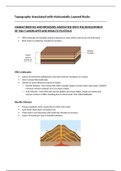
Hilly landscape and basaltic plateaus develop in areas where rock strata are horizontal.
Rock strata is uniformly resistant to erosion.
beddin
g plane
these
layers
erode at
the same
Hilly Landscapes
Layers of horizontal sedimentary rock with uniform resistance to erosion.
Form a steep hilly landscape.
Climate of area influences nature of slopes
Humid Climates - form steep hills with rounded slopes as sheet wash takes place. Rainfall
removes surface material as it runs down slopes
Arid Climates - form hills with narrow gullies and sharp ridges. Slopes are steep and
uneven as there is little rounding due to sheet wash. Also called badlands.
Basaltic Plateaus
Fissure eruptions have caused lava to flow onto earth.
Lave forms thick layers of basalt rock.
These layers are horizontal and uniformly resistant to erosion.
Layers of basalt give way to basaltic plateaus.
, CHARACTERISTICS AND PROCESSES ASSOCIATED WITH THE DEVELOPMENT
OF CANYON LANDSCAPES, KAROO LANDSCAPES AND SCARP RETREAT
Canyon landscapes - develop in areas where rocks are stratified, and strata is horizontal.
Rocks are not uniformly resistant to erosion.
Karoo landscapes develops from the canyon landscapes.
Canyon Landscapes
Result from horizontal strata vary in resistance to erosion.
How do canyons form?
Tectonic uplift results in a large flat surfaced plateau.
The horizontal resistant layer of rock prevents landscapes from becoming lower.
Rivers erode vertically along joints and cracks and for deep, steep valleys.
More resistant strata do not erode easily, form vertical cliffs, and less resistant strata
erode easily, form gentle slopes.
Climates influences canyons:
Humid Environment: water erodes slopes, makes canyon walls gentle and rounded.
Arid Environment: there is little rainfall, slopes remain steep.
Karoo Landscapes
Develop from canyon landscapes.
Consists of flat-topped mountains/hills differing in width, steepness and concave-shaped
sides.
Climate of Karoo is dry - little rain to make slopes gentle.
Resistant layer of rock at top of landform which is called cap rock is usually sandstone and
softer shale below.
Igneous intrusions can also for cap rock.
How does the Karoo landscape form?
Floor of canyon gets wider and plateau surface gets narrower.
Plateau remains at same height because of resistant cap rock.
Develops into a mesa.
When there is rain, water erodes the softer rock beneath cap rock and is formed into a
butte, pointed butte and then a conical hill.
CHARACTERISTICS AND PROCESSES ASSOCIATED WITH THE DEVELOPMENT
OF HILLY LANDSCAPES AND BASALTIC PLATEAUS
Hilly landscape and basaltic plateaus develop in areas where rock strata are horizontal.
Rock strata is uniformly resistant to erosion.
beddin
g plane
these
layers
erode at
the same
Hilly Landscapes
Layers of horizontal sedimentary rock with uniform resistance to erosion.
Form a steep hilly landscape.
Climate of area influences nature of slopes
Humid Climates - form steep hills with rounded slopes as sheet wash takes place. Rainfall
removes surface material as it runs down slopes
Arid Climates - form hills with narrow gullies and sharp ridges. Slopes are steep and
uneven as there is little rounding due to sheet wash. Also called badlands.
Basaltic Plateaus
Fissure eruptions have caused lava to flow onto earth.
Lave forms thick layers of basalt rock.
These layers are horizontal and uniformly resistant to erosion.
Layers of basalt give way to basaltic plateaus.
, CHARACTERISTICS AND PROCESSES ASSOCIATED WITH THE DEVELOPMENT
OF CANYON LANDSCAPES, KAROO LANDSCAPES AND SCARP RETREAT
Canyon landscapes - develop in areas where rocks are stratified, and strata is horizontal.
Rocks are not uniformly resistant to erosion.
Karoo landscapes develops from the canyon landscapes.
Canyon Landscapes
Result from horizontal strata vary in resistance to erosion.
How do canyons form?
Tectonic uplift results in a large flat surfaced plateau.
The horizontal resistant layer of rock prevents landscapes from becoming lower.
Rivers erode vertically along joints and cracks and for deep, steep valleys.
More resistant strata do not erode easily, form vertical cliffs, and less resistant strata
erode easily, form gentle slopes.
Climates influences canyons:
Humid Environment: water erodes slopes, makes canyon walls gentle and rounded.
Arid Environment: there is little rainfall, slopes remain steep.
Karoo Landscapes
Develop from canyon landscapes.
Consists of flat-topped mountains/hills differing in width, steepness and concave-shaped
sides.
Climate of Karoo is dry - little rain to make slopes gentle.
Resistant layer of rock at top of landform which is called cap rock is usually sandstone and
softer shale below.
Igneous intrusions can also for cap rock.
How does the Karoo landscape form?
Floor of canyon gets wider and plateau surface gets narrower.
Plateau remains at same height because of resistant cap rock.
Develops into a mesa.
When there is rain, water erodes the softer rock beneath cap rock and is formed into a
butte, pointed butte and then a conical hill.


