
• Wrong document? Swap it for free
  • Written by students who passed
  • Immediately available after payment
  • Read online or as PDF
Sell
Where do you study
Your language
Document preview thumbnail
Preview 3 out of 17 pages
Exam (elaborations)

WGU D664 EXAM QUESTIONS WITH CORRECT WELL DETAILED ANSWERS FOR A GUARANTEED PASS ALREADY GRADED A+

Document preview thumbnail
Preview 3 out of 17 pages

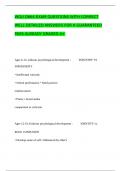
Ages 6-12, eriksons psychological development - INDUSTRY VS INFERIORITY • Intellectual curiosity • School performance • Need positive reinforcement • Praise • Avoid undue competition or criticism Ages 12-19, Eriksons psychological development - IDENTITY vs. ROLE CONFUSION • Develop sense of self • Influenced by other's reactions • Peers more important than parents or teachers • Social role models • Figuring out what they want to do after high school Birth - age 2, Piaget - SENSORIMOTOR • Reflexive or active • Sucking • Grabbing • Looking • Listening • Crawling • Object Permanence (unseen things still exist) Learning through movement and senses Ages 2-7, Piaget - Prelogical Thought PREOPERATIONAL • Play and pretend • Symbolic thinking • Language develops • Forms many new schemes • Egocentrism (focus on self, self-centered) • Centration (focus on only one aspect at a time) Ages 7-11, Piaget - Factual and Logical Thought CONCRETE OPERATIONAL • Need concrete, hands-on experiences • Mental reversal (balloons inflate-deflate) • Seriation • Sorting • Classitying • Conservation (tall skinny glass and short fat glass hold same amount of liquid) Sensory Exploration - involves activities that engage the senses—touch, sight, hearing, smell, and taste—helping children explore and understand the world around them autonomy versus shame/doubt stage - This stage involves a child's journey toward independence and decision-making trust versus mistrust stage - Infants learn to rely on caregivers for their basic needs, fostering trust—while inconsistency in meeting these needs can lead to mistrust, suspicion, and anxiety about their environment. object permanence - the understanding that something still exists even though it cannot be seen or heard sensorimotor stage - Infants (0-2 years old) explore through senses and actions, developing an understanding of object permanence and laying cognitive foundations Cognitive Transition - The transition from the sensorimotor stage to the preoperational stage is marked by mastery of object permanence, recognition of themselves as separate from their environment, and the realization that they can affect the objects and people around them. sensorimotor - Children know the world through movement and their senses. They learn through grasping, sucking, looking, and listening. Social Transition to Autonomy - shame vs doubt - At about 18 months old, a child transitions from the crisis of trust-mistrust to the crisis of autonomy-shame/doubt. This transition is marked by the desire to accomplish daily tasks by themselves. When children feel safe trying tasks on their own, even though they may not yet be capable, they move into the next stage.

Content preview

WGU D664 EXAM QUESTIONS WITH CORRECT

WELL DETAILED ANSWERS FOR A GUARANTEED

PASS ALREADY GRADED A+


Ages 6-12, eriksons psychological development - ✅✅INDUSTRY VS

INFERIORITY

• Intellectual curiosity

• School performance • Need positive

reinforcement

• Praise • Avoid undue

competition or criticism


Ages 12-19, Eriksons psychological development - ✅✅IDENTITY vs.

ROLE CONFUSION

• Develop sense of self • Influenced by other's

,reactions • Peers more important than parents or

teachers

• Social role models • Figuring out what they want to do after high

school


Birth - age 2, Piaget - ✅✅SENSORIMOTOR

• Reflexive or active

• Sucking

• Grabbing

• Looking

• Listening

• Crawling • Object Permanence (unseen

things still exist)


Learning through movement and senses

, Ages 2-7, Piaget - ✅✅Prelogical Thought


PREOPERATIONAL

• Play and pretend

• Symbolic thinking

• Language develops

• Forms many new schemes • Egocentrism (focus on self,

self-centered) • Centration (focus on only

one aspect at a time)


Ages 7-11, Piaget - ✅✅Factual and Logical Thought


CONCRETE OPERATIONAL • Need concrete, hands-on

experiences • Mental reversal (balloons

inflate-deflate)

• Seriation

Document information

Uploaded on
May 6, 2025
Number of pages
17
Written in
2024/2025
Type
Exam (elaborations)
Contains
Questions & answers
$9.99

Wrong document? Swap it for free Within 14 days of purchase and before downloading, you can choose a different document. You can simply spend the amount again.
Written by students who passed
Immediately available after payment
Read online or as PDF

Seller avatar
Aceyourscores
4.0
(1)
Sold
2
Followers
1
Items
253
Last sold
1 year ago


Why students choose Stuvia

Created by fellow students, verified by reviews

Quality you can trust: written by students who passed their tests and reviewed by others who've used these notes.

Didn't get what you expected? Choose another document

No worries! You can instantly pick a different document that better fits what you're looking for.

Pay as you like, start learning right away

No subscription, no commitments. Pay the way you're used to via credit card and download your PDF document instantly.

Student with book image

“Bought, downloaded, and aced it. It really can be that simple.”

Alisha Student

Working on your references?

Create accurate citations in APA, MLA and Harvard with our free citation generator.

Working on your references?

Frequently asked questions
