
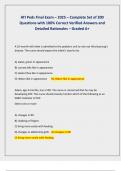
ATI Peds Final Exam – 2025 – Complete Set of 200
Questions with 100% Correct Verified Answers and
Detailed Rationales – Graded A+
A 10-month-old infant is admitted to the pediatric unit to rule out Hirschsprung's
disease. The nurse should expect the infant's stool to be
A) water, green in appearance
B) currant jelly like in appearance
C) steatorrhea like in appearance
D) ribbon like in appearance D) ribbon like in appearance
Adam, age 4 months, has a VSD. The nurse is concerned that he may be
developing CHF. The nurse should closely monitor which of the following as an
EARLY indicator of CHF
Select one or more
A) changes in RR
B) clubbing of fingers
C) tiring more easily with feeding
D) changes in abdominal girth A) changes in RR
C) tiring more easily with feeding
,A nurse conducts teaching with parents about the cause of tinea capitis. The nurse
evaluates success of the teaching when the parent repeats which of the
following?
A) it is a result from overexposure to the sun
B) it is caused by infestations with mites
C) it is an allergic reaction
D) it is a fungal infection of the scalp D) it is a fungal infection of the scalp
An adolescent with type 1 DM tells the nurse she is feeling lightheaded. The
adolescents Blood glucose is 60. Which of the following interventions would be
best to safely and effectively correct her blood sugar?
A) give 15 mls of juice and some crackers, follow up with protein
B) give 15 g of carbs, no protein and retest BG level in 1 hr
C) give 15 g simple carbs, retest BG in 15 min and then follow up with 16 g
complex carbs & 7 g protein if next meal is more than 60 min away
D) give 15 oz of juice and retest BG in 15 min, then administer glucose tabs if BG is
still low C) give 15 g simple carbs, retest BG in 15 min and then follow up
with 16 g complex carbs & 7 g protein if next meal is more than 60 min away
The infant with congenital heart defects often has a need for
A) increased calories
B) increased fluids
,C) decreased electrolytes
D) increased activity and physical therapy A) increased calories
The nurse explains to a parent that the normal reaction an infant may experience
12-25 hrs after receiving a dtap immunization. The nurse determines the teaching
is effective when the parent asks:
A) should i wake my baby up to breastfeed more frequently?
B) how much acetaminophen should i give for the fever?
C) can you give imodium to an infant?
D) what kind of nose spray can I use for the baby's condition B) how much
acetaminophen should i give for the fever?
A child presents with FTT (failure to thrive) secondary to GER (Gastroesophageal
reflux). Which of the following s/s may be seen in this child?
A) avoidance of care giver attention
B) an associated malabsorption defect
C) weight that falls below the 5th percentile
D) an abnormal achievement of developmental milestones C) weight that
falls below the 5th percentile
Which nursing consideration is important when caring for an infant that
demonstrates failure to thrive?
, A) establish a structured routine that is followed consistently
B) require the parent to room in and provide the child's care
C) place the child within an infant seat during feedings to prevent overstimulation
D) limit sensory play activities A) establish a structured routine that is followed
consistently
The most appropriate means of rehydration of a 7 month old with diarrhea and
mild dehydration is
A) oral rehydration therapy with an electrolyte solution
B) administration of 20 ml/kg IV fluid bolus of LR or Normal Saline
C) Administration of maintenance IV fluid of Dextrose 5% and 1/4 normal saline
D) offering BRAT diet (bananas, rice, applesauce, toast) A) oral rehydration
therapy with an electrolyte solution
A 2 month old is admitted to the ED with severe diarrhea. The physician orders IV
fluids with potassium. Prior to starting the infusion, the nurse should assess for
which of the following?
A) that the child has voided
B) anxiety
C) the baby is resting comfortably
D) has a temperature of 98.6 A) that the child has voided
Questions with 100% Correct Verified Answers and
Detailed Rationales – Graded A+
A 10-month-old infant is admitted to the pediatric unit to rule out Hirschsprung's
disease. The nurse should expect the infant's stool to be
A) water, green in appearance
B) currant jelly like in appearance
C) steatorrhea like in appearance
D) ribbon like in appearance D) ribbon like in appearance
Adam, age 4 months, has a VSD. The nurse is concerned that he may be
developing CHF. The nurse should closely monitor which of the following as an
EARLY indicator of CHF
Select one or more
A) changes in RR
B) clubbing of fingers
C) tiring more easily with feeding
D) changes in abdominal girth A) changes in RR
C) tiring more easily with feeding
,A nurse conducts teaching with parents about the cause of tinea capitis. The nurse
evaluates success of the teaching when the parent repeats which of the
following?
A) it is a result from overexposure to the sun
B) it is caused by infestations with mites
C) it is an allergic reaction
D) it is a fungal infection of the scalp D) it is a fungal infection of the scalp
An adolescent with type 1 DM tells the nurse she is feeling lightheaded. The
adolescents Blood glucose is 60. Which of the following interventions would be
best to safely and effectively correct her blood sugar?
A) give 15 mls of juice and some crackers, follow up with protein
B) give 15 g of carbs, no protein and retest BG level in 1 hr
C) give 15 g simple carbs, retest BG in 15 min and then follow up with 16 g
complex carbs & 7 g protein if next meal is more than 60 min away
D) give 15 oz of juice and retest BG in 15 min, then administer glucose tabs if BG is
still low C) give 15 g simple carbs, retest BG in 15 min and then follow up
with 16 g complex carbs & 7 g protein if next meal is more than 60 min away
The infant with congenital heart defects often has a need for
A) increased calories
B) increased fluids
,C) decreased electrolytes
D) increased activity and physical therapy A) increased calories
The nurse explains to a parent that the normal reaction an infant may experience
12-25 hrs after receiving a dtap immunization. The nurse determines the teaching
is effective when the parent asks:
A) should i wake my baby up to breastfeed more frequently?
B) how much acetaminophen should i give for the fever?
C) can you give imodium to an infant?
D) what kind of nose spray can I use for the baby's condition B) how much
acetaminophen should i give for the fever?
A child presents with FTT (failure to thrive) secondary to GER (Gastroesophageal
reflux). Which of the following s/s may be seen in this child?
A) avoidance of care giver attention
B) an associated malabsorption defect
C) weight that falls below the 5th percentile
D) an abnormal achievement of developmental milestones C) weight that
falls below the 5th percentile
Which nursing consideration is important when caring for an infant that
demonstrates failure to thrive?
, A) establish a structured routine that is followed consistently
B) require the parent to room in and provide the child's care
C) place the child within an infant seat during feedings to prevent overstimulation
D) limit sensory play activities A) establish a structured routine that is followed
consistently
The most appropriate means of rehydration of a 7 month old with diarrhea and
mild dehydration is
A) oral rehydration therapy with an electrolyte solution
B) administration of 20 ml/kg IV fluid bolus of LR or Normal Saline
C) Administration of maintenance IV fluid of Dextrose 5% and 1/4 normal saline
D) offering BRAT diet (bananas, rice, applesauce, toast) A) oral rehydration
therapy with an electrolyte solution
A 2 month old is admitted to the ED with severe diarrhea. The physician orders IV
fluids with potassium. Prior to starting the infusion, the nurse should assess for
which of the following?
A) that the child has voided
B) anxiety
C) the baby is resting comfortably
D) has a temperature of 98.6 A) that the child has voided


