CVS 200- EXAM 1 questions with correct answers
A+ rated
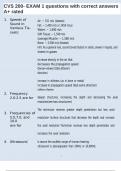
1. Speeds of Air: ~ 331 m/s (slowest)
Sound in Fat: ~ 1,450 m/s or 1450 m/us
Various Tis-
Water: ~ 1,480 m/s
sues:
Soft Tissue: ~ 1,540 m/s
(average) Muscle: ~ 1,580 m/s
Bone: ~ 3,500 m/s (fastest)
hint: As a general rule, sound travels fastest in solids, slower in liquids, and
slowest in gases
increase density in the air that
decreases the propagation speed
Denser=slower (D&S ditterent
direction)
increase in stittness (as in bone or metal)
increase in propagation speed (S&S same direction)
stitter=faster
2. Frequency
2.0-2.5 are for deeper structures, increasing the depth and decreasing the axial
resolution(see two structures)
The technician receives greater depth penetration but less axial
3. Frequencies of
5.0,7.0, and resolution• Surface structures that decrease the depth and increase
10.0
are for the axial resolution Technician receives less depth penetration and
increases the axial resolution
4. Ultrasound is above the audible range of human hearing-
ultrasound is above/greater than 20KHz or 20,000Hz
1/
22
,CVS 200- EXAM 1 questions with correct answers
A+ rated
-Sound waves beyond the audible range
-Diagnostic applications of ultrasound use
frequencies of 1-10 MHz
-Ultrasound is used to evaluate soft tissue
2/
22
, CVS 200- EXAM 1 questions with correct answers
A+ rated
5. Infrasound Below/Less the audible range of human hearing (animals)- infrasound
is below 20Hz
6. Audible Is the range of human hearing-between 20Hz-20,000Hz or 20Hz-20KHz
7. The speed of 1540 m/sec or 1.54mm/us
Soft tissue is
8. The speed of
330 m/sec
Air is
9. The speed
3500m/sec
of Bond is
10. The speed of
Fat is 1450m/sec
11. Sound is a longitudinal mechanical wave
Sound is a type of mechanical wave that travels through a medium (such
as air, water, or solid materials) by causing the particles in the medium
to vibrate
12. in phase waves when their peaks (max values) occur at the same time and location
peak simultaneous
13. out of their peaks occur at ditterent times
phase
waves
3/
22
A+ rated
1. Speeds of Air: ~ 331 m/s (slowest)
Sound in Fat: ~ 1,450 m/s or 1450 m/us
Various Tis-
Water: ~ 1,480 m/s
sues:
Soft Tissue: ~ 1,540 m/s
(average) Muscle: ~ 1,580 m/s
Bone: ~ 3,500 m/s (fastest)
hint: As a general rule, sound travels fastest in solids, slower in liquids, and
slowest in gases
increase density in the air that
decreases the propagation speed
Denser=slower (D&S ditterent
direction)
increase in stittness (as in bone or metal)
increase in propagation speed (S&S same direction)
stitter=faster
2. Frequency
2.0-2.5 are for deeper structures, increasing the depth and decreasing the axial
resolution(see two structures)
The technician receives greater depth penetration but less axial
3. Frequencies of
5.0,7.0, and resolution• Surface structures that decrease the depth and increase
10.0
are for the axial resolution Technician receives less depth penetration and
increases the axial resolution
4. Ultrasound is above the audible range of human hearing-
ultrasound is above/greater than 20KHz or 20,000Hz
1/
22
,CVS 200- EXAM 1 questions with correct answers
A+ rated
-Sound waves beyond the audible range
-Diagnostic applications of ultrasound use
frequencies of 1-10 MHz
-Ultrasound is used to evaluate soft tissue
2/
22
, CVS 200- EXAM 1 questions with correct answers
A+ rated
5. Infrasound Below/Less the audible range of human hearing (animals)- infrasound
is below 20Hz
6. Audible Is the range of human hearing-between 20Hz-20,000Hz or 20Hz-20KHz
7. The speed of 1540 m/sec or 1.54mm/us
Soft tissue is
8. The speed of
330 m/sec
Air is
9. The speed
3500m/sec
of Bond is
10. The speed of
Fat is 1450m/sec
11. Sound is a longitudinal mechanical wave
Sound is a type of mechanical wave that travels through a medium (such
as air, water, or solid materials) by causing the particles in the medium
to vibrate
12. in phase waves when their peaks (max values) occur at the same time and location
peak simultaneous
13. out of their peaks occur at ditterent times
phase
waves
3/
22