

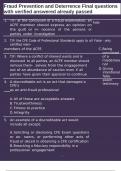
Fraud Prevention and Deterrence Final questions
with verified answered already passed
1. T/F: at the conclusion of a fraud examination, an
False
ACFE member should express an opinion on
the guilt or in- nocence of the persons or
parties under investigation
2. T/F: the CFE Code of Professional Standards apply to all False - only
certified mem-
members of the ACFE C. Being
convicted
3. T/F: Where a conflict of interest exists and is of a
disclosed to all parties, an ACFE member should misdemea
remove them- selves from the engagement nor
out of an abundance of caution even if all D. Giving
intentional
parties have given their approval to continue
false
sworn
4. A discreditable act is an act that damaged a
testimony
CFE's
as an anti-fraud professional
A. All of these are acceptable answers
B. Trustworthiness
C. Fitness to practice
D. Integrity
5. An example of a discreditable act would
include all except:
A. Soliciting or disclosing CFE Exam questions
or an- swers, or performing other acts of
fraud or deceit in obtaining a CFE certification
B. Breaching a fiduciary responsibility in a
professional engagement
, Fraud Prevention and Deterrence Final questions
with verified answered already passed
ers not associate False
6. True
,Fraud Prevention and Deterrence Final questions
with verified answered already passed
T/F: the fact that a fraud examination might fraud?
deviate in course from the CFE's initial plan does
not necessarily indicate that the CFE failed to A. The
adequately plan the engagement nature of
the
7. T/F: at the outset of a fraud examination, the business
in which it
CFE should communicate with his or her
is
client/employer to ensure that there is engaged
mutual understanding regard- ing the scope, B. The
expectations, subject matter, compensa- tion, environme
deliverables and other key issues concerning nt in
the examination which it
operates
8. Predication is required for which of the C. The
following en- gagements conducted by a CFE? effectiven
ess of its
A. Risk assessment internal
controls
B. Conduct a non-forensic internal or external
audit
C. Consulting service
D. Fraud examination
9. T/F: ethics is concerned with what is right or
wrong as well as what is legal or illegal
10. T/F: what constitutes adequate
documentation and work product is
something that can vary greatly from case
to case
11. Which of the following is not a factor that
influences how at-risk an organization is to
, Fraud Prevention and Deterrence Final questions
with verified answered already passed
rue
D
alse
rue
with verified answered already passed
1. T/F: at the conclusion of a fraud examination, an
False
ACFE member should express an opinion on
the guilt or in- nocence of the persons or
parties under investigation
2. T/F: the CFE Code of Professional Standards apply to all False - only
certified mem-
members of the ACFE C. Being
convicted
3. T/F: Where a conflict of interest exists and is of a
disclosed to all parties, an ACFE member should misdemea
remove them- selves from the engagement nor
out of an abundance of caution even if all D. Giving
intentional
parties have given their approval to continue
false
sworn
4. A discreditable act is an act that damaged a
testimony
CFE's
as an anti-fraud professional
A. All of these are acceptable answers
B. Trustworthiness
C. Fitness to practice
D. Integrity
5. An example of a discreditable act would
include all except:
A. Soliciting or disclosing CFE Exam questions
or an- swers, or performing other acts of
fraud or deceit in obtaining a CFE certification
B. Breaching a fiduciary responsibility in a
professional engagement
, Fraud Prevention and Deterrence Final questions
with verified answered already passed
ers not associate False
6. True
,Fraud Prevention and Deterrence Final questions
with verified answered already passed
T/F: the fact that a fraud examination might fraud?
deviate in course from the CFE's initial plan does
not necessarily indicate that the CFE failed to A. The
adequately plan the engagement nature of
the
7. T/F: at the outset of a fraud examination, the business
in which it
CFE should communicate with his or her
is
client/employer to ensure that there is engaged
mutual understanding regard- ing the scope, B. The
expectations, subject matter, compensa- tion, environme
deliverables and other key issues concerning nt in
the examination which it
operates
8. Predication is required for which of the C. The
following en- gagements conducted by a CFE? effectiven
ess of its
A. Risk assessment internal
controls
B. Conduct a non-forensic internal or external
audit
C. Consulting service
D. Fraud examination
9. T/F: ethics is concerned with what is right or
wrong as well as what is legal or illegal
10. T/F: what constitutes adequate
documentation and work product is
something that can vary greatly from case
to case
11. Which of the following is not a factor that
influences how at-risk an organization is to
, Fraud Prevention and Deterrence Final questions
with verified answered already passed
rue
D
alse
rue


