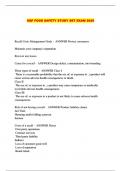
SQF FOOD SAFETY STUDY SET EXAM 2025
Recall Crisis Management Goals - ANSWER Protect consumers
Maintain your company's reputation
Recover any losses
Cause for a recall - ANSWER Design defect, contamination, mis-branding
Three types of recall - ANSWER Class I
There is a reasonable probability that the use of, or exposure to , a product will
cause serious adverse health consequences or death.
Class II
The use of, or exposure to , a product may cause temporary or medically
reversible adverse health consequences.
Class III
The use of, or exposure to a product is not likely to cause adverse health
consequences.
Risk of not having a recall - ANSWER Product liability claims
Jail Time
Harming and/or killing a person
Seizure
Costs of a recall - ANSWER Direct
First party operations
Contract services
Third party liability
Indirect
Loss of customer good will
Loss of reputation
Brand rehab
, Georgia Tech findings - ANSWER That fast response to a recall can improve
customer satisfaction
Mock Recall - ANSWER The product withdrawal and recall system shall be
reviewed, tested and verified as effective at least annually.
Ensure everyone on the product withdrawal team understands their role
Goal is for 100% Traceability within 2 hours
Any shortcomings should be evaluated and tested again after alteration
CIP and Traceability - ANSWER CIP type designated for Critical Tracking
Event equipment. (Full, Sanitize)
CIP occurs on raw silos before refilling.
CIP resets Critical Tracking Event lot when complete.
Why SQF/GSFI - ANSWER - Build Confidence in Third Party Certification -
Reduce Inefficiency in the Food System
Why SQF for retailers - ANSWER • From a retailer perspective it is critical
that they have confidence in the audits of their suppliers
• From a supplier perspective the duplication of audit effort is not sustainable
Why SQF for suppliers? - ANSWER Where management is committed to
creating a food safety management culture:
- Recalls and market withdraws are reduced - Efficiencies are increased
- Costs are lowered
• Where management's interest is complying with a buyer's certification
requirements:
- A certificate is issued
Definition of Quality - ANSWER A good quality product is one that
consistently meets the needs of the customer at the lowest cost to the producer
• Quality is a moving target
• Its control has evolved over time from QC, to QA to TQM
Cost, consistency, conformance
Recall Crisis Management Goals - ANSWER Protect consumers
Maintain your company's reputation
Recover any losses
Cause for a recall - ANSWER Design defect, contamination, mis-branding
Three types of recall - ANSWER Class I
There is a reasonable probability that the use of, or exposure to , a product will
cause serious adverse health consequences or death.
Class II
The use of, or exposure to , a product may cause temporary or medically
reversible adverse health consequences.
Class III
The use of, or exposure to a product is not likely to cause adverse health
consequences.
Risk of not having a recall - ANSWER Product liability claims
Jail Time
Harming and/or killing a person
Seizure
Costs of a recall - ANSWER Direct
First party operations
Contract services
Third party liability
Indirect
Loss of customer good will
Loss of reputation
Brand rehab
, Georgia Tech findings - ANSWER That fast response to a recall can improve
customer satisfaction
Mock Recall - ANSWER The product withdrawal and recall system shall be
reviewed, tested and verified as effective at least annually.
Ensure everyone on the product withdrawal team understands their role
Goal is for 100% Traceability within 2 hours
Any shortcomings should be evaluated and tested again after alteration
CIP and Traceability - ANSWER CIP type designated for Critical Tracking
Event equipment. (Full, Sanitize)
CIP occurs on raw silos before refilling.
CIP resets Critical Tracking Event lot when complete.
Why SQF/GSFI - ANSWER - Build Confidence in Third Party Certification -
Reduce Inefficiency in the Food System
Why SQF for retailers - ANSWER • From a retailer perspective it is critical
that they have confidence in the audits of their suppliers
• From a supplier perspective the duplication of audit effort is not sustainable
Why SQF for suppliers? - ANSWER Where management is committed to
creating a food safety management culture:
- Recalls and market withdraws are reduced - Efficiencies are increased
- Costs are lowered
• Where management's interest is complying with a buyer's certification
requirements:
- A certificate is issued
Definition of Quality - ANSWER A good quality product is one that
consistently meets the needs of the customer at the lowest cost to the producer
• Quality is a moving target
• Its control has evolved over time from QC, to QA to TQM
Cost, consistency, conformance