Administration of Criminal Justice: Test 1 study guide 2025
updated
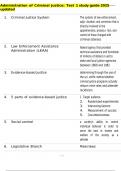
1. Criminal Justice System The system of law enforcement,
adju- dication, and correction that is
directly involved in the
apprehension, prosecu- tion, and
control of those charged with
criminal ottenses
2. Law Enforcement Assistance federal agency that provided
Administration (LEAA) technical assistance and hundreds
of millions of dollars in aid to
state and local justice agencies
between 1969 and 1982
3. Evidence-based justice determining through the use of
the sci- entific method whether
criminal justice programs actually
reduce crime rates and ottender
recidivism
4. 5 parts of evidence-based justice 1. Target audience
2. Randomized experiments
3. Intervening factors
4. Measurement of success
5. Cost-ettectiveness
5. Social control a society's ability to control
individual behavior in order to
serve the best in- terests and
welfare of the society as a
whole
6. Legislative Branch Makes laws
,Administration of Criminal Justice: Test 1 study guide 2025
updated
7. judical branch the branch of government,
including the federal court system,
that interprets the nation's laws
,Administration of Criminal Justice: Test 1 study guide 2025
updated
8. Executive Branch Enforces laws
9. Initial Contact An ottender's initial contact with
the criminal justice system takes
place as a result of police action
10. Investigation gather enough evidence to
identify a suspect and support
legal arrest
11. Arrest probable cause, deprives individual o
freedom, suspect believes that
they are now in the custody of the
police and has lost their liberty
12. in-presence requirement a police oflcer cannot arrest
someone for a misdemeanor
unless the oflcer sees the crime
occur. To make an arrest for a
crime the oflcer did not witness,
an arrest warrant must be
obtained.
13. Custody After an arrest and while the
suspect is being detained, the
police may wish to search for
evidence, conduct an interro-
gation, or even encourage a
confession
14. Charging If the arresting oflcers or their
superi- ors believe that suflcient
evidence ex- ists to charge a
person with a crime, the case will
,Administration of Criminal Justice: Test 1 study guide 2025
updated
be turned over to the prosecu-
tor's oflce.
15. Miranda warning Miranda v. Arizona established that
sus- pects under arrest must be
advised
updated
1. Criminal Justice System The system of law enforcement,
adju- dication, and correction that is
directly involved in the
apprehension, prosecu- tion, and
control of those charged with
criminal ottenses
2. Law Enforcement Assistance federal agency that provided
Administration (LEAA) technical assistance and hundreds
of millions of dollars in aid to
state and local justice agencies
between 1969 and 1982
3. Evidence-based justice determining through the use of
the sci- entific method whether
criminal justice programs actually
reduce crime rates and ottender
recidivism
4. 5 parts of evidence-based justice 1. Target audience
2. Randomized experiments
3. Intervening factors
4. Measurement of success
5. Cost-ettectiveness
5. Social control a society's ability to control
individual behavior in order to
serve the best in- terests and
welfare of the society as a
whole
6. Legislative Branch Makes laws
,Administration of Criminal Justice: Test 1 study guide 2025
updated
7. judical branch the branch of government,
including the federal court system,
that interprets the nation's laws
,Administration of Criminal Justice: Test 1 study guide 2025
updated
8. Executive Branch Enforces laws
9. Initial Contact An ottender's initial contact with
the criminal justice system takes
place as a result of police action
10. Investigation gather enough evidence to
identify a suspect and support
legal arrest
11. Arrest probable cause, deprives individual o
freedom, suspect believes that
they are now in the custody of the
police and has lost their liberty
12. in-presence requirement a police oflcer cannot arrest
someone for a misdemeanor
unless the oflcer sees the crime
occur. To make an arrest for a
crime the oflcer did not witness,
an arrest warrant must be
obtained.
13. Custody After an arrest and while the
suspect is being detained, the
police may wish to search for
evidence, conduct an interro-
gation, or even encourage a
confession
14. Charging If the arresting oflcers or their
superi- ors believe that suflcient
evidence ex- ists to charge a
person with a crime, the case will
,Administration of Criminal Justice: Test 1 study guide 2025
updated
be turned over to the prosecu-
tor's oflce.
15. Miranda warning Miranda v. Arizona established that
sus- pects under arrest must be
advised