Solution Manual For
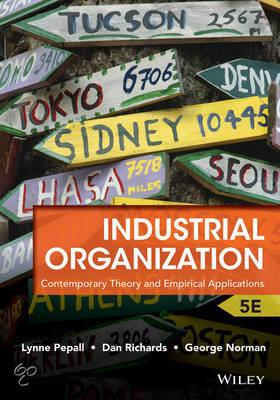
Industrial organization: Contemporary Theory and Empirical Applications 5th Edition Lynne
Pepall Dan Richards George Norman
Chapter 1-14
exams include:Multiple Choice Questions (MCQs): These are frequently used to assess students’ understanding of business terminology, theories, and principles.Case Studies: A staple of business exams, case
studies present students with real-world business scenarios and ask them to apply their knowledge to solve complex problems. Case studies evaluate students' ability to think critically and make strategic
decisions.Essay/Short Answer Questions: These types of questions test the student’s ability to explain and analyze business concepts in a detailed and coherent manner.1.3. Skills Tested in Business ExamsCritical
Thinking and Problem-Solving: Business exams often include case studies that challenge students to apply theoretical knowledge to real-life situations. These tests assess decision-making skills, as well as the
ability to evaluate various business alternatives.Quantitative Analysis: For subjects like finance or economics, business exams often require students to perform calculations and interpret data. The ability to
analyze financial statements, project revenues, and manage budgets is essential.Communicatio
Chapter 1: Industrial Organization: What, How and Why?
Problem 1
Many examples imperfectly competitive markets are possible. Common ones include: (1)
Automobiles, (2) Beer, (3) Telephone/Telecommunications, (4) Jet Aircraft, (5) Patented
Pharmaceuticals, and (6) Computer Operating Systems, .Large entry costs, scale economies,
network effects and government regulations all play a role in these examples.
Problem 2
In a perfectly competitive market, each agent is a price taker. That is, decisions of individual firm
and / or consumer do not affect the market price or environment. Therefore, there is no room for
strategic behavior in a perfectly competitive market.
Problem 3
In general, the Clayton Act was designed to prevent monopoly “in its incipiency” by making
explicitly illegal a number of business practices. In particular, Section 2 prevents strategic
manipulations of the upstream / downstream market by a firm with market power. Under Section
2 of the Clayton Act, it is illegal to “discriminate in price between different purchasers of
commodities of like grade and quality”. Section 7 was passed to prevent anti-competitive
mergers.
Problem 4
If higher concentration leads to higher worker productivity, then industrial concentration can
lower production cost, and therefore, horizontal mergers may improve economic efficiency.
Problem 5
Market dominance by one firm may be due to the firm’s better performance, higher efficiency
etc. Price fixing, however, does not indicate higher efficiencies for the participating firms. It
simply hurts the consumers and reduces overall welfare.
exams include:Multiple Choice Questions (MCQs): These are frequently used to assess students’ understanding of business terminology, theories, and principles.Case
Studies: A staple of business exams, case studies present students with real-world business scenarios and ask them to apply their knowledge to solve complex
problems. Case studies evaluate students' ability to think critically and make strategic decisions.Essay/Short Answer Questions: These types of questions test the
student’s ability to explain and analyze business concepts in a detailed and coherent manner.1.3. Skills Tested in Business ExamsCritical Thinking and Problem-
Solving: Business exams often include case studies that challenge students to apply theoretical knowledge to real-life situations. These tests assess decision-making
skills, as well as the ability to evaluate various business alternatives.Quantitative Analysis: For subjects like finance or economics, business exams often require
students to perform calculations and interpret data. The ability to analyze financial statements, project revenues, and manage budgets is essential.Communicatio
Chapter 2: Some Basic Microeconomic Tools
Problem 1
(a) Setting inverse demand function equal to the inverse supply function, we obtain the
equilibrium quantity
,We find price by substituting Q into the inverse demand or supply equation
1
(b) CS (1000 633.6207 )(14655.172 ) 2684675.8
2
1
PS ( 633.6207 150 )(14655.172 ) 3543772.3
2
Problem 2
C
Before forming the supply association, the industry price is given by P = MC. The quantity
C
supplied is Q where price is equal to marginal cost. There are no profits and consumer surplus is
C M
equal to the area adP . After forming the association and restricting supply, the price rises to P .
M c M
The quantity is Q . Producers now have profits equal to the area P cbP while consumer surplus
M
falls to abP . The deadweight loss is equal to the area bcd.
exams include:Multiple Choice Questions (MCQs): These are frequently used to assess students’ understanding of business terminology, theories, and principles.Case Studies: A staple of
business exams, case studies present students with real-world business scenarios and ask them to apply their knowledge to solve complex problems. Case studies evaluate students' ability to
think critically and make strategic decisions.Essay/Short Answer Questions: These types of questions test the student’s ability to explain and analyze business concepts in a detailed and coherent
manner.1.3. Skills Tested in Business ExamsCritical Thinking and Problem-Solving: Business exams often include case studies that challenge students to apply theoretical knowledge to real-life
situations. These tests assess decision-making skills, as well as the ability to evaluate various business alternatives.Quantitative Analysis: For subjects like finance or economics, business exams
often require students to perform calculations and interpret data. The ability to analyze financial statements, project revenues, and manage budgets is essential.Communicatio
Problem 3
(a) We set price equal to marginal cost for any one of the firms to obtain
,(b) Because there are 100 identical firms, we can simply multiply the supply curve in part a by
100 as follows to obtain the supply equation.
We then solve this equation for P as a function of Q to get inverse supply
exams include:Multiple Choice Questions (MCQs): These are frequently used to assess students’ understanding of business terminology, theories, and principles.Case Studies: A
staple of business exams, case studies present students with real-world business scenarios and ask them to apply their knowledge to solve complex problems. Case studies evaluate
students' ability to think critically and make strategic decisions.Essay/Short Answer Questions: These types of questions test the student’s ability to explain and analyze business
concepts in a detailed and coherent manner.1.3. Skills Tested in Business ExamsCritical Thinking and Problem-Solving: Business exams often include case studies that challenge
students to apply theoretical knowledge to real-life situations. These tests assess decision-making skills, as well as the ability to evaluate various business alternatives.Quantitative
Analysis: For subjects like finance or economics, business exams often require students to perform calculations and interpret data. The ability to analyze financial statements, project
revenues, and manage budgets is essential.Communicatio
Problem 4
(a) Find the inverse demand function by solving the demand equation for P as a function of Q
Then set this equal to marginal cost to find the competitive solution. This will give
Under monopoly we set marginal revenue equal to marginal cost. We find marginal revenue by
finding total revenue first and taking the derivative with respect to Q or by applying the same
intercept - twice the slope rule to the inverse demand. Using the same intercept - twice the slope
rule we obtain
If we derive an equation for revenue we obtain
, Taking the derivative we obtain
Setting this equal to marginal cost we obtain
(b) First compute the elasticity for the competitive case where Q = 500 and P = 10.
Then compute the elasticity for the monopoly case where Q = 250 and P = 15.
exams include:Multiple Choice Questions (MCQs): These are frequently used to assess students’ understanding of business terminology, theories, and principles.Case Studies: A staple of
business exams, case studies present students with real-world business scenarios and ask them to apply their knowledge to solve complex problems. Case studies evaluate students' ability to
think critically and make strategic decisions.Essay/Short Answer Questions: These types of questions test the student’s ability to explain and analyze business concepts in a detailed and coherent
manner.1.3. Skills Tested in Business ExamsCritical Thinking and Problem-Solving: Business exams often include case studies that challenge students to apply theoretical knowledge to real-life
situations. These tests assess decision-making skills, as well as the ability to evaluate various business alternatives.Quantitative Analysis: For subjects like finance or economics, business exams
often require students to perform calculations and interpret data. The ability to analyze financial statements, project revenues, and manage budgets is essential.Communicatio
P Q 15 750
( monoply ) ( 50 ) 3
D
Q P 250 250
(c) The monopoly price is P = 15. Marginal cost for this firm is MC = 10. So we obtain
P MC 15 10 5 1
P 15 15 3
1 1 1
3,
D
3 3
Industrial organization: Contemporary Theory and Empirical Applications 5th Edition Lynne
Pepall Dan Richards George Norman
Chapter 1-14
exams include:Multiple Choice Questions (MCQs): These are frequently used to assess students’ understanding of business terminology, theories, and principles.Case Studies: A staple of business exams, case
studies present students with real-world business scenarios and ask them to apply their knowledge to solve complex problems. Case studies evaluate students' ability to think critically and make strategic
decisions.Essay/Short Answer Questions: These types of questions test the student’s ability to explain and analyze business concepts in a detailed and coherent manner.1.3. Skills Tested in Business ExamsCritical
Thinking and Problem-Solving: Business exams often include case studies that challenge students to apply theoretical knowledge to real-life situations. These tests assess decision-making skills, as well as the
ability to evaluate various business alternatives.Quantitative Analysis: For subjects like finance or economics, business exams often require students to perform calculations and interpret data. The ability to
analyze financial statements, project revenues, and manage budgets is essential.Communicatio
Chapter 1: Industrial Organization: What, How and Why?
Problem 1
Many examples imperfectly competitive markets are possible. Common ones include: (1)
Automobiles, (2) Beer, (3) Telephone/Telecommunications, (4) Jet Aircraft, (5) Patented
Pharmaceuticals, and (6) Computer Operating Systems, .Large entry costs, scale economies,
network effects and government regulations all play a role in these examples.
Problem 2
In a perfectly competitive market, each agent is a price taker. That is, decisions of individual firm
and / or consumer do not affect the market price or environment. Therefore, there is no room for
strategic behavior in a perfectly competitive market.
Problem 3
In general, the Clayton Act was designed to prevent monopoly “in its incipiency” by making
explicitly illegal a number of business practices. In particular, Section 2 prevents strategic
manipulations of the upstream / downstream market by a firm with market power. Under Section
2 of the Clayton Act, it is illegal to “discriminate in price between different purchasers of
commodities of like grade and quality”. Section 7 was passed to prevent anti-competitive
mergers.
Problem 4
If higher concentration leads to higher worker productivity, then industrial concentration can
lower production cost, and therefore, horizontal mergers may improve economic efficiency.
Problem 5
Market dominance by one firm may be due to the firm’s better performance, higher efficiency
etc. Price fixing, however, does not indicate higher efficiencies for the participating firms. It
simply hurts the consumers and reduces overall welfare.
exams include:Multiple Choice Questions (MCQs): These are frequently used to assess students’ understanding of business terminology, theories, and principles.Case
Studies: A staple of business exams, case studies present students with real-world business scenarios and ask them to apply their knowledge to solve complex
problems. Case studies evaluate students' ability to think critically and make strategic decisions.Essay/Short Answer Questions: These types of questions test the
student’s ability to explain and analyze business concepts in a detailed and coherent manner.1.3. Skills Tested in Business ExamsCritical Thinking and Problem-
Solving: Business exams often include case studies that challenge students to apply theoretical knowledge to real-life situations. These tests assess decision-making
skills, as well as the ability to evaluate various business alternatives.Quantitative Analysis: For subjects like finance or economics, business exams often require
students to perform calculations and interpret data. The ability to analyze financial statements, project revenues, and manage budgets is essential.Communicatio
Chapter 2: Some Basic Microeconomic Tools
Problem 1
(a) Setting inverse demand function equal to the inverse supply function, we obtain the
equilibrium quantity
,We find price by substituting Q into the inverse demand or supply equation
1
(b) CS (1000 633.6207 )(14655.172 ) 2684675.8
2
1
PS ( 633.6207 150 )(14655.172 ) 3543772.3
2
Problem 2
C
Before forming the supply association, the industry price is given by P = MC. The quantity
C
supplied is Q where price is equal to marginal cost. There are no profits and consumer surplus is
C M
equal to the area adP . After forming the association and restricting supply, the price rises to P .
M c M
The quantity is Q . Producers now have profits equal to the area P cbP while consumer surplus
M
falls to abP . The deadweight loss is equal to the area bcd.
exams include:Multiple Choice Questions (MCQs): These are frequently used to assess students’ understanding of business terminology, theories, and principles.Case Studies: A staple of
business exams, case studies present students with real-world business scenarios and ask them to apply their knowledge to solve complex problems. Case studies evaluate students' ability to
think critically and make strategic decisions.Essay/Short Answer Questions: These types of questions test the student’s ability to explain and analyze business concepts in a detailed and coherent
manner.1.3. Skills Tested in Business ExamsCritical Thinking and Problem-Solving: Business exams often include case studies that challenge students to apply theoretical knowledge to real-life
situations. These tests assess decision-making skills, as well as the ability to evaluate various business alternatives.Quantitative Analysis: For subjects like finance or economics, business exams
often require students to perform calculations and interpret data. The ability to analyze financial statements, project revenues, and manage budgets is essential.Communicatio
Problem 3
(a) We set price equal to marginal cost for any one of the firms to obtain
,(b) Because there are 100 identical firms, we can simply multiply the supply curve in part a by
100 as follows to obtain the supply equation.
We then solve this equation for P as a function of Q to get inverse supply
exams include:Multiple Choice Questions (MCQs): These are frequently used to assess students’ understanding of business terminology, theories, and principles.Case Studies: A
staple of business exams, case studies present students with real-world business scenarios and ask them to apply their knowledge to solve complex problems. Case studies evaluate
students' ability to think critically and make strategic decisions.Essay/Short Answer Questions: These types of questions test the student’s ability to explain and analyze business
concepts in a detailed and coherent manner.1.3. Skills Tested in Business ExamsCritical Thinking and Problem-Solving: Business exams often include case studies that challenge
students to apply theoretical knowledge to real-life situations. These tests assess decision-making skills, as well as the ability to evaluate various business alternatives.Quantitative
Analysis: For subjects like finance or economics, business exams often require students to perform calculations and interpret data. The ability to analyze financial statements, project
revenues, and manage budgets is essential.Communicatio
Problem 4
(a) Find the inverse demand function by solving the demand equation for P as a function of Q
Then set this equal to marginal cost to find the competitive solution. This will give
Under monopoly we set marginal revenue equal to marginal cost. We find marginal revenue by
finding total revenue first and taking the derivative with respect to Q or by applying the same
intercept - twice the slope rule to the inverse demand. Using the same intercept - twice the slope
rule we obtain
If we derive an equation for revenue we obtain
, Taking the derivative we obtain
Setting this equal to marginal cost we obtain
(b) First compute the elasticity for the competitive case where Q = 500 and P = 10.
Then compute the elasticity for the monopoly case where Q = 250 and P = 15.
exams include:Multiple Choice Questions (MCQs): These are frequently used to assess students’ understanding of business terminology, theories, and principles.Case Studies: A staple of
business exams, case studies present students with real-world business scenarios and ask them to apply their knowledge to solve complex problems. Case studies evaluate students' ability to
think critically and make strategic decisions.Essay/Short Answer Questions: These types of questions test the student’s ability to explain and analyze business concepts in a detailed and coherent
manner.1.3. Skills Tested in Business ExamsCritical Thinking and Problem-Solving: Business exams often include case studies that challenge students to apply theoretical knowledge to real-life
situations. These tests assess decision-making skills, as well as the ability to evaluate various business alternatives.Quantitative Analysis: For subjects like finance or economics, business exams
often require students to perform calculations and interpret data. The ability to analyze financial statements, project revenues, and manage budgets is essential.Communicatio
P Q 15 750
( monoply ) ( 50 ) 3
D
Q P 250 250
(c) The monopoly price is P = 15. Marginal cost for this firm is MC = 10. So we obtain
P MC 15 10 5 1
P 15 15 3
1 1 1
3,
D
3 3