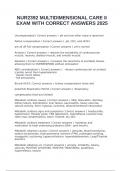
NUR2392 MULTIDIMENSIONAL CARE II
EXAM WITH CORRECT ANSWERS 2025
Uncompensated ( Correct answers ) pH and one other value is abnormal
Partial compensation ( Correct answers ) pH, CO2, and HCO3
are all off Full compensation ( Correct answers ) pH is normal
Acidosis ( Correct answers ) reduces the excitability of cardiovascular
muscle, neurons, skeletal muscle, and smooth muscle.
Alkalosis ( Correct answers ) increases the sensitivity of excitable tissues
allowing them to OVERRESPOND without stimulation
ABG considerations ( Correct answers ) - Assess cardiovascular w/ acidosis
(cardiac arrest from hyperkalemia)
- Assess neuro status
- Fall precautions
Bicarb HC03 ( Correct answers ) kidney compensation (slow and
powerful) Respiratory PaC02 ( Correct answers ) Respiratory
compensation (fast but limited)
Metabolic acidosis causes ( Correct answers ) DKA, Starvation, diarrhea,
kidney failure, dehydration, liver failure, pancreatitis, heavy exercise,
seizure activity, fever, hypoxia, ischemia, ethanol/methanol intoxication
Metabolic acidosis signs and symptoms ( Correct answers ) bradycardia,
hypotension, thready pulse, CNS depression, hyporeflexia, kussmal resp
(with resp compensation), warm, flushed, dry skin.
Metabolic acidosis treatment ( Correct answers ) hydration and
medication to treat underlying problems (DKA - give insulin).
Metabolic alkalosis causes ( Correct answers ) antacids, blood transfusion,
sodium bicarbonate, total parenteral nutrition (TPN), prolonged vomiting,
nasogastric suctioning, hypercortisolism, hyperaldosteronism, Loop/Thiazide
diuretics.
Metabolic Alkalosis s/s ( Correct answers ) anxiety, irritability, tetany,
seizures, POSITIVE CHVOSTEK, POSITIVE TROUSSEAU, parathesis,
hyperreflexia, muscle
, cramping/twitching, skeletal muscle weakness, Tachycardia, norm/low BP,
increased Digoxin toxicity, decreased respiratory effort (muscle
weakness).
metabolic alkalosis treatment ( Correct answers ) restore fluid/electrolyte
imbalances
Respiratory acidosis cause ( Correct answers ) Opioids, anesthetics,
electrolyte imbalance, inadequate chest expansion, muscle weakness,
airway obstruction, alveolar-capillary block.
Respiratory acidosis s/s ( Correct answers ) bradycardia, hypotension,
thready pulse, CNS depression, hyporeflexia, ineffective respirations, pale-
to-cyanotic dry skin.
Respiratory acidosis treatment ( Correct answers ) (Assess airway)
Improve gas exchange, drug therapy (bronchodilators, anti-inflammatory),
oxygen therapy (lowest flow possible), ventilation.
Respiratory alkalosis cause ( Correct answers ) Hyperventilation (fear,
anxiety), mechanical ventilation, salicylate toxicity, high altitudes, early-
stage acute pulmonary issues.
respiratory alkalosis s/s ( Correct answers ) anxiety, irritability, tetany,
seizures, POSITIVE CHVOSTEK, POSITIVE TROUSSEAU (hypocalcemia),
parathesis, hyperreflexia, muscle cramping/twitching, skeletal muscle
weakness, Tachycardia, norm/low BP, increased Digoxin toxicity,
hyperventilation
respiratory alkalosis treatment ( Correct answers ) restore
fluid/electrolyte imbalances
How do acid/base imbalances affect electrolytes ( Correct answers ) -
Potassium levels increase in acidosis as the body attempts to maintain
electroneutrality during buffering.
- Potassium is elevated in acute respiratory acidosis and normal/low in
chronic
respiratory acidosis when kidney compensation is present
- Alkalosis = hypocalcemia and hypokalemia
- Acidosis = HYPERkalemia
alkalosis ( Correct answers ) hypocalcemia and
hypokalemia acidosis ( Correct answers )
HYPERkalemia
Upper GI consists of ( Correct answers ) mouth, pharynx, esophagus,
stomach, and duodenum.
Barret's Epithelium ( Correct answers ) premalignant; columnar
epithelium that develops in lower esophagus
Zollinger-Ellison syndrome (dumping syndrome) ( Correct answers )
happens in PT with gastrectomy, from rapid emptying of food contents
EXAM WITH CORRECT ANSWERS 2025
Uncompensated ( Correct answers ) pH and one other value is abnormal
Partial compensation ( Correct answers ) pH, CO2, and HCO3
are all off Full compensation ( Correct answers ) pH is normal
Acidosis ( Correct answers ) reduces the excitability of cardiovascular
muscle, neurons, skeletal muscle, and smooth muscle.
Alkalosis ( Correct answers ) increases the sensitivity of excitable tissues
allowing them to OVERRESPOND without stimulation
ABG considerations ( Correct answers ) - Assess cardiovascular w/ acidosis
(cardiac arrest from hyperkalemia)
- Assess neuro status
- Fall precautions
Bicarb HC03 ( Correct answers ) kidney compensation (slow and
powerful) Respiratory PaC02 ( Correct answers ) Respiratory
compensation (fast but limited)
Metabolic acidosis causes ( Correct answers ) DKA, Starvation, diarrhea,
kidney failure, dehydration, liver failure, pancreatitis, heavy exercise,
seizure activity, fever, hypoxia, ischemia, ethanol/methanol intoxication
Metabolic acidosis signs and symptoms ( Correct answers ) bradycardia,
hypotension, thready pulse, CNS depression, hyporeflexia, kussmal resp
(with resp compensation), warm, flushed, dry skin.
Metabolic acidosis treatment ( Correct answers ) hydration and
medication to treat underlying problems (DKA - give insulin).
Metabolic alkalosis causes ( Correct answers ) antacids, blood transfusion,
sodium bicarbonate, total parenteral nutrition (TPN), prolonged vomiting,
nasogastric suctioning, hypercortisolism, hyperaldosteronism, Loop/Thiazide
diuretics.
Metabolic Alkalosis s/s ( Correct answers ) anxiety, irritability, tetany,
seizures, POSITIVE CHVOSTEK, POSITIVE TROUSSEAU, parathesis,
hyperreflexia, muscle
, cramping/twitching, skeletal muscle weakness, Tachycardia, norm/low BP,
increased Digoxin toxicity, decreased respiratory effort (muscle
weakness).
metabolic alkalosis treatment ( Correct answers ) restore fluid/electrolyte
imbalances
Respiratory acidosis cause ( Correct answers ) Opioids, anesthetics,
electrolyte imbalance, inadequate chest expansion, muscle weakness,
airway obstruction, alveolar-capillary block.
Respiratory acidosis s/s ( Correct answers ) bradycardia, hypotension,
thready pulse, CNS depression, hyporeflexia, ineffective respirations, pale-
to-cyanotic dry skin.
Respiratory acidosis treatment ( Correct answers ) (Assess airway)
Improve gas exchange, drug therapy (bronchodilators, anti-inflammatory),
oxygen therapy (lowest flow possible), ventilation.
Respiratory alkalosis cause ( Correct answers ) Hyperventilation (fear,
anxiety), mechanical ventilation, salicylate toxicity, high altitudes, early-
stage acute pulmonary issues.
respiratory alkalosis s/s ( Correct answers ) anxiety, irritability, tetany,
seizures, POSITIVE CHVOSTEK, POSITIVE TROUSSEAU (hypocalcemia),
parathesis, hyperreflexia, muscle cramping/twitching, skeletal muscle
weakness, Tachycardia, norm/low BP, increased Digoxin toxicity,
hyperventilation
respiratory alkalosis treatment ( Correct answers ) restore
fluid/electrolyte imbalances
How do acid/base imbalances affect electrolytes ( Correct answers ) -
Potassium levels increase in acidosis as the body attempts to maintain
electroneutrality during buffering.
- Potassium is elevated in acute respiratory acidosis and normal/low in
chronic
respiratory acidosis when kidney compensation is present
- Alkalosis = hypocalcemia and hypokalemia
- Acidosis = HYPERkalemia
alkalosis ( Correct answers ) hypocalcemia and
hypokalemia acidosis ( Correct answers )
HYPERkalemia
Upper GI consists of ( Correct answers ) mouth, pharynx, esophagus,
stomach, and duodenum.
Barret's Epithelium ( Correct answers ) premalignant; columnar
epithelium that develops in lower esophagus
Zollinger-Ellison syndrome (dumping syndrome) ( Correct answers )
happens in PT with gastrectomy, from rapid emptying of food contents