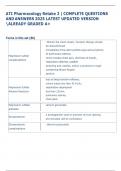
ATI Pharmacology Retake 2 | COMPLETE QUESTIONS
AND ANSWERS 2025 LATEST UPDATED VERSION
\ALREADY GRADED A+
Terms in this set (86)
-Monitor the client closely. Tocolytic therapy should
be discontinued
immediately if the client exhibits signs and symptoms
of pulmonary edema,
Magnesium sulfate
which includes chest pain, shortness of breath,
considerations
respiratory distress, audible
wheezing and crackles, and/or a productive cough
containing blood-tinged
sputum.
loss of deep tendon reflexes,
urinary output less than 30 mL/hr,
Magnesium Sulfate respiratory depression
Adverse Reactions less than 12/min,
pulmonary edema,
chest pain.
Magnesium sulfate calcium gluconate
antidote
a prostaglandin used to promote cervical ripening
Dinoprostone
and stimulate uterine contractions
Dinoprostone -Uterine tachysystole
complications
, C-section,
fetal distress,
Dinoprostone (Cervidil) vaginal bleeding
Contraindications Use with caution with maternal history of hypotension,
hypertension,
and asthma.
, Consists of using analgesics such as fentanyl and
sufentanil, which are short-acting opioids that are
administered as a motor block into the epidural or
Epidural and spinal
intrathecal space without anesthesia. These opioids
regional analgesia
produce regional analgesia, providing rapid pain
relief while still allowing the client to sense
contractions and maintain the ability to bear down
■ Decreased gastric emptying resulting in
nausea and vomiting
■ Inhibition of bowel and bladder
Adverse effects of elimination sensations
epidural and spinal ■ Bradycardia or tachycardia
analgesia ■ Hypotension
■ Respiratory depression
■ Allergic reaction and pruritus
■ Elevated temperature
Regional blocks are most commonly used vs. general
anesthesia
Regional blocks Pudendal block
Epidural block
Spinal block
Paracervical nerve block.
AND ANSWERS 2025 LATEST UPDATED VERSION
\ALREADY GRADED A+
Terms in this set (86)
-Monitor the client closely. Tocolytic therapy should
be discontinued
immediately if the client exhibits signs and symptoms
of pulmonary edema,
Magnesium sulfate
which includes chest pain, shortness of breath,
considerations
respiratory distress, audible
wheezing and crackles, and/or a productive cough
containing blood-tinged
sputum.
loss of deep tendon reflexes,
urinary output less than 30 mL/hr,
Magnesium Sulfate respiratory depression
Adverse Reactions less than 12/min,
pulmonary edema,
chest pain.
Magnesium sulfate calcium gluconate
antidote
a prostaglandin used to promote cervical ripening
Dinoprostone
and stimulate uterine contractions
Dinoprostone -Uterine tachysystole
complications
, C-section,
fetal distress,
Dinoprostone (Cervidil) vaginal bleeding
Contraindications Use with caution with maternal history of hypotension,
hypertension,
and asthma.
, Consists of using analgesics such as fentanyl and
sufentanil, which are short-acting opioids that are
administered as a motor block into the epidural or
Epidural and spinal
intrathecal space without anesthesia. These opioids
regional analgesia
produce regional analgesia, providing rapid pain
relief while still allowing the client to sense
contractions and maintain the ability to bear down
■ Decreased gastric emptying resulting in
nausea and vomiting
■ Inhibition of bowel and bladder
Adverse effects of elimination sensations
epidural and spinal ■ Bradycardia or tachycardia
analgesia ■ Hypotension
■ Respiratory depression
■ Allergic reaction and pruritus
■ Elevated temperature
Regional blocks are most commonly used vs. general
anesthesia
Regional blocks Pudendal block
Epidural block
Spinal block
Paracervical nerve block.