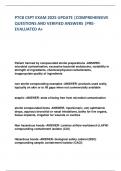
PTCB CSPT EXAM 2025 UPDATE |COMPREHENSIVE
QUESTIONS AND VERIFIED ANSWERS |PRE-
EVALUATED A+
Patient harmed by compounded sterile preparations -ANSWER-
microbial contamination, excessive bacterial endotoxins, variability in
strength of ingredients, chemical/physical contaminants,
inappropriate quality of ingredients
non sterile compounding examples -ANSWER- products used orally,
topically on skin or to fill gaps when not commercially available
aesptic -ANSWER- state of being free from microbial contamination
sterile compounded items -ANSWER- injections(iv, etc) ophthalmic
drops, aqueous bronchial or nasal inhalations, baths for live organs,
tissue implants, irrigation for wounds or cavities
Non hazardous hoods -ANSWER- Laminar airflow workbench (LAFW)
compounding containment isolator (CAI)
Hazardous hoods -ANSWER- biological safety cabinet (BSC)
compounding aseptic containment isolator (CACI)
,Primary Engineering Control (PEC) -ANSWER- a device or room that
provides an ISO Class 5 environment for the exposure of critical sites
when compounding CSPs. Such devices include, but may not be
limited to, laminar airflow workbenches (LAFWs), biological safety
cabinets (BSCs), compounding aseptic isolators (CAIs), and
compounding aseptic containment isolators (CACIs).
secondary engineering controls -ANSWER- the ante area and buffer
area
Buffer or Clean Room -ANSWER- ISO 7
Ante Room ISO class -ANSWER- ISO 8, unless provides access to
negative pressure room then ISO 7
vertical hood -ANSWER- hazardous compounding-air flows vertically
Horizontal Hood -ANSWER- air flows horizontally across the work
area from back to front
Direct Compounding Area (DCA) -ANSWER- - a critical area within the
hood (ISO Class 5) where areas are exposed to filtered air; also
known as "first air"
Negative Pressure room -ANSWER- Hazardous materials
High-efficiency particulate air (HEPA) filters -ANSWER- remove
microbes > 0.3 micrometers
, Ante Room -ANSWER- washing, garbing, product decontamination
Buffer area air change per hour (APCH) -ANSWER- 30 exchanges per
hour
ante room air change per hour (APCH) -ANSWER- ISO 8-20 per hour
ISO 7- 30 per hour
Cleaning of compounding area -ANSWER- germicidal detergent &
water for visible solids, 70% isopropyl alcohol
ISO Class 5 PEC cleaned -ANSWER- beginning of each shift, before
each batch, every 30 minus when compounding, after spills,
contamination
Cleaning of Counters and floors of specific sites -ANSWER- daily
Cleaning Walls, ceilings, storage shelving: -ANSWER- monthly
Suface sampling frequency -ANSWER- every 6 months or significant
changes in procedure
Temperature of CSP areas -ANSWER- room temperature 20'C(68'F) or
cooler
Airborne Particle Testing -ANSWER- every 6 months or device
relocated or serviced
QUESTIONS AND VERIFIED ANSWERS |PRE-
EVALUATED A+
Patient harmed by compounded sterile preparations -ANSWER-
microbial contamination, excessive bacterial endotoxins, variability in
strength of ingredients, chemical/physical contaminants,
inappropriate quality of ingredients
non sterile compounding examples -ANSWER- products used orally,
topically on skin or to fill gaps when not commercially available
aesptic -ANSWER- state of being free from microbial contamination
sterile compounded items -ANSWER- injections(iv, etc) ophthalmic
drops, aqueous bronchial or nasal inhalations, baths for live organs,
tissue implants, irrigation for wounds or cavities
Non hazardous hoods -ANSWER- Laminar airflow workbench (LAFW)
compounding containment isolator (CAI)
Hazardous hoods -ANSWER- biological safety cabinet (BSC)
compounding aseptic containment isolator (CACI)
,Primary Engineering Control (PEC) -ANSWER- a device or room that
provides an ISO Class 5 environment for the exposure of critical sites
when compounding CSPs. Such devices include, but may not be
limited to, laminar airflow workbenches (LAFWs), biological safety
cabinets (BSCs), compounding aseptic isolators (CAIs), and
compounding aseptic containment isolators (CACIs).
secondary engineering controls -ANSWER- the ante area and buffer
area
Buffer or Clean Room -ANSWER- ISO 7
Ante Room ISO class -ANSWER- ISO 8, unless provides access to
negative pressure room then ISO 7
vertical hood -ANSWER- hazardous compounding-air flows vertically
Horizontal Hood -ANSWER- air flows horizontally across the work
area from back to front
Direct Compounding Area (DCA) -ANSWER- - a critical area within the
hood (ISO Class 5) where areas are exposed to filtered air; also
known as "first air"
Negative Pressure room -ANSWER- Hazardous materials
High-efficiency particulate air (HEPA) filters -ANSWER- remove
microbes > 0.3 micrometers
, Ante Room -ANSWER- washing, garbing, product decontamination
Buffer area air change per hour (APCH) -ANSWER- 30 exchanges per
hour
ante room air change per hour (APCH) -ANSWER- ISO 8-20 per hour
ISO 7- 30 per hour
Cleaning of compounding area -ANSWER- germicidal detergent &
water for visible solids, 70% isopropyl alcohol
ISO Class 5 PEC cleaned -ANSWER- beginning of each shift, before
each batch, every 30 minus when compounding, after spills,
contamination
Cleaning of Counters and floors of specific sites -ANSWER- daily
Cleaning Walls, ceilings, storage shelving: -ANSWER- monthly
Suface sampling frequency -ANSWER- every 6 months or significant
changes in procedure
Temperature of CSP areas -ANSWER- room temperature 20'C(68'F) or
cooler
Airborne Particle Testing -ANSWER- every 6 months or device
relocated or serviced