

HLT 307V Week 4 DQ 2
Read "Case Study: Communicating Accurate Information in a Care Situation" at the
beginning of Chapter 12 in the textbook. Prepare a communication plan or memo to share
what you have found with a physician and post this information in the discussion forum.
Identify similarities and differences between your response and those of your peers.
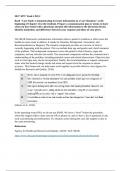
The SBAR framework communicates information about a patient's condition or other issues the
healthcare team needs to address. It stands for Situation, Background, Assessment, and
Recommendation (or Request). The situation component provides an overview of what is
currently happening with the patient. This can include their age and gender and a brief statement
of the problem. The background component covers the patient's clinical history, signs and
symptoms, and any relevant test results. The assessment component outlines the communicator's
understanding of the problem, including potential causes and related observations. Objective data
such as vital signs may also be incorporated. Finally, the recommendation or request component
states what the desired change entails and when and repeats back the response to ensure
accuracy. This framework can help teams work together to provide effective care (Agency for
Healthcare Research and Quality, 2019).
(Slusser et al., 2019).
In the operating room (OR), we do not use SBAR. We have a “brief” before the procedure,
where the surgeon either comes into the OR or phones in, and we have a list of questions to ask,
such as positioning and medications. If a situation arises during the case, the surgeon is also in
the room monitoring.
References
Agency for Healthcare Research and Quality. (2019). Tool: SBAR.
https://www.ahrq.gov/teamstepps-program/curriculum/communication/tools/sbar.html
Read "Case Study: Communicating Accurate Information in a Care Situation" at the
beginning of Chapter 12 in the textbook. Prepare a communication plan or memo to share
what you have found with a physician and post this information in the discussion forum.
Identify similarities and differences between your response and those of your peers.
The SBAR framework communicates information about a patient's condition or other issues the
healthcare team needs to address. It stands for Situation, Background, Assessment, and
Recommendation (or Request). The situation component provides an overview of what is
currently happening with the patient. This can include their age and gender and a brief statement
of the problem. The background component covers the patient's clinical history, signs and
symptoms, and any relevant test results. The assessment component outlines the communicator's
understanding of the problem, including potential causes and related observations. Objective data
such as vital signs may also be incorporated. Finally, the recommendation or request component
states what the desired change entails and when and repeats back the response to ensure
accuracy. This framework can help teams work together to provide effective care (Agency for
Healthcare Research and Quality, 2019).
(Slusser et al., 2019).
In the operating room (OR), we do not use SBAR. We have a “brief” before the procedure,
where the surgeon either comes into the OR or phones in, and we have a list of questions to ask,
such as positioning and medications. If a situation arises during the case, the surgeon is also in
the room monitoring.
References
Agency for Healthcare Research and Quality. (2019). Tool: SBAR.
https://www.ahrq.gov/teamstepps-program/curriculum/communication/tools/sbar.html


