

100% satisfaction guarantee Immediately available after payment Both online and in PDF No strings attached 4.2 TrustPilot
logo-home
Exam (elaborations)

HED4806 Assignment 4 (COMPLETE GUIDELINE) 2025

Rating
4.5
(2)
Sold
7
Pages
16
Grade
A+
Uploaded on
23-04-2025
Written in
2024/2025

HED4806 Assignment 4 (COMPLETE GUIDELINE) 2025 - DUE 2025; 100% TRUSTED Complete, trusted solutions and explanations. For assistance, Whats-App 0.6.7-1.7.1-1.7.3.9. Ensure your success with us.. SECTION A The extract below is taken from chapter 9 of the prescribed book: Seroto, J, Davids, MN & Wolhuter, C. 2020. Decolonising education in the Global South. Cape Town: Pearson. Given the slow pace of structural change in the Indian economy, described in an earlier section, the pursuit of this education has created the following outcomes: A relatively small section of the population completed schooling and different levels of higher education (and they benefitted from the employment in the service sector after India opened up its economy). Most Indian people did not complete schooling and ended up in less productive agriculture or unskilled work. There was no major focus on mass education in India during the first four decades after its independence (Balakrishnan, 2010). Given the nature of the economy, there was a weak link between education and industrial development. Even when students pursued technical education, the focus was more on the higher end of such technical education and post-school certificate courses on vocational education did not get adequate support from people and governments. Questions: Discuss the following topics regarding education in India: (Is starting from point 2 and not 1 deliberate? It might confuse some of the students) 2. What was the difference in the aims and objectives of education in India both during the colonial period and after independence? (10) 3. Discuss the debate about the nature of formal education in India. (10) 4. Do you think India made the right decision when it rejected the basic-schooling approach proposed by Mahatma Gandhi? (10) 5. How did the slow structural change in the Indian economy affect Indian education? (10) 6. Discuss the challenges in the Indian education system by referring to their implications for Indian citizens from less affluent backgrounds. (10) Subtotal: [50] 26 SECTION B The extract below is taken from chapter 10 of the prescribed book: Seroto, J, Davids, MN & Wolhuter, C. 2020. Decolonising education in the Global South. Cape Town: Pearson. None of the existing education systems in the world operates outside a country’s ideological framework. Education in Tanzania has largely been guided by the ideology of Ujamaa na Kujitegemea (Socialism and Self-Reliance). Within this ideological framework, education was designed to support efforts aimed to build an egalitarian society epitomised by relevance, equality, and equity. For many years Tanzanians have understood and viewed education as an indispensable tool for liberation (Nyerere, 1974). Although education is a factor for social, economic, political, scientific, and technological liberation, it is also a clear indicator of a nation’s development achievement. Indeed, education and development are inseparable. After all, central to any form of education in any society is its power to liberate and develop its recipients and people. As Ndunguru puts it: ‘[I]f education in Tanzania and, indeed, in other parts of Africa is to mean anything, it must aim at equipping children with the knowledge, skills and attitudes for tackling … societal problems.’ (Ndunguru,1976:75). The Education for Self-Reliance (ESR), an offshoot of the Arusha Declaration that ushered in the ideology of socialism and self-reliance, articulates clearly such an education. The ESR was a radical education policy-cum-philosophy designed to decolonise education meant for Tanzanians. Questions: 1. Essentially, the ESR policy paper published in March 1967 was the education version of Ujamaa na Kujitegemea. It was a radical education reform in Tanzania. Describe the ESR policy’s criticism of colonial education. (10) 2. Discuss the challenges of the education-for-self-reliance policy. (10) 3. Elaborate on the development of non-formal education in Tanzania and explain why it was introduced. (10) Subtotal: [30] SECTION C The extract below is taken from chapter 14 of the prescribed book: Seroto, J, Davids, MN & Wolhuter, C. 2020. Decolonising education in the Global South. Cape Town: Pearson. As language and culture are intractably intertwined, so are curriculum and language (Nguyen, 2017). Language in a curriculum has a dual character: it is both a means of communication and the carrier of culture (Wa Thiong’o, 1986:13). Language as culture is considered a ‘collective memory bank’ of a people’s historical experiences. The two are inseparable. As a carrier of culture, language makes possible cultural growth, expression and indeed its transmission from one generation to the next. To be successful in their learning of culture, learners need to HED4806/101/0/2025 27 understand the language of the curriculum – not only to comprehend what is being said, but also what is being asked of them (Earp, 2017). However, this has not been the case with the South African education system. Even after the democratic dispensation more than two decades ago, including indigenous languages in the curriculum has been difficult. This, we think should be the starting point for the decolonisation of the curriculum, which would require a paradigm shift. Some Africans have been made to believe that they cannot be taught in their own languages (Wa Thiong’o, 1986). This kind of thinking, Wa Thiong’o says, means that the African thought has been produced and stored in other people’s languages, in other people’s memories. This is like storing the grain people have cultivated and harvested in someone else’s granary. People keep saying ‘it’s okay, we understand your languages’, but if they keep doing so, the domination of Western languages will persist. Local languages will remain inferior forever (Wababa, 2017). Questions: 1. What is your interpretation of the term “mother tongue”? In view of the arguments in scholarly literature, should learners be educated in their mother tongue? (10) 4.1. How does the medium of instruction impact educational success in South African schools? (10)

Show more Read less
Institution
Course


Whoops! We can’t load your doc right now. Try again or contact support.

Connected book

Written for

Institution
Course

Document information

Uploaded on
April 23, 2025
Number of pages
16
Written in
2024/2025
Type
Exam (elaborations)
Contains
Questions & answers

Subjects

Content preview

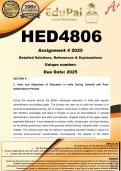
HED4806
Assignment 4 2025
Detailed Solutions, References & Explanations

Unique number:

Due Date: 2025
SECTION A

2. Aims and Objectives of Education in India During Colonial and Post-
Independence Periods


During the colonial period, the British introduced education in India with specific
administrative and political goals. The primary aim was not to uplift the masses or to
promote broad-based learning, but to create a small class of Indians who were familiar
with Western knowledge and fluent in English to serve as intermediaries in colonial
administration. Education was elitist and selective, targeted mainly at the upper castes,
especially Brahmins. It was designed to produce clerks, bureaucrats, and loyal workers
for the British government rather than promote critical thinking, industrial skills, or social
mobility. The colonial rulers had no interest in spreading education widely or using it to
promote socio-economic transformation. Consequently, the majority of the Indian
Terms of use
population remained uneducated and excluded from formal learning
By making systems.
use of this document you agree to:
 Use this document as a guide for learning, comparison and reference purpose,
Terms of use
 Not to duplicate, reproduce and/or misrepresent the contents of this document as your own work,
By making use of this document you agree to:
 Use this document
Fully accept the consequences
solely as a guide forshould you plagiarise
learning, reference,or and
misuse this document.
comparison purposes,
 Ensure originality of your own work, and fully accept the consequences should you plagiarise or misuse this document.
 Comply with all relevant standards, guidelines, regulations, and legislation governing academic and written work.

Disclaimer
Great care has been taken in the preparation of this document; however, the contents are provided "as is" without any express or
implied representations or warranties. The author accepts no responsibility or liability for any actions taken based on the
information contained within this document. This document is intended solely for comparison, research, and reference purposes.
Reproduction, resale, or transmission of any part of this document, in any form or by any means, is strictly prohibited.


Reviews from verified buyers

Showing all 2 reviews
3 months ago

7 months ago

4.5

2 reviews

5
1
4
1
3
0
2
0
1
0
Trustworthy reviews on Stuvia

All reviews are made by real Stuvia users after verified purchases.

Get to know the seller

Seller avatar
Reputation scores are based on the amount of documents a seller has sold for a fee and the reviews they have received for those documents. There are three levels: Bronze, Silver and Gold. The better the reputation, the more your can rely on the quality of the sellers work.
EduPal University of South Africa (Unisa)
Follow You need to be logged in order to follow users or courses
Sold
149163
Member since
7 year
Number of followers
35995
Documents
4310
Last sold
18 hours ago

4.2

13555 reviews

5
7803
4
2688
3
1790
2
455
1
819

Recently viewed by you

Why students choose Stuvia

Created by fellow students, verified by reviews

Quality you can trust: written by students who passed their exams and reviewed by others who've used these notes.

Didn't get what you expected? Choose another document

No worries! You can immediately select a different document that better matches what you need.

Pay how you prefer, start learning right away

No subscription, no commitments. Pay the way you're used to via credit card or EFT and download your PDF document instantly.

Student with book image

“Bought, downloaded, and aced it. It really can be that simple.”

Alisha Student

Frequently asked questions


