

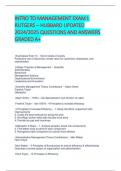
INTRO TO MANAGEMENT EXAM I:
RUTGERS – HUBBARD UPDATED
2024/2025 QUESTIONS AND ANSWERS
GRADED A+
Businesses Exist To - Serve needs of society
ta
Productive use of resources, create value for customers, employees, and
shareholders
6 Major Theories of Management - Scientific
Administrative
Behavioral
Management Science
Organizational Environment
Leadership and Innovation
Scientific Management Theory Contributors - Adam Smith
Fredrick Taylor
Gilbreaths
Adam Smith - 1700's - Job Specialization and Division of Labor
Fredrick Taylor - late 1800's - 4 Principles to increase efficiency
4 Principles to Increase Efficiency - 1. Study the Work, experiment with
improvements
2. Codify the best methods for doing the work
3. Hire/Align worker skills with the jobs to be done
4. Provide fair pay and incentives
Gilbreaths: 3 Steps - 1. Analyze all tasks, break into components
2. Find better ways to perform each component
3. Reorganize each component so overall more efficient
Administrative Management Theory Contributors - Max Weber
Henri Fayol
Max Weber - 5 Principles of Bureaucracy to ensure efficiency & effectiveness
Describes a formal system of organization and administration
Henri Fayol - 14 Principles of Efficiency
, More comprehensive and balanced view of the organization
Behavioral Management Theory Contributors - Mary Parker Follet
Elton Mayo
Douglas McGregor
Mary Parker Follet - Emphasized the Human side of management
"Authority should go with knowledge" - employee job self determination
Identified the importance of cross-functioning (collaboration across the org)
Elton Mayo - Hawthorne Studies
Management involvement with workers more important than physical work conditions
Birth of Human Relations movement
Douglas McGregor - Theory X, Theory Y
Management Science Theory - Quantitative Management
Operations Management
Total Quality Management
Management Information Systems
Quantitative Management - Uses data and math based models, simulations, and
techniques to aid decisions
Operations Management - Specialized techniques for optimizing productions
systems
Total Quality Management (TQM) - Integrates process management,
measures/evaluation, and proven improvement methedologies to improve
effectivnes and efficiency
Management Informations Systems (MIS) - Provide easy access to external and
internal data to enhance decision making
Organizational Environment Theory - Open Systems View (1960s) - Katz, Kahn,
Thompson
Contingency Theory (1960s) - Burns, Stalker, Lawrence, Lorsch
Contingency Theory (1960s) - Burns, Stalker, Lawrence, Lorsch - No one best way
to organize:
Stable environment => Mechanistic Structure
Rapidly changing environment => Organic Structure
Open Systems View (1960s) - Katz, Kahn, Thompson - Resources come from the
external environment, are converted internally, and then sent back as goods and
services to the external environment
Leadership & Innovation - Leadership vs Management (2000 - Goleman, Kotter)
Importance of Innovation (2000 - Foster, Christensen, Amabile)
RUTGERS – HUBBARD UPDATED
2024/2025 QUESTIONS AND ANSWERS
GRADED A+
Businesses Exist To - Serve needs of society
ta
Productive use of resources, create value for customers, employees, and
shareholders
6 Major Theories of Management - Scientific
Administrative
Behavioral
Management Science
Organizational Environment
Leadership and Innovation
Scientific Management Theory Contributors - Adam Smith
Fredrick Taylor
Gilbreaths
Adam Smith - 1700's - Job Specialization and Division of Labor
Fredrick Taylor - late 1800's - 4 Principles to increase efficiency
4 Principles to Increase Efficiency - 1. Study the Work, experiment with
improvements
2. Codify the best methods for doing the work
3. Hire/Align worker skills with the jobs to be done
4. Provide fair pay and incentives
Gilbreaths: 3 Steps - 1. Analyze all tasks, break into components
2. Find better ways to perform each component
3. Reorganize each component so overall more efficient
Administrative Management Theory Contributors - Max Weber
Henri Fayol
Max Weber - 5 Principles of Bureaucracy to ensure efficiency & effectiveness
Describes a formal system of organization and administration
Henri Fayol - 14 Principles of Efficiency
, More comprehensive and balanced view of the organization
Behavioral Management Theory Contributors - Mary Parker Follet
Elton Mayo
Douglas McGregor
Mary Parker Follet - Emphasized the Human side of management
"Authority should go with knowledge" - employee job self determination
Identified the importance of cross-functioning (collaboration across the org)
Elton Mayo - Hawthorne Studies
Management involvement with workers more important than physical work conditions
Birth of Human Relations movement
Douglas McGregor - Theory X, Theory Y
Management Science Theory - Quantitative Management
Operations Management
Total Quality Management
Management Information Systems
Quantitative Management - Uses data and math based models, simulations, and
techniques to aid decisions
Operations Management - Specialized techniques for optimizing productions
systems
Total Quality Management (TQM) - Integrates process management,
measures/evaluation, and proven improvement methedologies to improve
effectivnes and efficiency
Management Informations Systems (MIS) - Provide easy access to external and
internal data to enhance decision making
Organizational Environment Theory - Open Systems View (1960s) - Katz, Kahn,
Thompson
Contingency Theory (1960s) - Burns, Stalker, Lawrence, Lorsch
Contingency Theory (1960s) - Burns, Stalker, Lawrence, Lorsch - No one best way
to organize:
Stable environment => Mechanistic Structure
Rapidly changing environment => Organic Structure
Open Systems View (1960s) - Katz, Kahn, Thompson - Resources come from the
external environment, are converted internally, and then sent back as goods and
services to the external environment
Leadership & Innovation - Leadership vs Management (2000 - Goleman, Kotter)
Importance of Innovation (2000 - Foster, Christensen, Amabile)


