

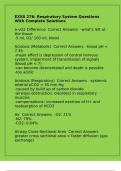
EXSS 276: Respiratory System Questions
With Complete Solutions
a-vO2 Difference Correct Answers -what's left at
the tissue
-5 mL O2/ 100 mL blood
Acidosis (Metabolic) Correct Answers -blood pH <
7.35
-major effect is depression of central nervous
system, impairment of transmission of signals
(blood pH < 7)
-can become disorientated and death is possible
-too acidic
Acidosis (Respiratory) Correct Answers -systemic
arterial pCO2 > 45 mm Hg
-caused by build up of carbon dioxide
-airways obstruction, disorders in respiratory
muscles
-compensations: increased exertion of H+ and
reabsorption of HCO3
Air Correct Answers -O2: 21%
-N2: 79%
-CO2: 0.04%
Airway Cross-Sectional Area Correct Answers
greater cross sectional area = faster diffusion (gas
exchange)
,Airway Resistance Correct Answers -resistance to
airflow depends upon airway size
-inverse relationship
-increase size of chest
~airways increase in diameter, decrease resistance
-contraction of smooth muscles in airway
~decreases in diameter, increases resistance
Alkalosis (Metabolic) Correct Answers -blood pH >
7.45
-over-excitability in both CNS and periphery,
conduction of impulses repetitively, resulting in
nervousness, muscle spasms, convulsions and
even death
-too basic
Alkalosis (Respiratory) Correct Answers -systemic
arterial pCO2 < 35 mm Hg
-caused by hyperventilation
-O2 deficient situations or conditions (altitude,
pulmonary disease)
-compensation: decreased secretion of H+ and
reabsorption of HCO3
Alveolar Air Correct Answers -O2: 14%
-N2: 79%
-CO2: 5.2%
, Alveolar Surface Tension Correct Answers -thin
layer of fluid in alveoli causes inwardly directed
force
-water molecules strongly attracted to each other
-causes alveoli to remain as small as possible,
needs to be overcome for inhalation
Alveolar Ventilation Correct Answers -volume of
air per minute that reaches the alveoli and
respiratory areas
-takes part in gas exchange
Anemic Hypoxia Correct Answers -too little
functioning Hb (hemorrhage, anemia, carbon
monoxide poisoning, no carrying capacity)
Apnea Correct Answers breath holding
Apneustic Area Correct Answers -send impulses to
the inspiratory area that activates it and prolong
inspiration
-inhibits expiration
Arterial Blood Correct Answers -what's going into
a tissue
-20 mL O2/ 100 mL blood
Atmospheric Pressure Correct Answers -
atmospheric pressure = barometric pressure
With Complete Solutions
a-vO2 Difference Correct Answers -what's left at
the tissue
-5 mL O2/ 100 mL blood
Acidosis (Metabolic) Correct Answers -blood pH <
7.35
-major effect is depression of central nervous
system, impairment of transmission of signals
(blood pH < 7)
-can become disorientated and death is possible
-too acidic
Acidosis (Respiratory) Correct Answers -systemic
arterial pCO2 > 45 mm Hg
-caused by build up of carbon dioxide
-airways obstruction, disorders in respiratory
muscles
-compensations: increased exertion of H+ and
reabsorption of HCO3
Air Correct Answers -O2: 21%
-N2: 79%
-CO2: 0.04%
Airway Cross-Sectional Area Correct Answers
greater cross sectional area = faster diffusion (gas
exchange)
,Airway Resistance Correct Answers -resistance to
airflow depends upon airway size
-inverse relationship
-increase size of chest
~airways increase in diameter, decrease resistance
-contraction of smooth muscles in airway
~decreases in diameter, increases resistance
Alkalosis (Metabolic) Correct Answers -blood pH >
7.45
-over-excitability in both CNS and periphery,
conduction of impulses repetitively, resulting in
nervousness, muscle spasms, convulsions and
even death
-too basic
Alkalosis (Respiratory) Correct Answers -systemic
arterial pCO2 < 35 mm Hg
-caused by hyperventilation
-O2 deficient situations or conditions (altitude,
pulmonary disease)
-compensation: decreased secretion of H+ and
reabsorption of HCO3
Alveolar Air Correct Answers -O2: 14%
-N2: 79%
-CO2: 5.2%
, Alveolar Surface Tension Correct Answers -thin
layer of fluid in alveoli causes inwardly directed
force
-water molecules strongly attracted to each other
-causes alveoli to remain as small as possible,
needs to be overcome for inhalation
Alveolar Ventilation Correct Answers -volume of
air per minute that reaches the alveoli and
respiratory areas
-takes part in gas exchange
Anemic Hypoxia Correct Answers -too little
functioning Hb (hemorrhage, anemia, carbon
monoxide poisoning, no carrying capacity)
Apnea Correct Answers breath holding
Apneustic Area Correct Answers -send impulses to
the inspiratory area that activates it and prolong
inspiration
-inhibits expiration
Arterial Blood Correct Answers -what's going into
a tissue
-20 mL O2/ 100 mL blood
Atmospheric Pressure Correct Answers -
atmospheric pressure = barometric pressure


