
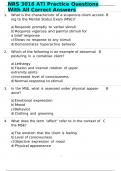
NRS 3016 ATI Practice Questions
With All Correct Answers
1. What is the characteristic of a stuporous client accord- B
ing to the Mental Status Exam (MSE)?
a) Responds promptly to verbal stimuli
b) Requires vigorous and painful stimuli for
a brief response
c)Shows no response to any stimuli
d) Demonstrates hyperactive behavior
2. Which of the following is an example of abnormal B
posturing in a comatose client?
a) Lethargy
b) Flexion and internal rotation of upper
extremity joints
c)Increased level of consciousness
d) Normal response to stimuli
3. In the MSE, what is assessed under physical appear- B
ance?
a) Emotional expression
b) Mood
c)Behavior
d) Clothing and grooming
4. What does the term "affect" refer to in the context of C
the MSE?
a) The emotion that the client is feeling
b) Level of consciousness
c)Objective expression of mood
d) Physical appearance
1/
54
, NRS 3016 ATI Practice Questions
With All Correct Answers
5. Which of the following is an example of cognitive abil- D
ity assessed in the MSE?
a) Mood stability
b) Physical appearance
c)Emotional expression
d) Immediate memory
6. According to the DSM-5, what is its primary purpose? A
a) Establishing diagnostic criteria for mental
health disorders
b) Identifying expected findings for physical
health disorders
c)Setting guidelines for medication administration
d)Providing legal advice for mental health
profession- als
7. What is the goal of milieu therapy in mental health D
settings?
a)Administering medications to clients
b) Assisting with problem-solving
c)Promoting self-care activities
d) Orienting clients to the physical setting and
ensur- ing safety
8. Which therapeutic strategy involves modeling, oper- C
ant conditioning, and systemic desensitization?
a) Counseling
b) Health teaching
2/
54
, NRS 3016 ATI practice
questions
c)Cognitive and behavioral therapies
d) Promotion of self-care activities
9. What is the role of nurses in psychobiological inter- B
ventions?
a) Providing social support to clients
b) Administering prescribed medications and
moni- toring for adverse effects
c)Conducting group therapy sessions
d) Implementing cognitive restructuring techniques
10. What are the rights of clients in a mental health set- C
ting?
a) Limited rights compared to other citizens
b) Exclusion from the right to humane treatment
c)Right to due process of law, including the
right to press charges d) Right to only basic
care and treat- ment
11. Which ethical principle emphasizes the importance of A
doing good for the patient?
a) Beneficence
b) Autonomy
c) Justice
d) Veracity
12. What criteria are necessary for involuntary admission C
to a mental health facility?
a) Absence of mental illness
3/
54
, NRS 3016 ATI practice
questions
b) Voluntary agreement for treatment
c)Demonstrating severe disability or inability to
meet basic needs d) Ability to seek treatment
independently
13. How often must a provider reassess and
rewrite or-
B ders for seclusion or restraint for clients
aged 18 and older?
a) Every hour
b) Every 4 hours
c)Every 24 hours
d) Every week
14. Which of the following is an example of an
intentional C, D
tort according to the study guide? Select all that apply.
a) Negligence
b) Malpractice
c)Assault
d) Battery
15. What must nurses document regarding violent or un- D
usual episodes, as stated in the study guide?
a) Only client behavior
b) Staff response without timelines
c)Time provider was notified, but not
prescriptions received
d) Client behavior, staff response with
timelines, and time provider was notified and
4/
54
With All Correct Answers
1. What is the characteristic of a stuporous client accord- B
ing to the Mental Status Exam (MSE)?
a) Responds promptly to verbal stimuli
b) Requires vigorous and painful stimuli for
a brief response
c)Shows no response to any stimuli
d) Demonstrates hyperactive behavior
2. Which of the following is an example of abnormal B
posturing in a comatose client?
a) Lethargy
b) Flexion and internal rotation of upper
extremity joints
c)Increased level of consciousness
d) Normal response to stimuli
3. In the MSE, what is assessed under physical appear- B
ance?
a) Emotional expression
b) Mood
c)Behavior
d) Clothing and grooming
4. What does the term "affect" refer to in the context of C
the MSE?
a) The emotion that the client is feeling
b) Level of consciousness
c)Objective expression of mood
d) Physical appearance
1/
54
, NRS 3016 ATI Practice Questions
With All Correct Answers
5. Which of the following is an example of cognitive abil- D
ity assessed in the MSE?
a) Mood stability
b) Physical appearance
c)Emotional expression
d) Immediate memory
6. According to the DSM-5, what is its primary purpose? A
a) Establishing diagnostic criteria for mental
health disorders
b) Identifying expected findings for physical
health disorders
c)Setting guidelines for medication administration
d)Providing legal advice for mental health
profession- als
7. What is the goal of milieu therapy in mental health D
settings?
a)Administering medications to clients
b) Assisting with problem-solving
c)Promoting self-care activities
d) Orienting clients to the physical setting and
ensur- ing safety
8. Which therapeutic strategy involves modeling, oper- C
ant conditioning, and systemic desensitization?
a) Counseling
b) Health teaching
2/
54
, NRS 3016 ATI practice
questions
c)Cognitive and behavioral therapies
d) Promotion of self-care activities
9. What is the role of nurses in psychobiological inter- B
ventions?
a) Providing social support to clients
b) Administering prescribed medications and
moni- toring for adverse effects
c)Conducting group therapy sessions
d) Implementing cognitive restructuring techniques
10. What are the rights of clients in a mental health set- C
ting?
a) Limited rights compared to other citizens
b) Exclusion from the right to humane treatment
c)Right to due process of law, including the
right to press charges d) Right to only basic
care and treat- ment
11. Which ethical principle emphasizes the importance of A
doing good for the patient?
a) Beneficence
b) Autonomy
c) Justice
d) Veracity
12. What criteria are necessary for involuntary admission C
to a mental health facility?
a) Absence of mental illness
3/
54
, NRS 3016 ATI practice
questions
b) Voluntary agreement for treatment
c)Demonstrating severe disability or inability to
meet basic needs d) Ability to seek treatment
independently
13. How often must a provider reassess and
rewrite or-
B ders for seclusion or restraint for clients
aged 18 and older?
a) Every hour
b) Every 4 hours
c)Every 24 hours
d) Every week
14. Which of the following is an example of an
intentional C, D
tort according to the study guide? Select all that apply.
a) Negligence
b) Malpractice
c)Assault
d) Battery
15. What must nurses document regarding violent or un- D
usual episodes, as stated in the study guide?
a) Only client behavior
b) Staff response without timelines
c)Time provider was notified, but not
prescriptions received
d) Client behavior, staff response with
timelines, and time provider was notified and
4/
54


