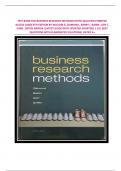
TEST BANK FOR BUSINESS RESEARCH METHODS (WITH QUALTRICS PRINTED
ACCESS CARD) 9TH EDITION BY WILLIAM G. ZIKMUND , BARRY J. BABIN , JON C.
CARR , MITCH GRIFFIN |LATEST GUIDE WITH UPDATED CHAPTERS 1-25| BEST
QUESTIONS WITH ELABORATED SOLUTIONS| RATED A+
,Table of Contents
PART I: INTRODUCTION. .............................................................................................................................. 3
Chapter 1—The Role Of Business Research.............................................................................................. 3
Chapter 2—Information Systems And Knowledge Management........................................................... 21
Chapter 3—Theory Building .................................................................................................................... 46
Chapter 4— The Business Research Process: An Overview. ................................................................... 65
Chapter 5—The Human Side Of Business Research: Organizational And Ethical Issues ........................ 95
PART II: BEGINNING STAGES OF THE RESEARCH PROCESS. .................................................................... 122
Chapter 6—Problem Definition: The Foundation Of Business Research.............................................. 122
Chapter 7— Qualitative Research Tools. .............................................................................................. 148
Chapter 8—Secondary Data Research In A Digital Age ........................................................................ 176
PART III: RESEARCH METHODS FOR COLLECTING PRIMARY DATA......................................................... 201
Chapter 9—Survey Research: An Overview .......................................................................................... 201
Chapter 10—Survey Research: Communicating With Respondents .................................................... 229
Chapter 11— Observation Methods. .................................................................................................... 253
Chapter 12—Experimental Research .................................................................................................... 281
PART IV: MEASUREMENT CONCEPTS. ..................................................................................................... 322
Chapter 13— Measurement And Scaling Concepts. ............................................................................. 322
Chapter 14—Attitude Measurement .................................................................................................... 351
Chapter 15—Questionnaire Design ...................................................................................................... 379
PART V: SAMPLING AND FIELDWORK. .................................................................................................... 413
Chapter 16—Sampling Designs And Sampling Procedures .................................................................. 413
Chapter 17—Determination Of Sample Size: A Review Of Statistical Theory ...................................... 440
Chapter 18—Fieldwork ......................................................................................................................... 466
PART VI: DATA ANALYSIS AND PRESENTATION. ..................................................................................... 486
Chapter 19—Editing And Coding: Transforming Raw Data Into Information....................................... 486
Chapter 20—Basic Data Analysis: Descriptive Statistics ....................................................................... 511
Chapter 21—Univariate Statistical Analysis.......................................................................................... 537
Chapter 22—Bivariate Statistical Analysis: Differences Between Two Variables ................................. 559
Chapter 23—Bivariate Statistical Analysis: Measures Of Association .................................................. 581
Chapter 24—Multivariate Statistical Analysis....................................................................................... 604
Chapter 25—Communicating Research Results: Report Generation, Oral Presentation, And Follow-Up
.............................................................................................................................................................. 629
,PART I: INTRODUCTION.
Chapter 1—The Role Of Business Research
True/False
1. Business Research Can Be Directed Toward An Element Of An Organization’s Internal
Operations.
CORRECT ANS: T Pts: 1 Dif: Moderate Ref: P. 3 Obj: Lo: 01-01
Nat: Aacsb Reflective Thinking| Cb&E Model Research| Blooms Comprehension
2. Researchers In Different Functional Areas Of A Business Differ In The Respect That They Typically
Use Different Research Methods.
CORRECT ANS: F
While Researchers In Different Functional Areas May Investigate Different Phenomena, They Are Similar
To One Another Because They Share Similar Research Methods.
Pts: 1 Dif: Moderate Ref: P. 4 Obj: Lo: 01-01
Nat: Aacsb Reflective Thinking| Cb&E Model Research| Blooms Comprehension
3. Business Research Is Basically About Conducting Surveys.
CORRECT ANS: F
Business Research Is More Than Conducting Surveys. This Process Includes Idea And Theory
Development, Problem Definition, Gathering Information, Analyzing Data, And Communicating The
Findings Including Potential Implications.
Pts: 1 Dif: Moderate Ref: P. 5 Obj: Lo: 01-02
Nat: Aacsb Reflective Thinking| Cb&E Model Research| Blooms Comprehension
, 4. The Term “Research” Means “To Search Again.”
CORRECT ANS: T Pts: 1 Dif: Moderate Ref: P. 5 Obj: Lo: 01-02
Nat: Aacsb Reflective Thinking| Cb&E Model Research| Blooms Knowledge
5. A Business Researcher Needs To Be Subjective In Order To Provide Accurate Information.
CORRECT ANS: F
The Researcher Should Be Personally Detached And Free Of Bias Attempting To Find Truth, So He Or She
Must Be Objective, Not Subjective.
Pts: 1 Dif: Moderate Ref: P. 5 Obj: Lo: 01-02
Nat: Aacsb Reflective Thinking| Cb&E Model Research| Blooms Comprehension
6. Business Research Is Restricted To For-Profit Organizations.
CORRECT ANS: F
Certainly, Business Research Focuses On For-Profit Business Activities, But It Is Also Applicable To Other
Types Of Organizations, Such As Non-Profits.
Pts: 1 Dif: Moderate Ref: P. 5 Obj: Lo: 01-02
Nat: Aacsb Reflective Thinking| Cb&E Model Research| Blooms Comprehension
7. Conducting Research To Determine Why Consumers Visit Starbucks Is An Example Of Basic
Business Research.
CORRECT ANS: F
This Is An Example Of Applied Business Research, Which Is Conducted To Address A Specific Decision For
A Specific Firm Or Organization, Such As Understanding Why Consumers Visit Starbucks.
ACCESS CARD) 9TH EDITION BY WILLIAM G. ZIKMUND , BARRY J. BABIN , JON C.
CARR , MITCH GRIFFIN |LATEST GUIDE WITH UPDATED CHAPTERS 1-25| BEST
QUESTIONS WITH ELABORATED SOLUTIONS| RATED A+
,Table of Contents
PART I: INTRODUCTION. .............................................................................................................................. 3
Chapter 1—The Role Of Business Research.............................................................................................. 3
Chapter 2—Information Systems And Knowledge Management........................................................... 21
Chapter 3—Theory Building .................................................................................................................... 46
Chapter 4— The Business Research Process: An Overview. ................................................................... 65
Chapter 5—The Human Side Of Business Research: Organizational And Ethical Issues ........................ 95
PART II: BEGINNING STAGES OF THE RESEARCH PROCESS. .................................................................... 122
Chapter 6—Problem Definition: The Foundation Of Business Research.............................................. 122
Chapter 7— Qualitative Research Tools. .............................................................................................. 148
Chapter 8—Secondary Data Research In A Digital Age ........................................................................ 176
PART III: RESEARCH METHODS FOR COLLECTING PRIMARY DATA......................................................... 201
Chapter 9—Survey Research: An Overview .......................................................................................... 201
Chapter 10—Survey Research: Communicating With Respondents .................................................... 229
Chapter 11— Observation Methods. .................................................................................................... 253
Chapter 12—Experimental Research .................................................................................................... 281
PART IV: MEASUREMENT CONCEPTS. ..................................................................................................... 322
Chapter 13— Measurement And Scaling Concepts. ............................................................................. 322
Chapter 14—Attitude Measurement .................................................................................................... 351
Chapter 15—Questionnaire Design ...................................................................................................... 379
PART V: SAMPLING AND FIELDWORK. .................................................................................................... 413
Chapter 16—Sampling Designs And Sampling Procedures .................................................................. 413
Chapter 17—Determination Of Sample Size: A Review Of Statistical Theory ...................................... 440
Chapter 18—Fieldwork ......................................................................................................................... 466
PART VI: DATA ANALYSIS AND PRESENTATION. ..................................................................................... 486
Chapter 19—Editing And Coding: Transforming Raw Data Into Information....................................... 486
Chapter 20—Basic Data Analysis: Descriptive Statistics ....................................................................... 511
Chapter 21—Univariate Statistical Analysis.......................................................................................... 537
Chapter 22—Bivariate Statistical Analysis: Differences Between Two Variables ................................. 559
Chapter 23—Bivariate Statistical Analysis: Measures Of Association .................................................. 581
Chapter 24—Multivariate Statistical Analysis....................................................................................... 604
Chapter 25—Communicating Research Results: Report Generation, Oral Presentation, And Follow-Up
.............................................................................................................................................................. 629
,PART I: INTRODUCTION.
Chapter 1—The Role Of Business Research
True/False
1. Business Research Can Be Directed Toward An Element Of An Organization’s Internal
Operations.
CORRECT ANS: T Pts: 1 Dif: Moderate Ref: P. 3 Obj: Lo: 01-01
Nat: Aacsb Reflective Thinking| Cb&E Model Research| Blooms Comprehension
2. Researchers In Different Functional Areas Of A Business Differ In The Respect That They Typically
Use Different Research Methods.
CORRECT ANS: F
While Researchers In Different Functional Areas May Investigate Different Phenomena, They Are Similar
To One Another Because They Share Similar Research Methods.
Pts: 1 Dif: Moderate Ref: P. 4 Obj: Lo: 01-01
Nat: Aacsb Reflective Thinking| Cb&E Model Research| Blooms Comprehension
3. Business Research Is Basically About Conducting Surveys.
CORRECT ANS: F
Business Research Is More Than Conducting Surveys. This Process Includes Idea And Theory
Development, Problem Definition, Gathering Information, Analyzing Data, And Communicating The
Findings Including Potential Implications.
Pts: 1 Dif: Moderate Ref: P. 5 Obj: Lo: 01-02
Nat: Aacsb Reflective Thinking| Cb&E Model Research| Blooms Comprehension
, 4. The Term “Research” Means “To Search Again.”
CORRECT ANS: T Pts: 1 Dif: Moderate Ref: P. 5 Obj: Lo: 01-02
Nat: Aacsb Reflective Thinking| Cb&E Model Research| Blooms Knowledge
5. A Business Researcher Needs To Be Subjective In Order To Provide Accurate Information.
CORRECT ANS: F
The Researcher Should Be Personally Detached And Free Of Bias Attempting To Find Truth, So He Or She
Must Be Objective, Not Subjective.
Pts: 1 Dif: Moderate Ref: P. 5 Obj: Lo: 01-02
Nat: Aacsb Reflective Thinking| Cb&E Model Research| Blooms Comprehension
6. Business Research Is Restricted To For-Profit Organizations.
CORRECT ANS: F
Certainly, Business Research Focuses On For-Profit Business Activities, But It Is Also Applicable To Other
Types Of Organizations, Such As Non-Profits.
Pts: 1 Dif: Moderate Ref: P. 5 Obj: Lo: 01-02
Nat: Aacsb Reflective Thinking| Cb&E Model Research| Blooms Comprehension
7. Conducting Research To Determine Why Consumers Visit Starbucks Is An Example Of Basic
Business Research.
CORRECT ANS: F
This Is An Example Of Applied Business Research, Which Is Conducted To Address A Specific Decision For
A Specific Firm Or Organization, Such As Understanding Why Consumers Visit Starbucks.