

NASM CPT 7
Study online at https://quizlet.com/_cq0g0k
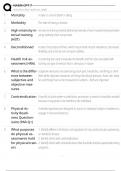
1. Mortality A state or a risk of death or dying.
2. Morbidity The state of having a disease.
3. High-intensity in- An exercise training method defined by intervals of near-maximal intensity broken
terval training up by relatively short rest periods.
(HIIT)
4. Deconditioned A state of lost physical fitness, which may include muscle imbalances, decreased
flexibility, and a lack of core and joint stability.
5. Health risk as- A screening tool used to evaluate the benefits and the risks associated with
sessment (HRA) starting any type of exercise that is strenuous in nature
6. What is the differ- Subjective measures are (low energy, back pain, headaches, and things a client
ence between feels while objectives measures are things like (blood pressure, heart rate, body
subjective and fat, and things that can be measured in numbers . Both are important
objective mea-
sures
7. Contraindication A specific situation where a medication, procedure, or exercise should be avoided
because it may prove to be harmful to the individual.
8. Physical Ac- A detailed questionnaire designed to assess an individual's physical readiness to
tivity Readi- engage in structured exercise.
ness Question-
naire (PAR-Q+)
9. What purposes 1. Identify different risk factors and symptoms for any cardio vascular, pulmonary,
do physical as- or metabolic disease
sessments hold 2. Identify clients with contraindications
for physical train- 3. Identify clients with contraindications that should be medical supervised during
ers programs
, NASM CPT 7
Study online at https://quizlet.com/_cq0g0k
4. Reduce the need for unwarranted medical evaluations prior
5. Provide safe and reliable exercise recommendations
6. Tell client their physical level
7. Effective program evaluation and baseline for follow ups
8. Motivation for client
10. False-positive A screening where the results of the health risk assessment might indicate a need
screenings for medical clearance, when one is in fact not needed.
11. Health Histo- A questionnaire with lists of questions that pertain to health history and habits,
ry Questionnaire such as exercise history, eating behaviors, and general lifestyle.
(HHQ)
12. What informa- Age
tion is consid- Gender
ered private and Weight
confidential in a Height
HHQ Physicians name and contact information
Emergency contact information
13. Symptoms of Elevated risk for chronic disease
chronic sleep de- Negative impact of cognition and mood
privation Less muscle regeneration
14. What can sitting Overactive hip flexors
for long periods Low back pain
of time cause Postural imbalances: rounded shoulders, forward head lean
physically Potential poor cardio respiratory conditioning
15. What can wear- Tightness in calf's
ing shoes with Achilles tendon
heels cause Postural imbalances:
Decreased dorsiflexion
, NASM CPT 7
Study online at https://quizlet.com/_cq0g0k
Over pronation at foot and ankle complex resulting in flat arch of the foot
Can lead to pain in knees, hips, and low back
16. Ankle sprains can Decreased muscle activation in gluteus medius and gluteus Maximus.
lead to Can lead to poor control of lower region when doing exercises
17. Knee injuries Decrease in muscle activation around patella tendon
involving liga-
ments can lead to
18. No contact knee Ankle and hip dysfunction when knee is caught between ankle and hip
injuries can be re-
lated to
19. Low back injuries Poor core stabilization muscles resulting in poor spine stabilization
can be related to
20. shoulder injuries Altered muscle activation in the rotator cuff muscles and leads to instability
can be related to
21. What are com- Foot and ankle surgery
mon surgeries Knee surgery
physical trainers Back surgery
have to deal with Shoulder surgery
A c-Section
Appendectomy (appendix surgery)
22. Resting heart the number of times the heart beats per minute while at rest
rate (RHR)
23. Thermoregula- The physiological process by which the body maintains a relatively constant
tion internal body temperature, including events like sweating to cool the body and
shivering to warm the body.
Study online at https://quizlet.com/_cq0g0k
1. Mortality A state or a risk of death or dying.
2. Morbidity The state of having a disease.
3. High-intensity in- An exercise training method defined by intervals of near-maximal intensity broken
terval training up by relatively short rest periods.
(HIIT)
4. Deconditioned A state of lost physical fitness, which may include muscle imbalances, decreased
flexibility, and a lack of core and joint stability.
5. Health risk as- A screening tool used to evaluate the benefits and the risks associated with
sessment (HRA) starting any type of exercise that is strenuous in nature
6. What is the differ- Subjective measures are (low energy, back pain, headaches, and things a client
ence between feels while objectives measures are things like (blood pressure, heart rate, body
subjective and fat, and things that can be measured in numbers . Both are important
objective mea-
sures
7. Contraindication A specific situation where a medication, procedure, or exercise should be avoided
because it may prove to be harmful to the individual.
8. Physical Ac- A detailed questionnaire designed to assess an individual's physical readiness to
tivity Readi- engage in structured exercise.
ness Question-
naire (PAR-Q+)
9. What purposes 1. Identify different risk factors and symptoms for any cardio vascular, pulmonary,
do physical as- or metabolic disease
sessments hold 2. Identify clients with contraindications
for physical train- 3. Identify clients with contraindications that should be medical supervised during
ers programs
, NASM CPT 7
Study online at https://quizlet.com/_cq0g0k
4. Reduce the need for unwarranted medical evaluations prior
5. Provide safe and reliable exercise recommendations
6. Tell client their physical level
7. Effective program evaluation and baseline for follow ups
8. Motivation for client
10. False-positive A screening where the results of the health risk assessment might indicate a need
screenings for medical clearance, when one is in fact not needed.
11. Health Histo- A questionnaire with lists of questions that pertain to health history and habits,
ry Questionnaire such as exercise history, eating behaviors, and general lifestyle.
(HHQ)
12. What informa- Age
tion is consid- Gender
ered private and Weight
confidential in a Height
HHQ Physicians name and contact information
Emergency contact information
13. Symptoms of Elevated risk for chronic disease
chronic sleep de- Negative impact of cognition and mood
privation Less muscle regeneration
14. What can sitting Overactive hip flexors
for long periods Low back pain
of time cause Postural imbalances: rounded shoulders, forward head lean
physically Potential poor cardio respiratory conditioning
15. What can wear- Tightness in calf's
ing shoes with Achilles tendon
heels cause Postural imbalances:
Decreased dorsiflexion
, NASM CPT 7
Study online at https://quizlet.com/_cq0g0k
Over pronation at foot and ankle complex resulting in flat arch of the foot
Can lead to pain in knees, hips, and low back
16. Ankle sprains can Decreased muscle activation in gluteus medius and gluteus Maximus.
lead to Can lead to poor control of lower region when doing exercises
17. Knee injuries Decrease in muscle activation around patella tendon
involving liga-
ments can lead to
18. No contact knee Ankle and hip dysfunction when knee is caught between ankle and hip
injuries can be re-
lated to
19. Low back injuries Poor core stabilization muscles resulting in poor spine stabilization
can be related to
20. shoulder injuries Altered muscle activation in the rotator cuff muscles and leads to instability
can be related to
21. What are com- Foot and ankle surgery
mon surgeries Knee surgery
physical trainers Back surgery
have to deal with Shoulder surgery
A c-Section
Appendectomy (appendix surgery)
22. Resting heart the number of times the heart beats per minute while at rest
rate (RHR)
23. Thermoregula- The physiological process by which the body maintains a relatively constant
tion internal body temperature, including events like sweating to cool the body and
shivering to warm the body.


