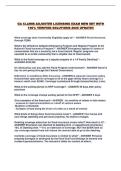
USA AAO Upper Extremity Exam with Answers
“Focus on Your Success”
Master Anatomy and Clinical Concepts with Confidence!
This exam-based study guide is crafted for physical therapy, chiropractic, and medical students preparing
for upper extremity-focused exams. It includes detailed questions and answers that reinforce clinical
anatomy, neurovascular pathways, and kinesiology for effective learning and practical understanding.
What You’ll Get:
- High-yield questions and clear, concise answers
- Clinical pearls and memory aids for better retention
- Designed to support students in USA AAO, NPTE, and board exams
Topics Covered:
- Brachial Plexus Injuries & Pathologies
- Nerve Lesions (Axillary, Radial, Ulnar, Median, Musculocutaneous)
- Shoulder Girdle Mechanics & Kinematics
- Scapulohumeral Rhythm & Muscle Actions
- Rotator Cuff Function & Injuries
- Joint Arthrokinematics & Common Fractures
- Wrist & Hand Biomechanics
- Common Syndromes (Carpal Tunnel, Cubital Tunnel, Impingement)
- Muscle Origins, Insertions, Actions, Innervations
- Clinical Case Applications and Mnemonics
Whether you're preparing for practicals, exams, or clinical rotations, this exam review will help you
sharpen your skills and boost your confidence. Let’s make anatomy your strength.
, USA AAO Upper Extremity Exam with Answers Focus on Your
Success
What pathology is characterized by an arm that is adducted, medially rotated, with an extended elbow
and a pronated wrist? Be aware of its alternative names.
Answer: Erb's Palsy / Waiter's Tip / Superior Trunk Lesion (C5,C6)
Which age group is most at risk for Erb's Palsy? Why?
Answer: Infants. Internal traction on neck during delivery
What pathology is caused by a sudden upward pull on the arm?
Answer: Klumpke Palsy / Claw Hand / Inferior Trunk (C8, T1)
What is the correct sequence of the subunits that form the brachial plexus?
Answer: Roots, Trunks, Divisions, Cords, Branches
(Remember to drink cold bubbly😉
Which nerve innervates the deltoid and the teres minor?
Answer: Axillary Nerve (C5, C6)
Damage to this will result in a flattened deltoid and loss of arm ABduction.
Answer: Axillary Nerve (C5, C6)
Which nerve is at risk when there is a fracture at the surgical neck of the humerus or an anterior
dislocation of the humerus?
Answer: Axillary Nerve (C5, C6)
What nerve can be damaged and thus results in Saturday Night Palsy / Wrist Drop?
Answer: Radial Nerve (C5 - T1)
Which nerve faces potential damage if an axillary crutch is improperly fitted or if there is a fracture at
the midshaft of the humerus?
Answer: Radial Nerve (C5 - T1)
Damage to the radial nerve can result in which pathology? Know the aliases!
Answer: Saturday Night Palsy / Wrist Drop
The extensors are innervated by which nerve?
Answer: Radial Nerve (C5 - T1)
Which nerve innervates the biceps brachii, coracobrachialis, and brachialis?
Answer: Musculocutaneous Nerve (C5, C6, C7)
In cases where an individual experiences a loss of elbow flexion and forearm supination, which nerve
is likely to be compressed?
Answer: Musculocutaneous Nerve (C5, C6, C7)
“Focus on Your Success”
Master Anatomy and Clinical Concepts with Confidence!
This exam-based study guide is crafted for physical therapy, chiropractic, and medical students preparing
for upper extremity-focused exams. It includes detailed questions and answers that reinforce clinical
anatomy, neurovascular pathways, and kinesiology for effective learning and practical understanding.
What You’ll Get:
- High-yield questions and clear, concise answers
- Clinical pearls and memory aids for better retention
- Designed to support students in USA AAO, NPTE, and board exams
Topics Covered:
- Brachial Plexus Injuries & Pathologies
- Nerve Lesions (Axillary, Radial, Ulnar, Median, Musculocutaneous)
- Shoulder Girdle Mechanics & Kinematics
- Scapulohumeral Rhythm & Muscle Actions
- Rotator Cuff Function & Injuries
- Joint Arthrokinematics & Common Fractures
- Wrist & Hand Biomechanics
- Common Syndromes (Carpal Tunnel, Cubital Tunnel, Impingement)
- Muscle Origins, Insertions, Actions, Innervations
- Clinical Case Applications and Mnemonics
Whether you're preparing for practicals, exams, or clinical rotations, this exam review will help you
sharpen your skills and boost your confidence. Let’s make anatomy your strength.
, USA AAO Upper Extremity Exam with Answers Focus on Your
Success
What pathology is characterized by an arm that is adducted, medially rotated, with an extended elbow
and a pronated wrist? Be aware of its alternative names.
Answer: Erb's Palsy / Waiter's Tip / Superior Trunk Lesion (C5,C6)
Which age group is most at risk for Erb's Palsy? Why?
Answer: Infants. Internal traction on neck during delivery
What pathology is caused by a sudden upward pull on the arm?
Answer: Klumpke Palsy / Claw Hand / Inferior Trunk (C8, T1)
What is the correct sequence of the subunits that form the brachial plexus?
Answer: Roots, Trunks, Divisions, Cords, Branches
(Remember to drink cold bubbly😉
Which nerve innervates the deltoid and the teres minor?
Answer: Axillary Nerve (C5, C6)
Damage to this will result in a flattened deltoid and loss of arm ABduction.
Answer: Axillary Nerve (C5, C6)
Which nerve is at risk when there is a fracture at the surgical neck of the humerus or an anterior
dislocation of the humerus?
Answer: Axillary Nerve (C5, C6)
What nerve can be damaged and thus results in Saturday Night Palsy / Wrist Drop?
Answer: Radial Nerve (C5 - T1)
Which nerve faces potential damage if an axillary crutch is improperly fitted or if there is a fracture at
the midshaft of the humerus?
Answer: Radial Nerve (C5 - T1)
Damage to the radial nerve can result in which pathology? Know the aliases!
Answer: Saturday Night Palsy / Wrist Drop
The extensors are innervated by which nerve?
Answer: Radial Nerve (C5 - T1)
Which nerve innervates the biceps brachii, coracobrachialis, and brachialis?
Answer: Musculocutaneous Nerve (C5, C6, C7)
In cases where an individual experiences a loss of elbow flexion and forearm supination, which nerve
is likely to be compressed?
Answer: Musculocutaneous Nerve (C5, C6, C7)