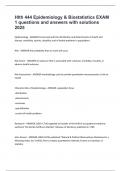
Hlth 444 Epidemiology & Biostatistics EXAM
1 questions and answers with solutions
2025
Epidemiology - ANSWER Concerned with the distribution and determinants of health and
disease, morbidity, injuries, disability, and of health problems in populations
Risk - ANSWER the probability that an event will occur
Risk Factor - ANSWER an exposure that is associated with a disease, morbidity, morality, or
adverse health outcome
Risk Assessment - ANSWER methodology used to provide quantitative measurements of risk to
health
Characteristics of Epidemiology - ANSWER -population focus
-distribution
-determinants
-outcomes
-quantification
-control of health problems
Ramazzini - ANSWER (1633-1714) regarded as founder of the field of occupational medicine;
authored "De Morbis Artificum Diatriba" (Disease of Workers), published in 1700
John Graunt - ANSWER (1620-1674) published "Natural & Political Observations Mentioned in a
following Index, etc" (1662); first to employ quantitative methods; known as Columbus of
statistics
, Edward Jenner - ANSWER (1749-1823) developed a method for smallpox vaccination in 1796
John Snow - ANSWER (Cholera in London, 19th century) An English anesthesiologist who
innovated several of the key epidemiological methods that remain valid and in use today;
believed Cholera was transmitted by contaminated water and was able to demonstrate this
association
Robert Koch - ANSWER (1843-1910) German physician; published "Die Aetiologie der
Tuberkulose" in 1882; His postulate demonstrated the association between a microorganism
and disease
Disease Causality - ANSWER used to search for causes of health and disease by computing the
experience of groups defined by their composition, inheritance & experience, their behavior
and environment.
Morbidity - ANSWER illnesses due to a specific disease or health condition
Morality - ANSWER Death (e.g., death from various causes)
Epidemics - ANSWER The occurrence in community or region of cases of an illness, specific,
health-related behavior, or other health-related events clearly in excess of normal expectancy
Association - ANSWER a statistical relationship between two or more events characteristics or
other variables
Epidemiologic transition - ANSWER Describes a shift in patterns of morbidity and morality from
causes related primarily to infections and communicable diseases to cause associated with
chronic, degenerative diseases
1 questions and answers with solutions
2025
Epidemiology - ANSWER Concerned with the distribution and determinants of health and
disease, morbidity, injuries, disability, and of health problems in populations
Risk - ANSWER the probability that an event will occur
Risk Factor - ANSWER an exposure that is associated with a disease, morbidity, morality, or
adverse health outcome
Risk Assessment - ANSWER methodology used to provide quantitative measurements of risk to
health
Characteristics of Epidemiology - ANSWER -population focus
-distribution
-determinants
-outcomes
-quantification
-control of health problems
Ramazzini - ANSWER (1633-1714) regarded as founder of the field of occupational medicine;
authored "De Morbis Artificum Diatriba" (Disease of Workers), published in 1700
John Graunt - ANSWER (1620-1674) published "Natural & Political Observations Mentioned in a
following Index, etc" (1662); first to employ quantitative methods; known as Columbus of
statistics
, Edward Jenner - ANSWER (1749-1823) developed a method for smallpox vaccination in 1796
John Snow - ANSWER (Cholera in London, 19th century) An English anesthesiologist who
innovated several of the key epidemiological methods that remain valid and in use today;
believed Cholera was transmitted by contaminated water and was able to demonstrate this
association
Robert Koch - ANSWER (1843-1910) German physician; published "Die Aetiologie der
Tuberkulose" in 1882; His postulate demonstrated the association between a microorganism
and disease
Disease Causality - ANSWER used to search for causes of health and disease by computing the
experience of groups defined by their composition, inheritance & experience, their behavior
and environment.
Morbidity - ANSWER illnesses due to a specific disease or health condition
Morality - ANSWER Death (e.g., death from various causes)
Epidemics - ANSWER The occurrence in community or region of cases of an illness, specific,
health-related behavior, or other health-related events clearly in excess of normal expectancy
Association - ANSWER a statistical relationship between two or more events characteristics or
other variables
Epidemiologic transition - ANSWER Describes a shift in patterns of morbidity and morality from
causes related primarily to infections and communicable diseases to cause associated with
chronic, degenerative diseases